
Brocken Spectre: The Giant Mountain Shadow Optical Illusion
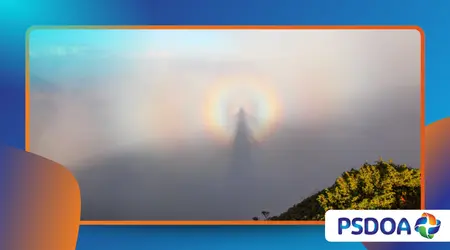
Brocken Spectre sightings have haunted mountaineers for centuries, creating a chilling silhouette that appears to loom like a guardian or a ghost within the mist.
Anúncios
This optical phenomenon occurs when the low sun projects a climber’s shadow onto a bank of clouds, resulting in a distorted, giant figure.
Nature often plays tricks on our depth perception, especially in high-altitude environments where the air is saturated with moisture and shifting light.
Modern hikers still report these encounters with awe, as the shadow is frequently surrounded by a colorful, rainbow-like halo known as a glory.
Navigating the Optical Mystery
- The Physics of Light: Understanding how diffraction and backscattering create the iconic colorful rings around the shadow.
- Geographical Hotspots: Identifying the specific mountain ranges where the unique atmospheric conditions for this illusion occur most frequently.
- Psychological Impact: Exploring how the human brain interprets these “shadow giants” and their role in local folklore and mountaineering legends.
- Safety and Gear: Tips for capturing this elusive phenomenon on camera while maintaining safety during the unpredictable weather shifts of 2026.
Why does the Brocken Spectre look like a giant?
The primary reason a Brocken Spectre appears so large is a trick of the human eye known as an “orthoscopic” misinterpretation of distance and scale.
Because the shadow falls on water droplets at varying depths within a cloud, our brains lose the traditional reference points needed to gauge size.
Imagine looking at a hand-drawn shadow on a distant wall; your mind automatically assumes the figure must be massive because it covers the horizon.
In reality, the shadow is no larger than the person casting it, but the lack of ground perspective creates a sense of looming, supernatural scale.
How does the atmosphere bend light?
When sunlight hits the tiny, uniform water droplets of a cloud or fog bank from behind you, the light undergoes a process called diffraction.
This scattering effect creates the “glory,” which consists of concentric circles of color centered directly on the shadow’s head, mimicking a holy halo.
This light-bending creates a visual bridge between the physical observer and the intangible mist, turning a simple shadow into a complex optical event.
Atmospheric scientists in 2026 continue to study these interactions to better understand the internal dynamics of high-altitude moisture and light refraction.
++ Columnar Basalt Formations: Nature’s Geometric Sculptures
What are the best conditions for a sighting?
You need a very specific alignment of the sun, your body, and a dense fog or cloud layer located directly below your current position.
The sun must be low on the horizon, typically during the first or last hour of daylight, to project your shadow long and flat.
Mist serves as a dynamic screen, shifting and pulsing with the wind, which can make the shadow appear to move or wave on its own.
These conditions are most common on isolated peaks where cloud decks frequently collide with the topography, creating a perfect stage for the light.
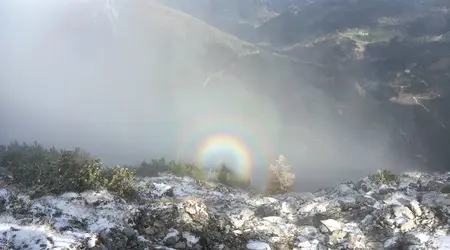
Why is the Harz Mountains region so famous for this?
The phenomenon was first described in detail on the Brocken, the highest peak in northern Germany’s Harz Mountains, giving the Brocken Spectre its name.
Local legends from the 1700s spoke of witches and spirits inhabiting the peak, likely inspired by unsuspecting travelers seeing their own distorted shadows.
Because the Brocken is often shrouded in mist for over 300 days a year, the statistical likelihood of seeing the illusion there is exceptionally high.
Modern travelers still flock to this region, hoping to catch a glimpse of the “Spectre” during the misty autumn months of the 2026 season.
Also read: Glowing Fungi: The Forests That Shine at Night
How does topography influence the illusion?
The specific shape of the mountain allows for “cloud-trapping,” where moisture is pushed up the slopes and hangs suspended just below the summit’s edge.
This creates a vertical wall of fog that acts as a perfect canvas for any light coming from the opposite side of the ridge.
Without this sudden drop in terrain, the shadow would simply fall on the ground, losing the three-dimensional depth that makes the Spectre so haunting.
It is the combination of steep cliffs and stagnant moisture that creates the necessary “void” for the shadow to appear as if it is floating.
Read more: Sulfur Springs That Change Color With the Weather
What role does folklore play today?
While we understand the science now, the emotional impact of seeing a giant figure wrapped in rainbow rings remains a powerful experience for many.
Hikers often describe a feeling of “witnessing something sacred,” even when they are fully aware of the scientific explanation behind the light scattering.
In 2026, many mountain communities have integrated these sightings into their local tourism, offering “Spectre Walks” during peak atmospheric windows.
This blends the ancient mystery of the mountain with modern meteorological forecasting, allowing more people to experience the wonder without the fear of the unknown.
How can you capture a Brocken Spectre on camera?
To photograph a Brocken Spectre effectively, you must position yourself with the sun directly at your back while looking down into a deep fog.
Modern camera sensors in 2026 are highly sensitive to the subtle color gradients of the “glory,” but manual exposure is often required.
If you let the camera decide the exposure, the bright light from the sun might wash out the delicate rainbow rings surrounding the shadow.
Aim for a slightly underexposed shot to preserve the saturation of the colors and the crispness of the silhouette against the grey mist.
Which gear works best for mountain illusions?
A polarizing filter can be an essential tool, as it helps manage the scattered light and increases the contrast between the shadow and the fog.
Wide-angle lenses help capture the scale of the environment, but a zoom lens can isolate the “glory” for a more intimate and detailed portrait.
Always ensure your equipment is weather-sealed, as the very conditions required for the Spectre involve high humidity and sudden temperature drops.
Many photographers now use lightweight carbon-fiber tripods to stabilize shots during the high winds often found at the edge of mountain ridges.
Why is timing everything for this phenomenon?
The window for a perfect sighting can open and close within seconds as the wind shifts the clouds or the sun dips behind a ridge.
You must be prepared to wait for the “gap” where the sun shines through the mist while a solid bank remains below you.
Think of it like a theatrical performance where the sun is the spotlight and the clouds are the moving curtains of the stage.
Patience is the primary virtue of any mountain photographer seeking to document the rare and beautiful interactions between light and the earth’s atmosphere.
Atmospheric Comparison of Optical Phenomena
| Phenomenon | Light Source Position | Medium | Defining Visual Feature |
| Brocken Spectre | Directly Behind Observer | Fog/Clouds | Giant Shadow with Halo (Glory) |
| Rainbow | Behind Observer | Raindrops | Multi-colored Arc in the Sky |
| Fata Morgana | In Front (Low Angle) | Air Temp Layers | Distorted, Floating Structures |
| Sun Dog | Side of the Sun | Ice Crystals | Bright “Mock Suns” on Halos |
| Heiligenschein | Behind Observer | Dew Drops | Bright White Glow around Shadow |
The Mountain’s Silent Companion
Witnessing a Brocken Spectre is a profound reminder of how our environment can manipulate our senses to create beauty and mystery from simple light.
We have explored how the unique geography of places like the Harz Mountains creates a natural laboratory for these giant shadows and their colorful halos.
As we navigate the peaks of 2026, technology allows us to understand the physics of diffraction while still appreciating the emotional weight of these encounters.
The Spectre is not a ghost, but a reflection a literal projection of ourselves onto the canvas of the sky.
The next time you find yourself on a misty ridge with the sun at your back, don’t be afraid if a giant appears in the clouds.
It is merely a silent invitation to witness the extraordinary ways our world interacts with light.
Have you ever felt a sense of “the supernatural” while witnessing a rare natural phenomenon, or do you always look for the scientific explanation first? Share your experience in the comments!
Frequent Questions
Is the Brocken Spectre dangerous?
The phenomenon itself is just light and shadow, but the conditions required to see it—fog and high cliffs can be very hazardous.
Always stay a safe distance from the edge of ridges and keep track of your orientation when the mist thickens around you.
Can you see the Spectre from an airplane?
Yes, if you look at the cloud deck below the plane while the sun is on the opposite side, you may see the plane’s shadow.
This version is often called an “Airplane Glory,” and it features the same colorful rings centered on the shadow of the aircraft.
How rare is a Brocken Spectre sighting?
While not as rare as some astronomical events, it requires a perfect coincidence of weather and positioning that many hikers never experience.
Statistically, according to Harz Mountain weather data, a dedicated observer on the Brocken might see it roughly 10% of the time.
Why are the rings called a “Glory”?
The term comes from the visual similarity to the halos depicted around the heads of saints in medieval religious art.
In the past, sailors and climbers believed these rings were a sign of divine protection or a reflection of their own spiritual state.
Does the shadow move when I don’t move?
The shadow might appear to dance or lunge because the “screen” of the clouds is constantly moving with the wind.
This creates a flickering effect that can make the giant figure seem like it has a life of its own, even if you are standing still.
