
Operation Paul Bunyan: The Forgotten Cold War Showdown

Operation Paul Bunyan stands as one of the most surreal and dangerous displays of military brinkmanship ever witnessed during the Cold War era.
Anúncios
In August 1976, the world watched in silence as a simple dispute over a poplar tree nearly sparked a nuclear conflict on the Korean Peninsula.
This mission remains a masterclass in overwhelming force projection, where the United States and South Korea responded to a brutal provocation with surgical precision.
It serves as a reminder that in high-stakes diplomacy, sometimes a literal axe carries more weight than a thousand diplomatic cables or warnings.
The North Korean military had previously ambushed and killed two American officers, Captain Arthur Bonifas and First Lieutenant Mark Barrett, during a routine tree-trimming task.
The tension reached a boiling point, forcing the American command to design a response that was both non-combative and undeniably threatening to the North.
History often forgets that for three days, the entire planet sat on the edge of a third global conflict because of a single tree.
Today, in 2026, we look back at this operation to understand how symbolic gestures can prevent or cause the absolute destruction of regional stability.
Strategic Highlights of the 1976 Incident
- The Axe Murder Incident: Understanding the brutal catalyst that led to the largest tree-trimming operation in human history and military records.
- Overwhelming Deterrence: How the US deployed B-52 bombers and an aircraft carrier just to cut down a single poplar tree safely.
- Psychological Warfare: The use of South Korean special forces to intimidate North Korean guards without firing a single bullet during the mission.
- De-escalation Tactics: How Kim Il-sung issued a rare “statement of regret,” marking a rare diplomatic victory for the United Nations Command.
What triggered the most expensive gardening mission in history?
The roots of Operation Paul Bunyan lie in the Joint Security Area (JSA), a small patch of land where North and South Korean forces stand face-to-face.
A large poplar tree was obstructing the view between two United Nations observation posts, creating a significant security blind spot for the guards.
On August 18, 1976, a small team attempted to trim the branches, but they were met by North Korean soldiers who claimed the tree was planted by Kim Il-sung.
The resulting brawl escalated into a massacre, leaving two American officers dead and the international community in a state of total shock.
Why was the poplar tree so significant?
This tree wasn’t just wood and leaves; it represented the delicate and volatile balance of power in the most militarized border on the entire planet.
North Korea used the tree to assert territorial dominance, testing the resolve of the United States and the United Nations Command in the JSA.
For the Americans, allowing the North to stop the trimming would have signaled a dangerous weakness in their commitment to South Korean defense.
The tree became a physical manifestation of the Cold War, where every branch pruned was a statement of sovereignty and military willpower.
++ How Historical Records Were Manipulated by the Victors
How did the US plan the retaliation?
President Gerald Ford and his advisors rejected a direct military strike, fearing a full-scale war that could involve China or the Soviet Union.
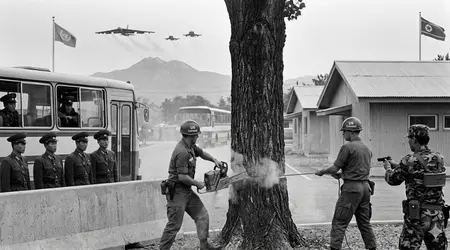
Instead, they opted for Operation Paul Bunyan, a plan to cut the tree down entirely while displaying massive, undeniable military power.
The logic was simple: show the North Koreans that the US was willing to go to war over the tree, but stop short of firing first.
It was the geopolitical equivalent of bringing a tank to a fistfight just to prove that you could win if you chose.
Why did the US use B-52 bombers for a tree?
Three days after the murders, a convoy of 23 American and South Korean vehicles entered the JSA, carrying engineers armed with chainsaws.
While the engineers worked, the sky above them filled with the roar of B-52 Stratofortress bombers flying in from Guam as a warning.
This display of Operation Paul Bunyan was designed to leave no doubt about the consequences of North Korean interference during the three-day mission.
The sheer volume of firepower in the air meant that any hostile move from the North would result in the total destruction of their border defenses.
Also read: The Hidden Story of the World’s First University
What was the role of the South Korean Special Forces?
Under the cover of the American air umbrella, South Korean special forces units were stationed on the ground, famously carrying hidden claymore mines.
They destroyed several North Korean guard posts during the operation, daring the North’s soldiers to intervene as the tree was finally brought down.
Their presence added a layer of raw, personal intimidation to the mission, showing that South Korea was just as ready for combat as their allies.
It was a calculated risk that relied on the North Korean leadership’s fear of a total and humiliating military defeat on live television.
Read more: How the Mongol Empire Was More Than Just War
How did the North Korean military react?
Faced with a massive carrier battle group offshore and nuclear-capable bombers overhead, the North Korean soldiers stayed in their barracks and watched the tree fall.
It was a rare moment in history where the “Hermit Kingdom” blinked first, choosing survival over another violent escalation in the neutral zone.
The operation lasted only 42 minutes, but it successfully restored the sightlines and re-established the authority of the United Nations Command without a single casualty.
By the time the tree stump was all that remained, the power dynamic of the peninsula had been firmly reset.
Why does this forgotten showdown matter in 2026?
We study Operation Paul Bunyan today because it perfectly illustrates the concept of “escalation dominance,” a strategy still used in modern international relations.
In 2026, as border tensions rise globally, the lessons of the JSA provide a blueprint for managing aggression through symbolic but overwhelming strength.
The mission proved that a clear, focused, and massive response can actually prevent a war by removing any ambiguity about a nation’s resolve.
If the US had done nothing, the North might have pushed further, leading to a much larger conflict later in that decade.
What is the statistical legacy of the operation?
According to historical archives from the United States Forces Korea (USFK), over 12,000 troops were placed on high alert during the 48 hours surrounding the mission.
The operation involved nearly 20 utility helicopters and 7 Cobra attack helicopters circling the tiny 42-minute work site in a massive show of force.
This data highlights the astronomical cost-to-benefit ratio of the mission, where millions of dollars were spent to ensure a $0 tree was removed.
Yet, the price of the alternative a full-scale war would have been measured in millions of lives and trillions of dollars in economic damage.
How does the analogy of “The Axe” apply today?
Think of Operation Paul Bunyan as a police officer drawing a weapon but never pulling the trigger to stop a dangerous suspect in their tracks.
The threat of the weapon is the tool of peace, provided the suspect believes the officer is truly willing to use it.
In a world of nuclear deterrence, the “axe” represents the visible capability to destroy, used specifically to ensure that destruction never becomes a reality.
This operation remains the most literal and successful application of that philosophy in the history of the 21st-century military thought.
Comparison of Forces during Operation Paul Bunyan
| Category | UN Command (Operation) | North Korean Response | Outcome |
| Ground Forces | 81 Specialized Troops | 150-200 Guards (On Standby) | No Combat |
| Air Support | B-52 Bombers & F-4 Phantoms | None (Stayed Grounded) | Air Superiority |
| Naval Power | USS Midway Carrier Group | Coastal Batteries | Total Deterrence |
| Equipment | Chainsaws & Axes | Small Arms | Tree Removed |
| Diplomacy | Zero Communication | Statement of Regret | Tension De-escalated |
The Echoes of a Falling Tree
The legacy of Operation Paul Bunyan is a profound testament to the power of symbolic military action in maintaining a fragile global peace.
We have explored how a violent tragedy was met with a response so massive that it made further violence seem like a mathematical impossibility for the aggressor.
By choosing to cut down a tree with the might of a superpower, the United States avoided a much darker path that could have redefined the late 20th century.
In 2026, this story serves as a reminder that the strongest defense is often the one that never has to fire a single shot.
The stump of that poplar tree still exists in our history as a monument to the day the world almost broke, but didn’t.
Do you believe that overwhelming force is still the most effective way to prevent war in our modern era? Share your experience in the comments!
Frequent Questions
Was Operation Paul Bunyan authorized by the UN?
The operation was carried out under the authority of the United Nations Command, which oversees the Armistice Agreement in Korea.
While the US provided the bulk of the military hardware, the mission was technically a multilateral response to a violation of the Joint Security Area’s neutral status.
Did the North Koreans ever apologize for the murders?
Shortly after the tree was felled, Kim Il-sung sent a message to the UN Command expressing “regret” for the incident.
While it was not a full apology, it was the first time since the Korean War that the North had officially admitted any level of responsibility for a violent provocation.
Where is the tree stump located today?
The stump of the poplar tree remained in the Joint Security Area for decades, eventually being replaced by a stone monument commemorating the officers who died.
It is one of the most famous stops on the tourist route for those visiting the DMZ from the South Korean side.
What happened to the axes used in the operation?
The axes and chainsaws used during Operation Paul Bunyan are preserved in various military museums, including the museum at Camp Bonifas in South Korea.
They serve as historical relics of a time when manual tools were the center of a potential nuclear standoff between superpowers.
Why is it named after Paul Bunyan?
The name refers to the American folk hero Paul Bunyan, a giant lumberjack known for his incredible strength and massive axe.
The name was chosen to reflect the “larger than life” nature of the mission and the literal task of cutting down a tree with overwhelming force.
