
Great Hedge of India: The British Empire’s Hidden Barrier

The Great Hedge of India stands as a haunting reminder of how imperial greed can physically scar an entire subcontinent’s geography and social fabric.
Anúncios
History often ignores this massive living wall, yet it once stretched thousands of miles across the heart of India to enforce British taxes.
Architects of the Empire designed this barrier not for defense, but to squeeze revenue from a vital mineral: salt.
This ecological monstrosity effectively imprisoned millions within a fiscal cage, dictating who could afford a basic biological necessity for survival.
Essential Guide to the Inland Customs Line
- The Living Wall: Discover the biological composition and sheer scale of the thorn-hedge barrier that divided a nation.
- Economic Siphon: Understand the Salt Tax mechanics and how the British used nature as a weapon of financial extraction.
- Modern Discovery: Trace the journey of Roy Moxham, the historian who rediscovered this “lost” hedge in the late 20th century.
- Human Impact: Examine the famine and hardship caused by the Customs Line, revealing the dark side of colonial infrastructure.
What exactly was the Great Hedge of India?
Colonial officials began planting the Great Hedge of India in the 1840s to prevent the smuggling of untaxed salt into British-held territories.
This biological fence eventually reached an astonishing length of 2,300 miles, guarded by over 12,000 men stationed at regular intervals.
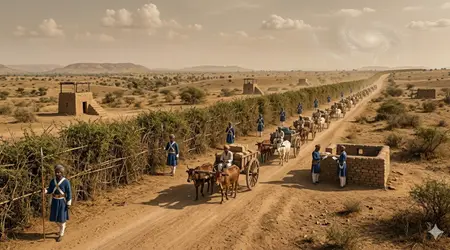
Imagine a thick, impenetrable wall of thorny bushes, prickly pears, and acacias, standing twelve feet high and equally broad in most sections.
It functioned like a terrestrial Great Wall, but instead of stones, it used the sharpest thorns nature could provide to deter movement.
How did the British build a wall of thorns?
The British Customs Department utilized local vegetation like Indian plum and bamboo to weave a dense, interlocking barrier that even a rat could struggle to pass.
In arid regions where plants failed to grow, they piled dry thorny branches into massive embankments to maintain the line.
This project required constant maintenance to fight off rot, locusts, and fire, making it one of the most labor-intensive colonial endeavors of its time.
The hedge wasn’t just a garden; it was a militarized botanical project that consumed vast administrative resources for decades.
++ Operation Paul Bunyan: The Forgotten Cold War Showdown
Why did the hedge cover such a vast distance?
To ensure no salt bypassed the tax collectors, the line stretched from the Indus River in the north down to the Mahanadi in the southeast.
It carved India into two economic zones, forcing travelers to pass through strictly monitored customs houses located every few miles.
The sheer scale of the project suggests a level of obsession with revenue that defined the East India Company’s transition into the British Raj. This was not a border for a country, but a border for a specific commodity’s price tag.
How did this barrier affect the Indian population?
The Great Hedge of India acted as a brutal tax collector that disproportionately harmed the poorest citizens who relied on salt for their health.
By artificially inflating salt prices, the British Raj forced many to choose between buying food or purchasing the salt needed to prevent disease.
Historians link the high salt prices enforced by the hedge to the severity of various famines that ravaged the subcontinent during the Victorian era.
Salt is like the oxygen of the kitchen; without it, the body fails, and the British held the valve.
Also read: The Secret Communications of WWII Resistance Movements
What was the economic cost of the Salt Tax?
Official records from the 1870s show that salt taxes provided roughly 10% of the total revenue for the British government in India.
This burden fell heavily on peasants, whose meager wages could barely cover the inflated costs of this essential daily nutrient.
Researchers like Roy Moxham highlight that the tax was often 1,200% to 2,000% of the salt’s original production value at the coast.
This massive markup funded the very bureaucracy that policed the hedge, creating a self-sustaining cycle of exploitation.
Read more: Ancient Democracies That Preceded Greece
How did Smugglers attempt to cross the line?
Smugglers used ingenious methods to bypass the thorns, often attempting to throw bags over the wall or bribe the poorly paid Indian guards.
The British responded by clearing wide paths on either side of the hedge to ensure guards had a clear line of sight.
Crossing the line without a permit led to heavy fines, imprisonment, or physical punishment, making the hedge a symbol of daily oppression.
For the local villager, the hedge was an alien scar on their ancestral land that served no purpose other than theft.
Why did the Great Hedge of India disappear from history?
By the late 1870s, the British realized that railways and more centralized administration made the Great Hedge of India obsolete for tax collection.
They abandoned the Customs Line in 1879, and the relentless Indian jungle quickly reclaimed the thorny wall within a few decades.
Because the wall was made of organic material, it left no ruins like the Great Wall of China or the Berlin Wall.
It evaporated into the earth, leaving only dusty administrative files and a few forgotten geographical markers in remote villages.
How was the lost hedge rediscovered?
Historian Roy Moxham spent years searching for the hedge after finding a brief mention of it in a 19th-century memoir.
He eventually used old maps and modern GPS technology to locate a small, surviving mound of earth and thorns in Uttar Pradesh.
His work transformed our understanding of colonial history, proving that even a 2,000-mile wall can be forgotten if it doesn’t fit a narrative.
Why do we remember the Taj Mahal but forget the wall that starved millions of its builders’ descendants?
What remains of the Customs Line today?
Today, almost nothing remains of the hedge except for a few raised embankments and local legends of a “long wall” passed down through oral history.
The trees died, the thorns rotted, and the land returned to the farmers who had once been divided by its presence.
The hedge serves as a cautionary tale about the use of technology and nature to enforce inequality.
It reminds us that infrastructure is never neutral; it either connects people or, as in this case, serves as a blade that severs them.
Data Analysis of the British Customs Line (1870)
| Feature | Statistical Detail |
| Total Length | 2,300 miles (3,700 km) |
| Personnel | 12,000+ Custom Officers/Guards |
| Salt Tax Revenue | ~£6 million annually (1870s value) |
| Height of Barrier | 10 to 14 feet |
| Material | Live thorns (Acacia, Plum, Cactus) |
| Abolition Date | April 1, 1879 |
Reflection on the Imperial Legacy
The story of this barrier exposes the cold, calculated logic of an empire that prioritized balance sheets over human lives.
We see a world where a biological wall becomes an instrument of fiscal control, proving that borders are often built to protect profit rather than people.
Understanding the Great Hedge of India allows us to see the invisible lines that still define our global economy today.
It challenges us to look at our modern infrastructures and ask: whom does this wall serve, and who is being left in the thorns?
What do you think? Should more colonial landmarks be left to disappear, or is it our duty to preserve the memory of these “hidden” barriers? Share your perspective in the comments below.
Frequently Asked Questions
Why isn’t the Great Hedge of India in school books?
The hedge was made of organic materials and left no stone ruins, making it easier for historians to overlook compared to permanent structures.
Additionally, its history is a dark chapter of colonial exploitation that didn’t fit the “civilizing” narrative of the British Empire.
Was the salt tax the same one Gandhi protested?
Yes, the Salt Tax Gandhi challenged in 1930 was the legal evolution of the tax once enforced by the Great Hedge.
While the hedge was gone by Gandhi’s time, the oppressive laws it once physically guarded remained in place for another fifty years.
Did the hedge cause ecological damage?
The introduction of non-native thorny species across thousands of miles certainly altered local biodiversity and disrupted natural animal migration patterns.
It was a massive, artificial intervention into the Indian landscape that prioritized customs control over ecological health.
Can you still see the hedge on satellite images?
While the plants are long gone, some segments of the raised earth embankments can still be traced using high-resolution satellite imagery and historical maps.
These faint lines are the only physical echoes of a barrier that once dominated the continent.
