
Dancing Plague 1518: The Bizarre Epidemic That Killed
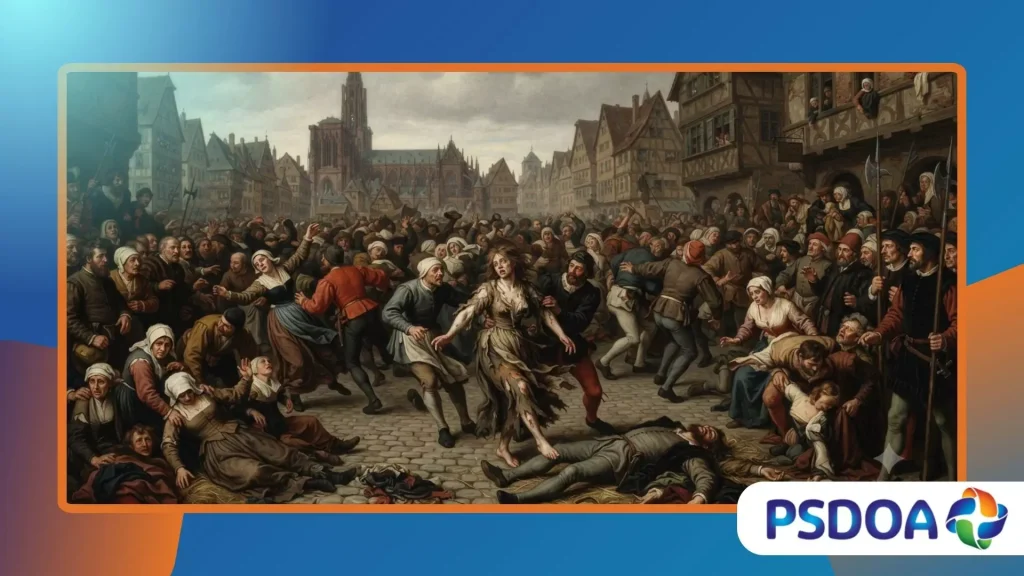
The Dancing Plague 1518 remains one of the most terrifyingly visceral medical mysteries ever recorded in human history.
Anúncios
Imagine stepping out of your home on a humid July morning in Strasbourg, France, and witnessing your neighbor twirling frantically in the street, completely unable to stop.
This was not a joyous celebration or a choreographed performance, but rather the onset of a compulsive, lethal delirium that gripped hundreds of ordinary citizens.
The sudden outbreak paralyzed an entire Renaissance city, forcing local authorities to confront a psychological or physiological nightmare that defied every contemporary scientific understanding.
By the time the madness subsided, the town square had transformed into a literal graveyard of exhausted, bleeding bodies that danced themselves directly into the afterlife.
Historical chronicles reveal that this bizarre phenomenon did not manifest as a sudden, mass explosion, but rather grew out of a solitary, stubborn act of compulsion.
A lone woman, historical records identify her as Frau Troffea, simply stepped into a narrow street and commenced her involuntary marathon.
She lacked any musical accompaniment, yet her movements remained intense, rhythmic, and entirely unyielding for days on end.
As spectators watched in absolute horror, her physical agony became obvious, yet her feet kept pounding the cobblestones until the infection spread across the community.
Within weeks, the lone dancer became a crowd, and the crowd became a full-blown societal catastrophe that challenged the boundaries of medicine and faith.
What Awaits in the Archives
- The First Outbreak: Exploring the tragic origin of Frau Troffea’s fatal marathon in the heart of Strasbourg.
- The Corporate Response: Analyzing the disastrous official counter-measures implemented by panicked municipal authorities.
- Scientific Diagnoses: Deconstructing modern medical theories ranging from toxic food poisoning to psychological mass hysteria.
- Chronological Data: A comparative table charting the progression and human toll of the affliction.
- Archival Answers: Frequently asked questions addressing the core mysteries of this Renaissance tragedy.
Why Did the Streets of Strasbourg Turn Into a Fatal Ballroom?
How could a civilized society watch its own citizens drop dead from pure exhaustion without finding a way to physically restrain them?
The sudden arrival of the Dancing Plague 1518 exposed the severe limitations of medieval municipal governance and early European medical science.
Local leaders looked at the growing chaos not as a physical disease, but as a spiritual emergency or a bizarre corporate disruption.
The sheer speed of the contagion left the city’s ruling council completely paralyzed, unable to establish basic quarantine zones.
As the body count began to rise, the absolute terror within the city walls grew exponentially, transforming daily commerce into a nightmare.
Citizens abandoned their shops, fields, and workshops just to watch the morbid spectacle unfold in the public squares.
This collective paralysis created a secondary crisis of starvation and economic collapse, as the infrastructure of Strasbourg ground to a halt.
The epidemic proved that psychological panic could destabilize a wealthy trading hub just as quickly as a weaponized military siege.
What triggered the initial hysteria?
The psychological pressure cookers of the sixteenth century provided the perfect breeding ground for deep, localized collective psychoses.
Strasbourg was suffering from catastrophic harvest failures, skyrocketing bread prices, and a devastating outbreak of syphilis that wiped out entire neighborhoods.
This crushing weight of existential dread created a massive reservoir of subconscious trauma among the peasant classes.
When Frau Troffea began her frantic movements, she effectively pulled the plug on a dam of accumulated societal terror.
++ The Kingdom of Aksum: Africa’s Forgotten Superpower
How did the compulsion spread so quickly?
Mass psychogenic illness thrives on visibility, turning casual onlookers into active participants through an involuntary neurological mirror effect.
As vulnerable individuals watched their neighbors succumb to the frenzy, their own intense fear triggered identical somatic responses.
It acted exactly like a modern viral internet trend, but with lethal physical consequences operating in a pre-technological era.
The public squares became echo chambers of kinetic panic, where every twitching limb validated and amplified the collective delusion.
Also read: The Ancient City Hidden Beneath Modern Mexico City
Why did the church blame demonic intervention?
The Renaissance clergy lacked any framework for neurological disorders, naturally attributing the uncontrollable movements to the wrath of Saint Vitus.
According to regional folklore, this specific saint possessed the power to curse sinners with unavoidable, frantic dancing fits if angered.
Therefore, priests viewed the victims as spiritual outcasts who required aggressive exorcisms rather than compassionate physical isolation or sedation.
This theological approach misdirected valuable civic resources, wasting precious time on religious ceremonies while citizens literally broke their bones.
How Did Official Medical Solutions Make the Tragedy Worse?
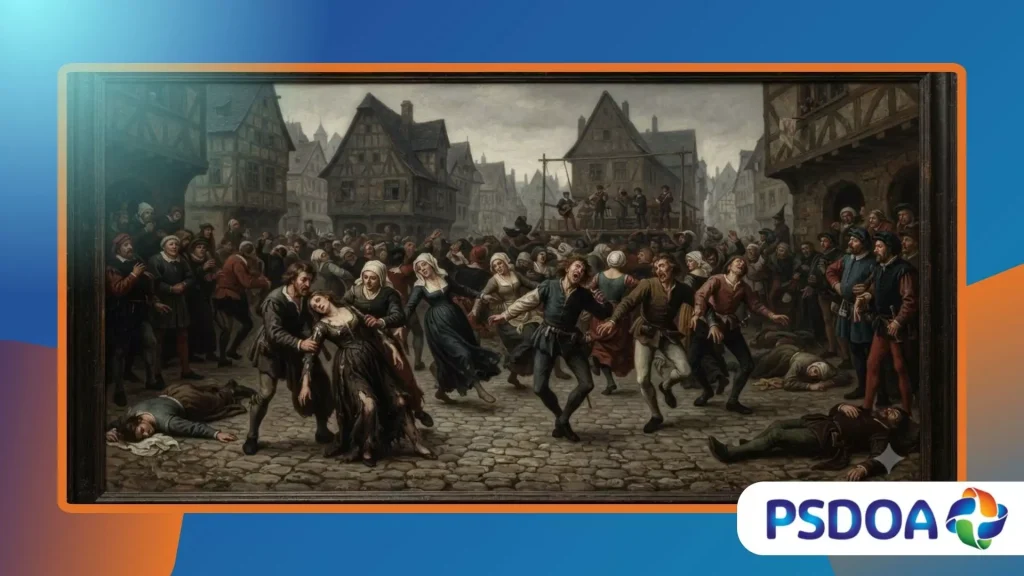
The local physicians hired by the city council made a catastrophic error by diagnosing the condition as “heated blood.”
Instead of ordering total bed rest, they actively encouraged the afflicted citizens to keep moving to burn off the excess internal heat.
The city went so far as to construct specialized wooden stages and hire professional musicians to provide a continuous backing rhythm.
This disastrous public policy transformed a localized medical emergency into a full-scale, highly organized festival of death.
By centralizing the dancers in the main marketplace, the authorities inadvertently created a massive stage that invited further psychological contagion.
The loud, relentless drumming and piping provided a structural framework that kept the exhausted victims moving far past their physical limits.
Rather than curing the problem, this institutionalized encouragement acted like pouring gasoline onto a raging structural fire.
It remains one of history’s most striking examples of institutional incompetence directly accelerating a public health disaster.
Read more: Operation Northwoods: The Declassified False Flag Proposal
What was the purpose of the dancing stages?
City officials believed that creating a dedicated, centralized zone would contain the chaos and prevent the madness from blocking commercial streets.
By building these platforms, they hoped to systematically manage the crisis while allowing the “diseased” citizens to exhaust their affliction.
However, the structures backfired completely, serving as highly visible beacons that attracted hundreds of new, highly susceptible victims.
The stages effectively institutionalized the Dancing Plague 1518, turning a erratic panic into a structured, daily civic event.
How did musicians accelerate the death toll?
The musicians hired by the council kept a steady, driving tempo that prevented the victims from dropping into natural slumbers.
Dehydrated individuals who were on the verge of collapsing were urged forward by the relentless, pounding rhythm of the drums.
This auditory stimulation overrode the body’s natural defense mechanisms, forcing hearts to pump far beyond safe physiological thresholds.
The music transformed an erratic psychological breakdown into a highly synchronized, lethal marathon that drove mortality rates straight upward.
When did the city realize its mistake?
The turning point arrived when the daily mortality rate climbed to approximately fifteen deaths per day from pure physical trauma.
The sight of prominent citizens collapsing from strokes and heart attacks finally forced the council to dismantle the wooden stages.
They abruptly banned all public music, prohibited dancing within the city, and began forcefully carting the survivors away.
The realization was brutal: their progressive, interventionist medical theories had directly constructed a slaughterhouse in the center of the city.
What Does Modern Science Say About This Renaissance Mystery?
Modern researchers remain deeply divided on the true underlying cause of the Dancing Plague 1518, balancing between chemical and psychological explanations.
One prominent theory points toward widespread ergot poisoning, a toxic fungus that grows naturally on damp rye grain during wet harvests.
Ergot contains alkaloids closely related to modern LSD, capable of inducing severe hallucinations, violent muscle spasms, and intense neurological tremors.
However, critics argue that ergotism typically impairs physical coordination, making a sustained, rhythmic marathon nearly impossible to execute.
The competing, more widely accepted consensus focuses on mass psychogenic illness driven by extreme, localized environmental stress.
In this scenario, the dancing was not caused by a chemical toxin, but by a profound dissociation from reality. The human mind, pushed to the absolute brink by famine and plague, simply fractured to escape the unbearable waking world.
This theory aligns perfectly with the historical behavior of the crowds, who appeared entirely oblivious to their physical surroundings.
How does ergotism explain the symptoms?
Ergot poisoning, or “Saint Anthony’s Fire,” caused intense burning sensations in the extremities alongside vivid, terrifying mental hallucinations.
Proponents of this theory suggest that the victims were frantically thrashing around to escape imaginary flames consuming their limbs.
The contaminated bread supply would have distributed the toxin evenly across the poorer quarters, explaining the sudden cluster of cases.
Yet, it fails to explain how victims maintained the precise motor control required to dance continuously for days.
Why is mass hysteria the preferred theory?
Mass psychogenic illness provides a much more comprehensive explanation for the highly socialized, contagious nature of the Strasbourg outbreak.
The specific cultural belief in the curse of Saint Vitus acted as a psychological template for the victims’ behavior.
Once their subconscious minds accepted the curse as real, their bodies manifested the exact symptoms they expected to see.
It was a physical manifestation of pure, unadulterated cultural anxiety, weaponized by the brain against its own physical vessel.
What can modern neurology teach us about the event?
Contemporary neurologists look at the event through the lens of psychogenic movement disorders, where stress alters brain function.
Under extreme duress, the frontal cortex can lose control over involuntary motor loops, trapping the individual in a repetitive physical cycle.
The victims were essentially experiencing waking nightmares where their motor systems were hijacked by deep-seated psychological trauma.
This perspective bridges the gap between ancient history and modern clinical medicine, proving the mind’s terrifying power over human flesh.
The Statistical Reality of the Mania
To truly comprehend the sheer scale of the Dancing Plague 1518, we must examine the recorded progression of the epidemic.
The following table provides a clear, data-driven timeline compiled from surviving municipal records and historical eyewitness accounts.
| Phase of Outbreak | Estimated Active Dancers | Primary Municipal Action | Recorded Fatalities / Impact |
| Week 1 (Early July) | 1 to 34 individuals | Observational monitoring by clergy | Zero initial deaths; mild public curiosity |
| Week 3 (Mid-July) | 50 to 100 individuals | Constructed public stages; hired musicians | Deaths from dehydration begin to occur |
| Week 4 (Late July) | 400+ individuals | Total ban on music; forced hospitalizations | Peak mortality; up to 15 deaths per day |
| Month 2 (September) | Rapidly declining numbers | Mandatory pilgrimages to Saint Vitus shrines | Outbreak ends; widespread societal trauma |
The Echoes of a Fractured Mind
The dark legacy of the Dancing Plague 1518 serves as a stark reminder of how fragile human psychology becomes under systemic duress.
When physical reality becomes completely unlivable, the human mind will find highly creative, often destructive ways to stage a total escape.
Strasbourg’s tragedy was not an isolated freak accident, but a profound warning about the dangers of ignoring collective societal trauma.
As we look back from the vantage point of 2026, we realize that the human condition remains susceptible to panic.
Understanding these historical anomalies allows us to better navigate the modern anxieties that threaten to destabilize our own hyper-connected communities.
The line between rational order and chaotic mass delusion is far thinner than most modern institutions care to admit. Have you ever felt a modern trend or collective anxiety completely overwhelm your social circle?
Share your thoughts and insights in the comments section below to keep this historical conversation alive!
Frequently Asked Questions
Did the dancers actually experience physical pain during the event?
Yes, contemporary historical accounts explicitly note that the dancers were weeping, screaming for mercy, and begging onlookers to stop them.
Their movements were entirely involuntary, meaning they were trapped inside bodies that refused to obey their conscious desire to rest.
How did the authorities finally bring the epidemic to an end?
The city council eventually loaded the surviving dancers into carts and transported them to a mountain shrine dedicated to Saint Vitus.
There, the victims were given small red shoes blessed with holy oil and led in quiet, solemn religious processions.
This shift from loud public stimulation to quiet, structured ritual successfully broke the psychological feedback loop sustaining the mass hysteria.
Are there any other recorded instances of dancing plagues in Europe?
Yes, Western Europe experienced several similar outbreaks between the tenth and sixteenth centuries, particularly along the Rhine and Moselle rivers.
The most famous precursor occurred in 1374, spreading across Germany and the Low Countries, though the Strasbourg event remains the best-documented.
