
Attention Residue: Why Switching Tasks Drains Your Brain

Attention Residue is the silent productivity killer that lingers in your synapses every time you check a quick notification during deep work sessions.
Anúncios
Even if you switch back to your primary task in seconds, a significant part of your cognitive power stays stuck on the previous interruption.
This biological lag prevents you from reaching a state of flow, leaving your brain fragmented and exhausted by the end of the workday.
In 2026, as digital distractions reach a fever pitch, understanding this mental tax is no longer optional for those seeking peak performance.
Core Concepts of Cognitive Friction
- The Transition Gap: Why your brain takes up to 20 minutes to fully “re-locate” to a complex task after a distraction.
- Mental Fragmentation: How micro-switches erode your ability to think critically and solve difficult problems.
- Deep Work Protection: Strategies to build a “fortress of focus” in an age of constant connectivity.
- Recovery Protocols: Techniques to flush out the lingering thoughts of past tasks before starting something new.
What is Attention Residue and how does it impact your daily productivity?
The phenomenon of Attention Residue occurs because the human brain does not function like a computer with instant, clean application switching capabilities.
When you move from Task A to Task B, your neurons continue to process information from the first task, creating a split-focus effect.
Professor Sophie Leroy, who pioneered this research at the University of Washington, found that people perform significantly worse on subsequent tasks after interruptions.
This happens even if the interruption was brief, such as glancing at an email or answering a quick “yes/no” question from a colleague.
Why do we feel “busy” but accomplish so little?
Most professionals spend their day in a state of semi-distraction, believing they are multitasking efficiently when they are actually just rapidly task-switching.
Each switch leaves a “residue” that accumulates, making each consecutive hour of work less productive than the one that came before it.
By midday, your brain feels like a browser with fifty tabs open; you have plenty of activity but very little available memory for processing.
The result is a feeling of mental fog where high-level thinking becomes impossible, replaced by a preference for shallow, easy-to-complete administrative chores.
++ Cognitive Offloading: How We Use Tech to Replace Memory
How does this affect our stress levels?
Constantly fighting against lingering thoughts increases cortisol production, leading to a state of chronic high-alert that drains your physical energy reserves.
Your brain works harder to ignore the “residue,” which creates internal friction and a sense of being overwhelmed by simple daily requirements.
In 2026, mental burnout is often the direct result of this accumulated cognitive debt rather than the actual volume of work completed.
Learning to close “mental loops” is the only way to lower this biological stress and regain a sense of calm control over your schedule.
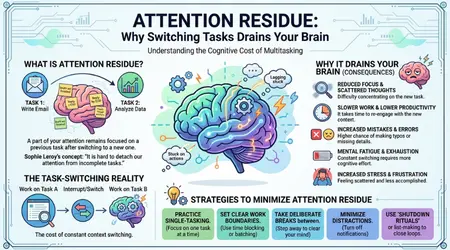
Why is task switching so costly for our neural networks?
The brain requires a specific set of neurochemicals to maintain deep focus, a balance that is instantly disrupted by the introduction of new stimuli.
When you switch tasks, the prefrontal cortex must reboot its “executive function” rules, which consumes massive amounts of glucose and oxygen.
This metabolic cost explains why you feel physically tired after a day of “just sitting at a desk” doing fragmented, non-sequential work.
Essentially, Attention Residue keeps your brain running in the background, heating up the processor without delivering any usable output for your current goal.
Also read: Why People Believe Their Pets Understand Them
What is the “Switching Cost” in real numbers?
Research indicates that frequent task-switching can reduce productive time by up to 40%, creating a hidden “tax” on every professional hour you work.
The impact is even more severe when the tasks are complex, as the “loading time” for your brain to reach peak performance increases significantly.
Imagine trying to heat a room while someone keeps opening the window every five minutes; the furnace works overtime but the temperature never rises.
This analogy perfectly describes the struggle of a modern worker trying to write a report while “staying available” on various messaging platforms.
Read more: The Psychology of Cancel Culture: Punishment vs. Justice
How do notifications exacerbate the problem?
Every “ping” acts as a hook that pulls a thread of your attention away, even if you choose not to open the actual message.
Your brain begins to wonder who it was and what they needed, effectively starting the “residue” process without you even touching your phone.
In 2026, the most successful individuals are those who have mastered the art of “asynchronous communication,” checking messages only at specific, pre-planned times.
They understand that their attention is a finite resource that must be spent wisely rather than distributed randomly to whoever asks for it.
Comparison: Deep Focus vs. Fragmented Work (2026 Metrics)
| Metric | Deep Focus Session | Fragmented (High Residue) Work |
| Time to Peak Performance | 15 – 20 Minutes | Never Reached |
| Cognitive Load | Low / Sustainable | High / Exhausting |
| Error Rate | Minimal | Significant (up to 20% higher) |
| Creativity Level | High (Integrative Thinking) | Low (Reactionary Thinking) |
| Mental Recovery Needed | Short Rest | Long Recovery / Burnout Risk |
How can we eliminate Attention Residue to reclaim our focus
Protecting your mind from Attention Residue requires a radical shift in how you structure your environment and your daily work-flow habits.
The most effective method is “Batching,” where you group similar tasks together to minimize the need for the brain to change its operating rules.
For example, answering all emails in one sixty-minute block is far less taxing than answering them one by one throughout the entire day.
This allows the brain to stay in a specific “mode” for a longer duration, reducing the number of transitions and the resulting cognitive debris.
Why is the “Closed-Loop” technique effective?
Before moving from one project to another, spend two minutes writing down exactly where you left off and what the next step will be.
This “externalizes” the lingering thoughts, giving your brain permission to stop processing Task A because the information is safely stored elsewhere.
By doing this, you significantly reduce the residue that follows you into Task B, allowing for a cleaner and faster mental transition.
It is like clearing your desk before starting a new craft project; you need a clean surface to do your best work without clutter.
Is the “20-Minute Rule” still relevant?
Current 2026 neuro-performance data suggests that it takes roughly 23 minutes to fully recover from a single significant distraction and return to deep focus.
If you are interrupted every 15 minutes, you are literally never operating at your full cognitive capacity at any point during your workday.
Building “uninterrupted blocks” into your calendar is not a luxury; it is a fundamental requirement for anyone doing high-value knowledge work today.
Would you allow someone to stop you every ten minutes during a surgery or a high-stakes flight? Why allow it during your most important work?
The Strategic Value of a Singular Mind
The battle against Attention Residue is ultimately a battle for the quality of your thoughts and the value of your professional contribution.
By minimizing switches and batching your work, you allow your brain to reach the depths necessary for true innovation and complex problem-solving.
As we navigate 2026, the ability to focus is becoming the rarest and most valuable skill in the global economy, separating the leaders from the followers.
We must treat our attention as a sacred asset, protecting it from the “residue” of a hyper-connected world that constantly demands our immediate reaction.
Stop being a victim of your notifications and start being the architect of your own cognitive environment for a more productive and peaceful life.
Have you ever felt the “drain” of a day filled with meetings and emails but no real progress? Share your experience in the comments!
Frequently Asked Questions
Can I train my brain to be a better multitasker?
No, human biology is limited to serial processing for complex tasks; you are only training yourself to be better at task-switching, which still carries a heavy residue cost.
Does listening to music create attention residue?
Instrumental music usually doesn’t, but lyrics can engage the language centers of the brain, creating a subtle form of residue that interferes with writing or reading tasks.
How long should a “Deep Work” block be?
Research suggests 90 minutes is the optimal duration, as it aligns with our natural ultradian rhythms and allows enough time to overcome the initial transition gap.
Is it possible to eliminate residue entirely?
While you can’t eliminate it 100%, using the “Closed-Loop” note-taking method can reduce the lingering cognitive load by up to 70%, making transitions much smoother.
