
Columnar Basalt Formations: Nature’s Geometric Sculptures
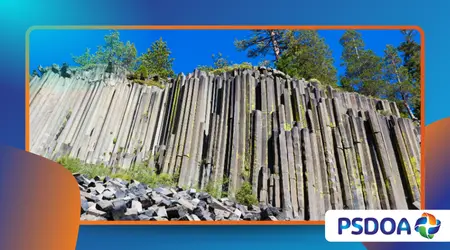
Columnar Basalt Formations define the intersection between chaotic volcanic fury and the absolute precision of Euclidean geometry.
Anúncios
When we gaze upon these pillars, we witness a rare moment where the earth’s cooling crust mimics the intentional design of a master architect.
These structures challenge our perception of natural randomness, forcing us to ask: how can flowing lava create such perfect hexagons?
In 2026, new geophysical data confirms that this cooling process is far more rhythmic than previously understood by science.
Essential Guide to Geological Geometry
- The Cooling Mechanism: How thermal contraction creates hexagonal patterns.
- Global Landmarks: Iconic sites from the Giant’s Causeway to Reynisfjara.
- Modern Discoveries: Recent 2026 research on underwater basalt plateaus.
What defines the formation of these volcanic pillars?
The birth of Columnar Basalt Formations begins with a thick lava flow that settles into a stagnant pool.
Anúncios
As the molten rock loses heat, it shrinks, creating internal tension that eventually snaps the cooling surface into distinct geometric cells.
Nature behaves like a drying mud flat here, but with much higher stakes and density.
The cracks propagate downward at a consistent speed, carving long, vertical prisms that can reach heights exceeding thirty meters in some regions.
How does thermal contraction dictate the shape?
Physics dictates that a hexagon is the most efficient shape for releasing tension while minimizing the total length of cracks.
This efficiency creates the “honeycomb” appearance that travelers find so mesmerizing at sites like the Devils Postpile in California.
A study by the University of Liverpool found that basalt fractures at temperatures between 840°C and 890°C.
This specific thermal window ensures the columns maintain their structural integrity without collapsing into rubble.
++ Supercell Thunderstorms: The Rare Storms That Spawn Giants
Why do some columns appear curved rather than straight?
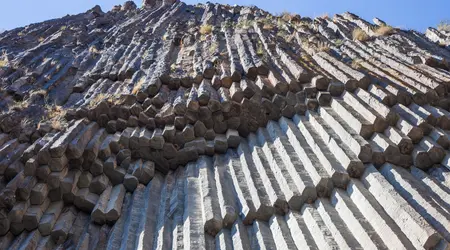
Local terrain influences the direction of cooling, causing cracks to bend as they follow the thermal gradient.
If the base of the lava flow is uneven, the resulting columns will twist, resembling a petrified forest in motion.
These “entablature” zones showcase the chaotic side of volcanic cooling, contrasting with the orderly “colonnade” at the base.
Geological mapping in 2026 highlights how water infiltration during cooling further distorts these magnificent stone pipes.
Where can you find the most impressive basalt structures today?
While the Giant’s Causeway in Northern Ireland remains the most famous example of Columnar Basalt Formations, incredible sites exist on every continent.
Each location offers a unique thumbprint of the specific volcanic event that shaped it millions of years ago.
Iceland’s black sand beaches feature basalt stacks that resemble a pipe organ emerging from the Atlantic.
These formations provide a raw, visceral look at how the Mid-Atlantic Ridge continues to sculpt our planet’s shifting crust.
Also read: Sulfur Springs That Change Color With the Weather
What makes the Giant’s Causeway a global benchmark?
This site contains approximately 40,000 interlocking basalt columns, resulting from a massive fissure eruption during the Paleogene Period.
It stands as a testament to the sheer scale of volcanic activity that once dominated the British Isles.
Legend may speak of giants, but the reality is an ancient lava plateau cooling over millennia.
Modern environmental monitoring in 2026 ensures these pillars remain protected from rising sea levels and increased coastal erosion.
Read more: Red Sprites and Blue Jets: Lightning’s Upper-Atmosphere Relatives
Are there hidden formations beneath the ocean?
Recent deep-sea expeditions have mapped vast Columnar Basalt Formations along the Pacific floor, revealing structures larger than any found on land.
These underwater cathedrals suggest that oceanic crust cooling follows the same geometric rules as terrestrial flows.
Scientists now believe these submerged pillars play a crucial role in supporting deep-sea biodiversity. They act as stable anchors for coral and rare sponges in the otherwise shifting sands of the deep ocean.
Why are these formations vital for modern geological research?
Studying Columnar Basalt Formations allows researchers to reconstruct the climate and volcanic intensity of Earth’s distant past.
The width of each column serves as a proxy for the speed at which the original lava flow cooled.
Wider columns indicate a slow, shielded cooling process, while narrow, spindly pillars suggest rapid heat loss.
This data helps vulcanologists predict how modern flows might behave in active zones like Hawaii or Iceland’s Reykjanes Peninsula.
How do researchers use basalt to understand planetary history?
By analyzing the magnetic minerals trapped within the stone, scientists can trace the historical shifts of Earth’s magnetic poles.
Basalt effectively “freezes” the magnetic field at the moment the lava solidifies into its final geometric shape.
The stability of these hexagonal prisms makes them ideal for long-term geological study.
Research published in 2026 suggests that similar patterns on Mars indicate the Red Planet once hosted significant volcanic lakes.
What is the relationship between basalt and carbon capture?
Innovative projects in 2026 are using Columnar Basalt Formations to permanently store atmospheric carbon dioxide.
By injecting CO2-saturated water into the porous rock, the gas mineralizes into solid stone within just a few years.
This process, known as mineral carbonation, represents one of the most promising tools for mitigating climate change.
The geometric regularity of the columns helps engineers map the flow of injected fluids through the subterranean layers.
Summary of Global Basalt Characteristics
| Location | Age (approx.) | Primary Shape | Unique Feature |
| Giant’s Causeway | 60 Million Years | Hexagonal | Interlocking “pavement” |
| Devils Postpile | 100,000 Years | Hexagonal/Pentagonal | Remarkable verticality |
| Fingal’s Cave | 60 Million Years | Hexagonal | Sea-hollowed cathedral |
| Svartifoss | Unknown | Hexagonal | Hanging “organ pipes” |
The Future of Natural Monuments
The preservation of Columnar Basalt Formations is essential for both scientific progress and our cultural connection to the Earth.
These stones remind us that nature operates under laws of physics that are both beautiful and predictably precise.
As we move through 2026, the focus shifts toward protecting these sites from the dual threats of over-tourism and climate instability.
We must treat these geometric sculptures as a shared heritage, ensuring they continue to inspire future generations of explorers.
Understanding the deep history written in these stones helps us navigate our own place in the world’s timeline.
Have you ever stood atop these ancient pillars and felt the pulse of the Earth’s volcanic history? Share your experience in the comments below!
Common Questions About Basalt Pillars
Can basalt columns form from any type of lava?
No, these formations require basaltic lava, which is low in silica and flows easily. Higher-viscosity lavas like rhyolite usually crumble before they can form perfect geometric columns during the contraction phase.
Are the columns always hexagonal?
While hexagons are the most common due to efficiency, you can also find three-sided to eight-sided columns. The specific geometry depends on the uniformity of the cooling and the lack of impurities in the lava.
Are basalt columns found on other planets?
Yes, high-resolution imagery from Mars has revealed Columnar Basalt Formations in the Marte Vallis region. This confirms that volcanic processes and thermal physics operate identically across the solar system.
Is it safe to climb on these formations?
Most protected sites discourage climbing to prevent erosion and ensure visitor safety. The surfaces can be extremely slippery when wet and the edges of the columns are often sharp.
How long does it take for a column to form?
The actual cracking happens relatively quickly as the lava reaches the 800°C threshold. However, the entire flow may take several years to cool completely from the surface down to the base.
