
Crown Flash: Rare Lightning-Driven Beams Above Storm Clouds

Crown Flash observations have captivated meteorologists in 2026, as this rare optical phenomenon continues to challenge our understanding of high-altitude atmospheric electricity.
Anuncios
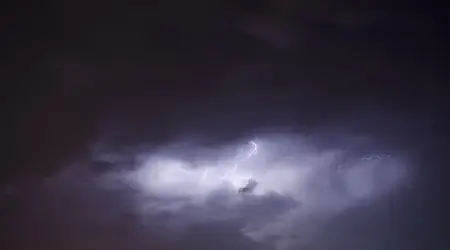
Unlike common lightning, this event occurs above the anvil of a cumulonimbus cloud, manifesting as a dancing, shifting beam of light.
Witnesses often describe it as a ghostly spotlight that swivels rapidly across the sky during intense thunderstorms.
This ethereal display is not a hallucination but a direct result of changing electric fields influencing ice crystals in the upper atmosphere.
Highlights of the Electric Sky
- The Mechanism: Understanding how lightning discharges instantly reorient ice crystals in the cirrus clouds above a storm.
- Optical Physics: Exploring how sunlight reflects off these shifting crystal “mirrors” to create the appearance of moving beams.
- Atmospheric Rarity: Why specific conditions of sun angle and cloud height are necessary for a visible display.
- Modern Documentation: The role of high-speed smartphone cameras in bringing this once-mythical event into the scientific mainstream.
What is the science behind this dancing light?
El fenómeno conocido como Crown Flash occurs when the electric field above a thunderhead undergoes a sudden, violent shift due to a lightning strike.
Anuncios
This change forces the plate-shaped ice crystals in the cirrus canopy to snap into a new alignment almost instantaneously.
As these crystals rotate, they act like millions of tiny mirrors reflecting the sun’s rays toward the observer on the ground.
When the lightning stops and the field resets, the crystals drift back, creating the illusion of a sweeping beam of light.
How do ice crystals act as mirrors?
Ice crystals in high-altitude clouds are often hexagonal and flat, naturally hovering in a horizontal position due to aerodynamic drag.
When a massive electrical discharge occurs nearby, the resulting torque overcomes gravity, flipping the crystals on their axes within milliseconds.
This sudden movement redirects the path of reflected sunlight, much like a person flashing a mirror at a distant observer.
The speed of the Crown Flash is what makes it so unsettling; it moves far faster than any cloud or bird could.
++ El espectro de Brocken: La ilusión óptica de la sombra de la montaña gigante
Why does the beam appear to “jump”?
Because lightning happens in pulses, the electric field is constantly flickering between high-intensity states and neutral recovery periods.
This causes the light beam to appear to skip or dance across the top of the storm cloud in a rhythmic fashion.
The effect is essentially a real-time visualization of the invisible electrical invisible forces that govern our atmosphere’s upper layers.
Scientists use these visual cues to map the intensity of the storm’s internal electrical engine without needing to fly sensors directly into the core.
Why is it so difficult to witness this event?
Observing a Crown Flash requires a perfect “celestial alignment” of the sun, the cloud, and the person watching from the ground.
The sun must be at a relatively low angle, usually during the late afternoon, to provide the necessary side-lighting for reflection.
Furthermore, the observer must be far enough from the storm to see the “crown” or anvil top clearly.
Most people are too close to the rain and darkness of the storm’s center to notice the silent light show happening miles above.
Lea también: Islas flotantes: balsas de vegetación que se mueven con el viento y la corriente
What are the ideal atmospheric conditions?
A stable layer of ice-heavy cirrus clouds must exist above a growing cumulonimbus for the reflection to be visible.
If the cloud is too dense or lacks the proper crystal structure, the sunlight will simply scatter rather than reflecting in a directed beam.
High-altitude winds must also be calm enough to allow the crystals to settle into a uniform starting position.
Without this initial uniformity, the sudden electrical reorientation would not produce a coherent, visible beam of light that we recognize as Crown Flash.
How has technology changed its documentation?
Before the 2020s, many reports of these beams were dismissed as “UFO sightings” or atmospheric tricks of the eye.
Today, the ubiquity of 4K video recording at high frame rates has allowed scientists to analyze the movement of these beams in extreme detail.
Recent footage from 2026 has confirmed that these flashes can last from a few seconds to several minutes, depending on the storm’s frequency.
This wealth of data has transformed Crown Flash from a meteorological curiosity into a vital area of study for atmospheric researchers.
Leer más: Hongos brillantes: los bosques que brillan de noche
How does the electric field control the sky?
The sheer power of a Crown Flash is a testament to the immense electrical potential that builds up within a supercell.
A single lightning bolt can carry over a billion volts, creating a temporary magnetic and electrical field that extends far beyond the visible spark.
This field is strong enough to physically move matter the ice crystals at a distance of several kilometers.
It is a stunning example of “action at a distance,” where a bolt of lightning below changes the color and light of the sky above.
Can this phenomenon predict storm intensity?
Researchers at the Administración Nacional Oceánica y Atmosférica (NOAA) have found that the frequency of these light beams correlates with the storm’s updraft strength.
A more active Crown Flash typically indicates a rapidly growing storm that may produce severe hail or even tornadoes.
By monitoring the “dance” of the ice crystals, meteorologists gain a window into the vertical development of the storm.
This visual data serves as a secondary warning system that complements traditional radar and satellite imagery in real-time.
Why is this considered an “Optical Masterpiece”?
Atmospheric physics is usually invisible to the naked eye, but this event makes the hidden geometry of nature strikingly clear.
It is like seeing the invisible magnetic lines of a magnet made visible through iron filings, but on a planetary scale.
The beauty of a Crown Flash lies in its transience; it is a fleeting moment where light, ice, and electricity create a singular work of art.
In 2026, as we face more extreme weather, these phenomena remind us of the terrifying yet beautiful power of our changing environment.
Atmospheric Light Phenomenon Comparison
| Fenómeno | Fuente de luz | Medio | Cause of Movement |
| Crown Flash | Luz del sol | cristales de hielo | Electric Field Shifts |
| Aurora boreal | Solar Wind | Ionized Gas | Geomagnetic Storms |
| Perro del sol | Luz del sol | cristales de hielo | Refraction (Static) |
| Pilares de luz | Artificial/Sun | cristales de hielo | Ground-level Reflection |
| Sprites | Plasma | Cold Gas | Upward Lightning |
Insights on the Lightning Beam
Understanding that Crown Flash is a purely physical and electrical event allows us to appreciate the sky as a giant, living laboratory.
We have explored how lightning reorients ice crystals to act as mirrors, why specific sun angles are required, and how modern technology has finally validated these rare sightings.
As our weather patterns shift in 2026, the opportunity to witness these “lightning-driven beams” grows for those who know where to look.
By looking up during the golden hour of a storm, you might see the heavens dance in a way that few in history ever have.
Nature still has many secrets hidden in the clouds, and this light show is perhaps its most spectacular.
Have you ever seen a beam of light dancing above a storm cloud, or did you assume it was just a trick of the setting sun? ¡Comparte tu experiencia en los comentarios!
Preguntas frecuentes
Is a Crown Flash dangerous to pilots or aircraft?
No, the phenomenon itself is just a reflection of light and does not carry an electrical charge that would harm an airplane.
However, the storm cloud beneath the Crown Flash is extremely dangerous due to turbulence and lightning, so pilots stay well clear of these areas.
Can I see this light show at night?
No, because the effect relies on the reflection of sunlight.
While lightning itself is visible at night, the “spotlight” effect of reorienting ice crystals requires a powerful external light source like the sun to be visible from the ground.
Are these beams related to UFO sightings?
Historically, many “unidentified flying objects” reported near storms were likely misidentified Crown Flash eventos.
The rapid, jerky movement of the light beam mimics the flight patterns often described in UFO lore, leading to centuries of confusion before the physics were understood.
Does this phenomenon happen in every thunderstorm?
It likely happens far more often than it is seen, but the conditions for human visibility are very strict.
You need the right cloud height, the right crystal shape, and the right observer position relative to the sun to actually perceive the beam.
How long does a single flash usually last?
The initial “snap” of the light beam happens in a fraction of a second, but the beam can appear to stay active as long as the storm is producing frequent lightning.
In 2026, observers have recorded continuous displays lasting over five minutes during peak storm activity.
