
Glowing Fungi: The Forests That Shine at Night
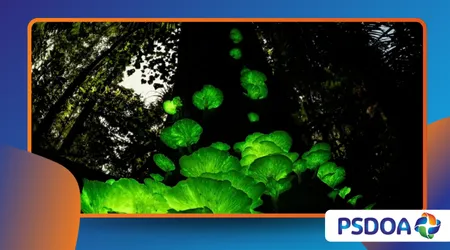
Glowing Fungi are one of the planet’s most enchanting and least understood natural wonders in 2025.
Anúncios
These bioluminescent mushrooms transform dark, damp forests into ethereal, glowing landscapes, a phenomenon known as foxfire.
This natural light show has fascinated observers for centuries, inspiring folklore and scientific inquiry alike.
The sight of wood and mushrooms emitting a soft, often greenish light defies common expectations of the natural world.
It proves that light can be generated biologically, without heat, deep within the forest floor, relying on unique, specialized chemistry.
Anúncios
What Biological Process Causes Fungi to Glow?
The mesmerizing light emitted by these mushrooms is the result of bioluminescence, a cold-light chemical reaction common in marine life but rarer on land.
This process is highly complex and specific to the fungal kingdom, involving specialized enzymes and molecules.
It requires the interaction of specific compounds and enzymes to convert stored chemical energy directly into light energy.
The glow is sustained and continuous, unlike the flashing, intermittent light of insects such as fireflies.
++ Sulfur Springs That Change Color With the Weather
How Does the Lucifern-Luciferase System Work?
The core mechanism involves a compound called luciferin reacting with oxygen. This light-producing chemical interaction is catalyzed by an enzyme called luciferase.
This specific enzymatic reaction releases excess energy in the form of photons, creating the characteristic steady, greenish light.
The process is remarkably efficient, maximizing light production while minimizing wasted energy as heat.
Also read: Red Sprites and Blue Jets: Lightning’s Upper-Atmosphere Relatives
Which Specific Fungi Species Exhibit Bioluminescence?
Currently, scientists have identified over 100 species of fungi capable of glowing, predominantly found in tropical and subtropical regions globally. Notable genera include Mycena and Omphalotus.
One famous example is the Ghost Fungus (Omphalotus nidiformis) found in Australia and India, known for its strong, ghostly light. Another is Mycena chlorophos, celebrated for its intense, almost electric green glow in parts of Asia.
Read more: The Devil’s Kettle: A Waterfall That Swallows Half Its Flow
What Role Does Circadian Rhythm Play in the Glow?
Recent research has shown that the bioluminescence in some fungi is regulated by a circadian rhythm, an internal biological clock. The glow is not constant but intensifies primarily during the nighttime hours.
This sophisticated control suggests that the fungi actively time the chemical reaction. This raising crucial questions about the adaptive purpose of the light within its nocturnal ecosystem.
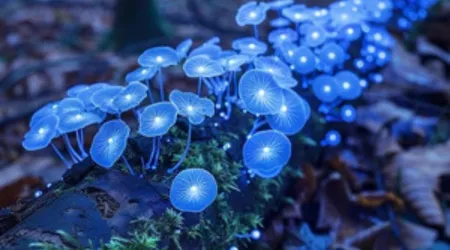
Why Do These Glowing Fungi Emit Light?
The exact evolutionary reason why these fungi expend precious biological energy to produce light remains a subject of intense scientific debate.
The primary hypotheses revolve around reproduction, dispersal, and defense against predators.
Understanding the “why” is key to unlocking the ecological role these glowing organisms play within their complex, competitive forest ecosystems. The energetic cost of the light must be justified by a significant biological advantage.
How Does Light Aid in Spore Dispersal?
The leading hypothesis suggests that the light acts as a visual lure, attracting nocturnal insects, such as flies and beetles, into the vicinity. These insects inadvertently pick up the fungal spores.
The insects then carry the spores far away from the parent organism, effectively dispersing them to new locations for growth.
The glow acts as an unambiguous beacon in the dark forest floor, facilitating successful reproduction.
Could the Light be a Defense Mechanism?
Another theory posits that the glow serves to deter predators that might feed on the fungus, or fungivores. The emitted light might signal to these organisms that the fungus is unpalatable or chemically toxic.
Alternatively, the light could attract larger, predatory creatures (like spiders or frogs) that feed on smaller spore-eating pests, thereby protecting the reproductive structures of the fungus itself.
The Beetle Attraction Study
A study conducted in Brazilian forests used small, green LED-lights to mimic the fungal glow.
They found that placing these green LED lights significantly increased the number of spore-dispersing insects visiting the immediate area compared to dark control environments.
This controlled experiment strongly supports the theory that the glow acts as an effective visual signal for insect vectors, highlighting the evolutionary success of the Glowing Fungi in leveraging animal mobility.
How Does Light Production Relate to Fungal Metabolism?
Bioluminescence is intrinsically linked to the fungi’s metabolic health and activity. The chemical reaction utilizes energy pathways similar to those used for growth and respiration.
Some researchers suggest the glow might even be a byproduct of detoxification.
It could simply be a way to harmlessly expend excess energy or deal with reactive oxygen species generated during intense metabolic activity.
Where Are These Ethereal Forests Located Around the World?
Bioluminescent fungi are not uniformly distributed; their presence is highly dependent on specific environmental conditions, primarily within moist, wooded environments where decaying organic material is abundant. They thrive where food sources are plentiful.
These “glowing forests” are often found in remote, high-humidity regions, making them spectacular, yet logistically difficult to observe natural phenomena for the average person.
Which Regions are Famous for Fungal Bioluminescence?
Tropical forests in Brazil, Puerto Rico, Japan (particularly the island of Hachijō-jima), and parts of Southeast Asia are major global hotspots for bioluminescent fungi.
The constant humidity and warm temperatures provide the ideal growing conditions.
The concentrated diversity of species in these regions suggests that the evolutionary conditions were highly favorable for this specific bioluminescent trait to develop repeatedly across different fungal genera.
What is the Best Time to Witness This Phenomenon?
To successfully witness the glow, observers must venture out on the darkest, moonless nights, ideally shortly after periods of heavy rain when fungal growth is at its peak.
The human eye needs about 20 to 30 minutes to adapt fully to the deep dark.
The faint green glow becomes truly visible only after prolonged dark adaptation, demanding patience. This requirement underscores the subtle and delicate nature of the light produced by Glowing Fungi.
What Role Does Humidity Play in the Intensity of the Glow?
High humidity is crucial not only for the growth of the fungi but also for the intensity of the light emission. Fungi are largely water-based organisms.
In dry conditions, the metabolic processes slow down, and the chemical reactions required for bioluminescence become less efficient, resulting in a significantly fainter or non-existent glow.
How Are Scientists Utilizing the Chemistry of Glowing Fungi?
The unique, stable, and efficient chemistry of fungal bioluminescence is not merely a biological curiosity; it holds massive practical potential for biotechnology and sustainable technology.
The continuous nature of the light production is a major draw.
Scientists are actively studying and isolating the genes responsible for the luciferin-luciferase pathway. Their goal is to transfer this highly efficient light production into other systems for practical applications.
What is the Potential for Bio-Indicators and Bio-Illumination?
The genes responsible for the fungal glow are being successfully engineered into other organisms, including plants. This biotechnology could create self-illuminating plants for lighting or environmental monitoring.
Imagine urban areas or indoor spaces lit by trees or houseplants that gently and continuously glow at night.
This offers a revolutionary, low-energy vision for sustainable illumination, removing reliance on conventional electric grids.
How Does This Research Aid Medical Imaging?
The stable, continuous light produced by fungal luciferase is being explored for its potential use in advanced medical imaging and molecular research.
It offers a cleaner, more sustained light source than many current bioluminescent tags.
It could help researchers track complex biological processes, like gene expression or disease progression, in real-time within living tissues. This non-invasive and highly specific tracking is a major asset in cellular biology.
The Glowing Plant Project
In a significant breakthrough, researchers successfully inserted the full bioluminescence genetic cassette from the mushroom Neonothopanus nambi into tobacco plants.
These genetically modified plants glowed continuously without needing external chemicals, powered solely by their internal plant metabolism.
This achievement confirms the potential to use the Glowing Fungi genetic code to create genuinely self-sustainable, living light sources. The impact on urban landscaping and bio-indicators could be transformative.
Scientists estimate that only about 1.5% of all known fungal species are bioluminescent.
However, within the highly-studied Mycena genus, approximately 20% of known species exhibit the trait, indicating a concentrated evolutionary advantage for this lineage in the deep forest environment.
| Fungi Species (Example) | Common Name | Primary Location | Color of Light | Proposed Ecological Function |
| Omphalotus nidiformis | Ghost Fungus | Australia, India | Green | Attracts flying insects for spore dispersal |
| Mycena chlorophos | Green Meanies | Japan, Indonesia | Bright Green | Regulated by circadian clock for efficient dispersal |
| Panellus stipticus | Bitter Oyster | North America, Europe | Faint Green/Yellow | Dispersal and/or defense against fungivores |
| Armillaria mellea | Honey Mushroom | Global (Root Rot) | Bluish-Green (Mycelium only) | Mycelial communication or byproduct of metabolism |
Conclusion: The Quiet Wonders of the Mycelial Network
The phenomenon of Glowing Fungi offers a humbling glimpse into the quiet, complex wonders of the natural world.
These bioluminescent organisms defy the darkness, utilizing sophisticated biochemistry to perform essential ecological tasks with elegant precision.
The order and precision of their light-producing chemistry suggest an elegant evolutionary design, serving the critical function of reproduction in a light-limited environment.
The transfer of these light-producing genes into plants heralds a new era of bio-illumination. D
oesn’t this natural light spectacle prove that the most profound beauty is often found in the unseen depths of nature?
Share your experiences of bioluminescence or your thoughts on its future applications in the comments below!
Frequently Asked Questions
What is the difference between foxfire and fungal bioluminescence?
Foxfire refers specifically to the eerie, faint glow emitted by the mycelium (the vegetative, root-like part) of certain fungi, usually found in rotting wood.
Fungal bioluminescence is the general term covering the glow from the mycelium and the mushroom fruiting body.
Does the fungus glow 24 hours a day?
No. Research suggests the light emission is often tied to the fungus’s circadian rhythm, maximizing the glow during the darkest hours when nocturnal, spore-dispersing insects are most active and visible.
Why does the light appear green in most species?
The specific chemical reaction in most Glowing Fungi is optimized to release photons in the green wavelength spectrum (around 520 nm). This color is highly visible in dark, low-light environments like the forest floor.
Can I eat glowing fungi, or are they all poisonous?
Absolutely not. While many fungi are edible, the known bioluminescent species are generally considered inedible or are outright poisonous.
Never consume any wild mushroom unless it has been unequivocally identified by a mycological expert.
Can I grow these glowing mushrooms at home?
Yes, some companies offer kits for growing species like Panellus stipticus at home. However, maintaining the necessary dark, moist, and stable environment for a strong glow can be challenging for hobbyists.
