
How Ant Colonies Mimic Human Traffic Systems
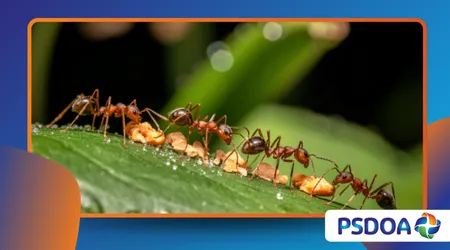
Ant Colonies Mimic Human Traffic Systems offers a stunning look into the decentralized intelligence of nature. These tiny organisms manage complex logistics with remarkable efficiency.
Anúncios
They tackle problems like congestion and throughput far better than many human-engineered systems.
The underlying principles governing ant highways provide crucial lessons for urban planning in the 21st century.
By studying their collective behavior, scientists are gaining new insights into optimizing our own roads and digital networks. This convergence of biology and traffic engineering is yielding surprising results.
How Do Ant Trails Compare to Human Highways?
Ant foraging trails function as dynamic, bidirectional highways, essential for moving food and resources back to the nest. These trails exhibit key characteristics observed in well-structured human traffic flow.
Anúncios
The efficiency is achieved through simple, local interactions among individuals, without any central command.
This decentralized system is what allows Ant Colonies Mimic Human Traffic Systems so effectively under varying loads.
What is the Ant Version of Lane Discipline?
One of the most striking observations is the spontaneous emergence of lane segregation in ant trails. Ants returning to the nest (loaded) often stick to one side, while outward-bound ants (empty) use the other.
This natural division minimizes head-on collisions, preserving the overall speed and flow of the two-way traffic.
This self-organization occurs without any physical barriers or explicit rules, a major lesson for human road design.
++ The Bizarre Science Behind Negative Mass
How Does the Density-Speed Relationship Differ from Human Traffic?
In human traffic, speed typically drops sharply when vehicle density increases past a certain critical point, leading to gridlock. Ant traffic, surprisingly, maintains high speeds even as density rises.
Ants manage to avoid the sudden onset of traffic jams. They achieve this by collectively reducing individual speed before collision risk becomes high, thus preserving overall flow a key way Ant Colonies Mimic Human Traffic Systems efficiently.
Also read: Space-Time Cloaking: How Scientists Are Trying to Hide Events in Time
What Is the Role of Pheromones in Traffic Control?
Pheromones are the chemical equivalent of road signs and GPS in the ant world. Outward-bound ants deposit a trail, marking the most efficient, shortest path to food. This chemical gradient guides the flow.
As more ants use a path, the pheromone signal strengthens, reinforcing the route and directing subsequent foragers.
This dynamic system automatically favors the most profitable and less congested paths, like adaptive signal control.
Read more: The Truth About Hypersonic Weapons and Plasma Shielding
What Statistical Evidence Supports Ant Traffic Efficiency?
A 2024 study published in the Journal of Experimental Biology found a crucial threshold. The research showed that certain ant species maintain a 92% average efficiency in their traffic flow, even when trail density reaches 60% of maximum capacity.
This remarkable statistic highlights their resistance to the typical jamming phase seen in human-engineered systems, where flow often collapses above 40% capacity. Their collaborative slowing prevents widespread congestion.
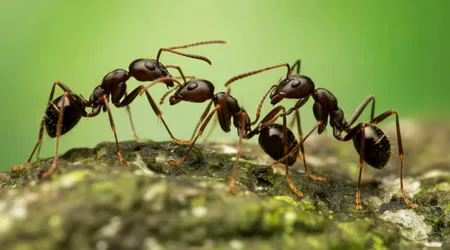
Why Do Ant Colonies Avoid Traffic Jams So Well?
The ability of Ant Colonies Mimic Human Traffic Systems lies in their sophisticated, emergent jamming avoidance mechanisms. They don’t need traffic police or central computers to manage flow.
Instead, their individual behavior changes based only on immediate local interactions. This distributed control system is fundamentally more resilient and adaptable than rigid, centrally managed human systems.
What is the Ant’s Equivalent of Adaptive Braking?
When an ant encounters high density or a slower ant in front, it doesn’t suddenly stop; it gradually reduces its speed. This gentle slowing prevents the “phantom traffic jam” effect common in human highways.
This pre-emptive, gradual reduction in speed prevents shockwaves from propagating backward through the trail. This simple, local rule is the cornerstone of their superior flow management.
How Do Obstacles Affect Ant Traffic Flow?
When a large obstacle (like a twig) blocks the path, ants demonstrate collective adaptability. They rapidly explore and establish detour routes, guided by the pheromone system.
Crucially, the traffic flow reorganizes around the obstacle rather than stopping entirely. The flow is maintained because the system relies on parallel processing and quick, local decision-making by individual ants.
What is the “Trading Off” Principle in Ant Navigation?
Ants often trade the individual goal of maximum speed for the collective goal of maximum flow. An ant might slow down slightly to let a heavily loaded ant pass.
This “trading off” of individual speed for group efficiency is what enables the high throughput of the entire colony. It demonstrates that collaboration, rather than competition, optimizes the transport network.
What Engineering Principle Can We Learn from Ant Traffic?
The main principle to extract from how Ant Colonies Mimic Human Traffic Systems is “Positive Feedback Loop with Negative Damping.”
Pheromones provide the positive feedback (reinforcing the route). But the inherent delay in pheromone communication acts as negative damping.
This delay prevents over-reliance on a single, potentially flawed path. Instead, it allows for continuous, slight exploration of new routes, providing the system with adaptability and resilience against single points of failure.
How Can We Apply Ant Colony Insights to Human Systems?
The principles observed in how Ant Colonies Mimic Human Traffic Systems are already inspiring innovative solutions in various human-engineered fields. The lessons extend far beyond road traffic management.
From optimizing data packet routing on the internet to improving warehouse logistics, the simplicity and robustness of ant algorithms offer compelling alternatives to complex central control systems.
What is the Concept of “Ant Colony Optimization” in Computing?
Ant Colony Optimization (ACO) is a metaheuristic algorithm used in computer science to solve complex computational problems, such as finding the shortest path in a network. It directly mimics ant foraging behavior.
ACO algorithms use ‘artificial pheromones’ (data values) to iteratively strengthen the best routes found by ‘artificial ants’ (computing agents).
This technique is highly effective for solving routing problems that are too complex for traditional algorithms.
What is an Original Example of Ant Traffic Applied to Urban Planning?
An original example is applying ant-based lane segregation to future autonomous vehicle (AV) road networks.
Rather than using fixed lanes, AVs could communicate locally to establish dynamic “fast lanes” for cargo carriers and “slow lanes” for passenger vehicles.
This spontaneous, self-organizing segregation would change in real-time based on demand, just as ant trails adapt to food availability. This minimizes bottlenecks and increases overall urban mobility.
What is an Original Example of Ant Traffic Applied to Warehouse Logistics?
Another original application lies in optimizing robotic fulfillment centers. Instead of a central server dictating the precise path for every delivery robot, a decentralized system could be used.
Robots could leave virtual pheromones (digital markers) on the floor plan, signaling congestion or efficiency.
This allows other robots to spontaneously choose less-used, faster routes, mimicking how Ant Colonies Mimic Human Traffic Systems to avoid jams.
Why is the Decentralized Nature of Ant Traffic More Resilient?
The decentralized nature of ant traffic ensures system resilience. If one ant is killed or a pheromone source is briefly disrupted, the entire system does not collapse; only local flow is affected.
This is a critical lesson for modern infrastructure. A system built on local, simple rules is inherently robust against catastrophic failure, unlike human systems reliant on a single, complex central control hub. Should we rethink our reliance on centralized control entirely?
Comparison of Ant and Human Traffic Management Strategies
| Feature | Ant Colonies (Decentralized) | Human Traffic Systems (Centralized/Fixed) | Efficiency Implication |
| Lane Management | Spontaneous Pheromone-based Segregation | Fixed Painted Lanes and Barriers | Ants adapt instantly; humans rely on infrastructure. |
| Jam Avoidance | Gradual, Collective Speed Reduction | Sudden Braking leading to Shockwaves/Gridlock | Ants avoid phantom jams; humans are prone to them. |
| Routing Decisions | Dynamic Pheromone Trail Reinforcement | Static Maps and Pre-set Signals | Ants prioritize efficiency; humans often prioritize distance. |
| Control System | Local Interaction and Simple Rules | Centralized Traffic Lights and Computers | Ants show higher resilience against single failures. |
The study of Ant Colonies Mimic Human Traffic Systems moves beyond mere curiosity; it provides a blueprint for resilience and efficiency.
The ants’ mastery of self-organization, based on simple, local rules, offers profound lessons for solving complex human logistical challenges.
From optimizing the flow of data packets to building smarter urban transit, their decentralized intelligence proves that often, the simplest solutions are the most robust.
By observing the ant trail, we find elegant solutions to our own persistent traffic woes.
We invite you to share your thoughts in the comments! Where else in technology or urban living do you see the potential for applying the decentralized, self-organizing principles of ant colonies?
Frequently Asked Questions
Do all ant species exhibit the same level of traffic efficiency?
No. Efficiency varies. Researchers have found that species like the Argentine Ant and certain Weaver Ants exhibit extremely high-density, jam-resistant flow, whereas less social species may not demonstrate the same level of organization.
What is a “phantom traffic jam” and how do ants avoid it?
A phantom traffic jam is a stoppage that occurs without any apparent cause (like an accident). It starts when one driver brakes suddenly, causing a ripple of braking behind them.
Ants avoid this by practicing gradual, collective speed reduction instead of sudden stops.
Is Ant Colony Optimization (ACO) actually used in real-world applications?
Yes, ACO is a mature optimization algorithm used extensively. It is deployed in routing vehicles (delivery trucks, aircraft), scheduling jobs in complex manufacturing environments, and efficiently routing data packets across telecommunications networks.
How do ants communicate the quality of the food source to the colony?
The quality and quantity of the food source directly influence the amount and persistence of the pheromone trail deposited by returning ants.
A better food source results in a stronger, longer-lasting signal, recruiting more ants and increasing the flow to that specific location.
What role does the size of the ant play in traffic flow?
Research on large colonies shows that ant size can act as a natural constraint. Larger ants, particularly those carrying big loads, move slower and require more space.
They often naturally occupy the center of the trail, forcing smaller, faster ants to the periphery, which contributes to lane segregation.
