
How Pirates Shaped Early Global Trade
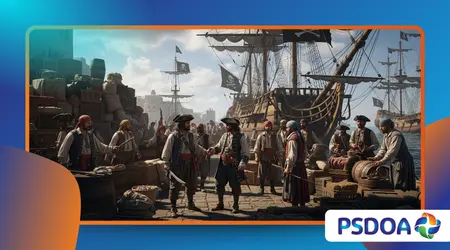
Pirates Shaped Early Global Trade by forcing empires to rethink how wealth moved across the oceans during the 17th and 18th centuries.
Anúncios
While history books often focus on the brutality of the Jolly Roger, they frequently miss the radical economic shifts triggered by these maritime outlaws.
The early modern era saw the birth of the first truly global markets, yet these routes were fragile and plagued by state monopolies.
Modern researchers now argue that piracy acted as a violent but effective catalyst for the development of international maritime law and insurance.
Key Insights of this Investigation
- The disruption of mercantilist monopolies and the rise of “free” black markets.
- Technological advancements in shipbuilding driven by the need for speed and survival.
- The evolution of maritime insurance and the protection of international investment.
How did piracy break the monopoly of colonial empires?
Colonization gave European powers a stranglehold on spices, silver, and silk, creating rigid trade routes that excluded much of the world.
Anúncios
Because Pirates Shaped Early Global Trade, they inadvertently pioneered a shadow economy that offered goods at lower prices to desperate colonial outfittings.
This underground market undermined the Spanish and British monopolies, proving that demand would always find a way to bypass restrictive royal decrees.
By raiding treasure fleets, pirates forced a redistribution of wealth that stimulated local economies in the Americas and the Indian Ocean.
What was the impact of the “Pirate Round” on Asian trade?
The “Pirate Round” was a specific route where Western outlaws sailed to the Indian Ocean to intercept the fabulously wealthy Great Mughal fleets.
These raids were so successful that they nearly collapsed the East India Company’s diplomatic relations with the Mogul Empire in the late 1690s.
Consequently, the British government had to implement the Piracy Act of 1698, which created new courts to handle crimes on the high seas.
This legal shift laid the groundwork for the modern international jurisdiction we use today to govern territorial waters and trade.
++ The Hidden Religious Conflicts Behind Famous Wars
How did the black market influence colonial consumption?
Pirates frequently traded stolen silks and spices in ports like New York or Charleston, where residents were starving for affordable luxury goods.
This illegal flow of commodities helped build the infrastructure of early American merchant families who grew wealthy on “redistributed” pirate loot.
Without this influx of untaxed goods, many colonial outposts would have struggled to sustain their growing populations against the high costs of legal imports.
Piracy was, in a sense, the first unintentional experiment in unregulated global capitalism.
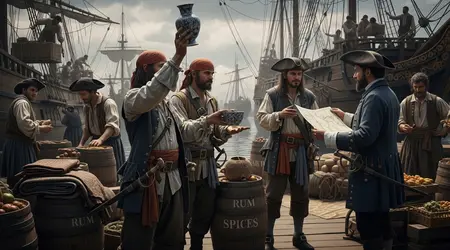
Why did pirate tactics force a revolution in maritime security?
Merchant ships were often slow, heavy vessels designed for capacity rather than defense, making them easy targets for swift pirate sloops.
As Pirates Shaped Early Global Trade, shipbuilders had to innovate, creating faster, more agile vessels that could outrun or outgun ocean predators.
This arms race led to the standardization of naval escorts and the “convoy system,” which is still used by modern navies to protect tankers.
Security became an essential cost of doing business, forever changing the profit margins and strategic planning of global logistics companies.
Also read: Ancient Democracies That Preceded Greece
How did insurance companies respond to pirate risks?
Lloyd’s of London emerged during this era partly to manage the astronomical risks associated with maritime trade and pirate attacks.
Investors realized they could not sustain individual losses from raids, so they began pooling capital to insure ships against “perils of the sea.”
Modern maritime insurance still carries the DNA of these early pirate-era contracts, proving that high-risk environments often breed the most resilient financial systems.
Have you ever considered that your modern insurance policy might owe its existence to a 17th-century sea thief?
Read more: Historical Hoaxes That Fooled the World
What role did technological innovation play in ship design?
Pirates preferred the “sloop,” a small, fast vessel that could navigate shallow waters where heavy warships would surely run aground and perish.
To counter this, merchant navies began integrating more cannons and developing the “frigate,” a ship that balanced speed with devastating firepower.
This technological evolution was not a choice but a necessity for survival in a world where the sea was no longer a safe highway.
The legacy of these designs can be seen in the streamlined hulls of modern naval vessels today.
Can we see the pirate legacy in modern economic systems?
It is a historical fact that Pirates Shaped Early Global Trade by creating the first democratic labor contracts and disability insurance schemes.
Long before modern unions, pirate crews signed “Articles” that guaranteed payouts for lost limbs and ensured every man had a vote.
These social innovations made piracy an attractive, albeit dangerous, career path for sailors who were tired of the tyrannical conditions on merchant ships.
This pressure eventually forced legitimate shipping companies to improve their own labor standards to keep their crews from deserting.
How did the suppression of piracy centralize state power?
The war on piracy allowed empires to justify a permanent naval presence in distant waters, effectively expanding their sovereign reach over the globe.
By declaring pirates “hostis humani generis” (enemies of all mankind), nations found a common cause to unite their military interests.
This cooperation established the first international coalitions, a precursor to modern alliances like NATO or the United Nations’ maritime task forces.
The effort to secure trade routes transformed the ocean from a lawless frontier into a regulated extension of national territory.
Why is the pirate “Golden Age” a case study in market disruption?
Economist Peter Leeson argues that pirates were not just lunatics; they were rational actors responding to the incentives of a rigid, monopolistic world.
Like a modern startup disrupting a stagnant industry, they used lean operations and high-risk strategies to capture massive market shares.
Their influence remains visible in how we handle digital piracy and intellectual property today, as the tension between regulation and “free” access continues.
Piracy proved that whenever a trade system becomes too restrictive, a counter-force will inevitably rise to break the locks.
Comparative Impact of Maritime Factors
| Factor | Mercantilist Approach | Pirate-Driven Shift | Long-term Trade Result |
| Market Control | Royal Monopolies | Clandestine Free Trade | Development of competitive global pricing |
| Security | Minimal/Individual | Convoy & Escort Systems | Modern naval protection of trade lanes |
| Finance | State-funded risk | Private Maritime Insurance | Growth of Lloyd’s and global risk management |
| Labor | Impressment/Tyranny | Early Democratic Contracts | Improvement in maritime labor laws |
According to research by the National Bureau of Economic Research, the suppression of piracy in the 18th century led to a 15% drop in freight rates.
This statistic highlights that while Pirates Shaped Early Global Trade through disruption, their removal was the final step in creating the efficient shipping lanes we use.
Piracy acted as a brutal forge, hammering the chaotic ocean trade into a structured, insured, and legally protected global network.
By challenging the status quo, these outlaws forced empires to build the very systems of security and law that would eventually make piracy obsolete.
Understanding this hidden history allows us to see our current global economy not as a planned masterpiece, but as a resilient system born from conflict.
We should remember that the safety of our modern deliveries was bought through centuries of struggle against those who sailed under the black flag.
What do you think was the most influential pirate “innovation” for today’s world? Share your thoughts in the comments below!
Frequently Asked Questions
Were pirates actually the “good guys” of trade?
Not exactly. While they broke monopolies and practiced early democracy, they were also violent criminals who engaged in theft and murder. Their contribution to trade was an unintended byproduct of their search for profit.
How did pirates help the American colonies?
Because Pirates Shaped Early Global Trade, they provided the colonies with goods that the British Crown made too expensive through high taxes. This illegal trade was essential for the survival of early American cities.
Is modern piracy similar to the Golden Age?
Modern piracy, like that seen off the coast of Somalia, is driven by similar economic desperation but lacks the democratic structures of the 18th-century crews. However, both still target the vulnerabilities of global supply chains.
Did pirates really have insurance for lost limbs?
Yes. Pirate “Articles” often specified exact amounts of money or gold for the loss of an eye, arm, or leg. This was the first documented form of workplace disability insurance in the Western world.
