
Modern Anarchist Subcultures and Digital Organizing
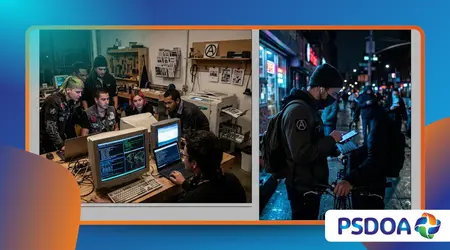
Modern Anarchist Subcultures and Digital Organizing represents a radical shift in how decentralization functions within our hyper-connected 2026 society.
Anúncios
Gone are the days when horizontal movements relied solely on physical pamphlets and secret basement meetings to challenge established power structures.
Today, the intersection of autonomous philosophy and encrypted technology creates a vibrant ecosystem where global solidarity manifests through lines of secure code.
Activists now utilize sophisticated mesh networks and decentralized autonomous organizations to bypass traditional surveillance states and corporate gatekeepers.
This digital evolution allows for real-time coordination across borders, transforming abstract political theories into practical, lived realities for thousands of participants worldwide.
Anúncios
We are witnessing a historic merger of old-world mutual aid and futuristic technology that redefines the very essence of community resistance.
Article Navigation
- Core Mechanisms: How cryptography and open-source tools facilitate leaderless social movements.
- Cultural Intersections: The role of gaming and “Solarpunk” aesthetics in envisioning a post-state future.
- Practical Impacts: Examining real-world examples of digital mutual aid and anti-surveillance strategies.
What defines the intersection of technology and autonomy?
The heart of Modern Anarchist Subcultures and Digital Organizing lies in the rejection of centralized platforms that profit from user data and surveillance.
Modern practitioners prioritize “Federated” systems, where power remains distributed among local nodes rather than resting in a single corporate or state-run server.
This technical architecture mirrors the political goal of a society built on voluntary association rather than enforced hierarchy.
Digital organizers use tools like Matrix and Signal to build resilient communication channels that are almost impossible for external authorities to penetrate.
By mastering end-to-end encryption, these subcultures have created “temporary autonomous zones” within the internet, allowing for radical experimentation without the immediate threat of state intervention.
Why is cryptography essential for modern resistance?
Encryption acts as the digital shield for those who operate outside the traditional political spectrum in 2026.
Without secure communication, horizontal movements are vulnerable to infiltration and disruption, which historically dismantled previous generations of anarchist organizing.
Modern activists treat privacy not as a luxury, but as a fundamental requirement for any meaningful collective action.
They view code as a form of law, using smart contracts to manage communal resources without needing a central bank or government.
This approach creates a high-trust environment in a low-trust world, proving that cooperation can flourish without a boss or a border.
++ The Skate Kitchen and the Rise of Feminist Skater Crews
How do mesh networks bypass state control?
Mesh networks allow communities to share internet access and data without relying on mainstream Internet Service Providers (ISPs).
This infrastructure is vital during periods of civil unrest or state-imposed internet blackouts, ensuring that the flow of information remains uninterrupted.
By owning the hardware, these subcultures achieve a level of physical and digital sovereignty that was once considered impossible.
Each device in the network acts as a router, making the system stronger as more people join the collective.
This is a perfect technological analogy for anarchism: a system where the strength of the whole depends on the active participation of every individual.

How do subcultures utilize gaming and virtual worlds?
The movement of Modern Anarchist Subcultures and Digital Organizing has found an unlikely home in the sprawling landscapes of online gaming.
Platforms and games like Minecraft or the decentralized world of Decentraland serve as testing grounds for architectural and social experiments.
In these digital spaces, players build massive communes and practice resource sharing that defies the capitalist mechanics of the game itself.
Gaming allows for the simulation of complex social interactions and the testing of “consensus-based” decision-making models in a low-stakes environment.
Have you ever wondered if a society without a king could actually manage a large-scale project? Virtual guilds are proving every day that collective labor, driven by passion rather than profit, can create wonders.
Also read: Mushroom Foraging Groups: Nature Meets Counterculture
What is the influence of Solarpunk in 2026?
Solarpunk has emerged as the aesthetic and philosophical backbone of many modern anarchist circles, focusing on a green, sustainable, and tech-integrated future.
Unlike the bleakness of Cyberpunk, Solarpunk envisions a world where high technology serves the earth and the community rather than the military-industrial complex.
This subculture organizes digitally to share blueprints for DIY wind turbines and urban permaculture systems.
This movement rejects the “doomerism” of previous decades, opting instead for a “radical optimism” that demands we build the new world within the shell of the old.
Their digital hubs are filled with open-source designs for ecological resilience, proving that the future can be both high-tech and high-nature.
Read more: Seapunk, Cybergoth, and Other Internet-Born Aesthetics
How do digital “affinity groups” operate in games?
In games like Eve Online, players have formed massive, leaderless collectives that manage complex economies and defense strategies through direct democracy.
These groups often use external Discord servers or private forums to vote on every major move, mimicking the “Spokescouncil” model used in historical anarchist movements.
This digital training ground prepares a new generation of activists to think horizontally in their real-world social lives.
These virtual experiments show that the “free rider” problem is often overstated when participants feel a genuine sense of ownership and belonging.
The digital realm has become a laboratory where the rules of the state simply do not apply, allowing for pure human agency.
Why is digital mutual aid the new standard for social safety?
The practice of Modern Anarchist Subcultures and Digital Organizing has revolutionized the concept of the social safety net through rapid-response mutual aid.
When traditional institutions fail during climate disasters or economic shifts, decentralized networks use apps to coordinate food distribution and medical help.
This isn’t charity; it is a horizontal exchange of resources where everyone contributes what they can.
Statistics from recent 2025-2026 humanitarian reports show that decentralized mutual aid networks reached affected areas 40% faster than traditional NGOs in urban zones.
By cutting through the red tape of bureaucracy, digital organizers save lives by trusting the community to know its own needs better than a distant official.
How do crypto-collectives fund social projects?
Cryptocurrency and “Gitcoin” style funding allow global supporters to send resources directly to local projects without the fees or interference of international banks.
This “stateless” money is used to buy seeds for community gardens or to pay the legal fees of activists facing state repression. It creates a global treasury for the resistance that no single government can seize or shut down.
This financial autonomy is crucial for movements that are often targets of “de-banking” or financial censorship.
In the digital age, being able to move value without a middleman is the ultimate form of economic protest.
What is the “Permanent Lab” of digital organizing?
The internet serves as a permanent, evolving library for anarchist tactics, from digital security guides to blueprints for modular housing.
Subcultures maintain “Wikis” that are constantly updated with the latest field-tested methods for community defense and food sovereignty.
This collective intelligence ensures that the movement never has to start from zero, as every success and failure is recorded for the benefit of all.
By sharing knowledge freely, these groups dismantle the “expert” hierarchy that often gatekeeps social change.
Everyone is encouraged to become a teacher and a student, fostering a culture of continuous, decentralized learning.
Comparison of Organizing Frameworks
| Feature | Traditional Centralized Model | Modern Digital Anarchist Model |
| Leadership | Top-down Hierarchy | Leaderless / Horizontal |
| Communication | Closed Corporate Platforms | Encrypted / Open Source |
| Resource Flow | Bureaucratic Grants | Direct Peer-to-Peer Aid |
| Governance | Representative Voting | Direct Consensus / DAOs |
| Sustainability | Dependent on State Support | Self-Reliant / Community Owned |
Reflections on a Leaderless Future
The landscape of Modern Anarchist Subcultures and Digital Organizing reminds us that the tools of the future can be reclaimed for the benefit of the many.
By moving away from centralized control, these subcultures are drafting a new social contract one written in code and sustained by mutual respect.
We are seeing the birth of a global community that values autonomy over authority and transparency over secrets.
The resilience of these networks in 2026 suggests that the more the state tries to tighten its grip, the more these decentralized alternatives will flourish.
It is a transition toward a world where the “gap between the platform and the train” is finally bridged by human solidarity.
As we navigate the complexities of this decade, the lessons of these digital pioneers offer a roadmap toward a more equitable and spontaneous society.
The digital realm is no longer just a place to consume; it is a place to build. Whether through the pixels of a video game or the encrypted packets of a mesh network, the spirit of autonomy is finding new ways to breathe.
The question is no longer if we can live without a center, but how much more we can achieve once we finally let go of the need for one.
Have you ever participated in a mutual aid network or used encrypted tools to organize a local event? Share your experience in the comments below!
Frequently Asked Questions
Is digital anarchism just about “chaos” on the internet?
No, it is the exact opposite. Anarchism literally means “without rulers,” not “without order.”
Digital organizing is about creating highly structured, voluntary systems of cooperation that do not rely on a central authority.
How do these groups prevent bad actors without a police force?
Digital subcultures use “Reputation Systems” and “Social Ostracism” to manage behavior.
If a participant violates the community’s trust, they lose access to the network’s resources and communication channels, which is a powerful deterrent in a specialized digital ecosystem.
Can these digital movements actually change anything in the real world?
Absolutely. We see the results in every community garden funded by crypto, every successful protest coordinated via Signal, and every neighborhood that stays fed through digital mutual aid apps during a crisis.
Do you have to be a “hacker” to participate?
While technical skills are valued, most movements prioritize “Radical Accessibility.”
They create user-friendly guides and tools so that anyone, regardless of their tech background, can join the network and contribute to the community.
