
Sun Dogs: Ice Crystal Halos That Mimic Twin Suns
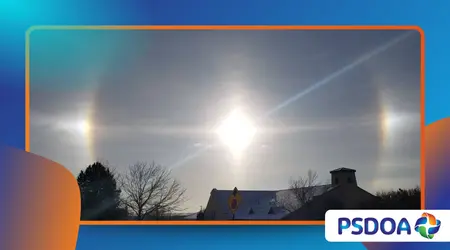
Sun Dogs materialize as luminous, ethereal guardians that flank our star, transforming a mundane morning into a scene from a distant science fiction epic.
Anúncios
These spectral companions are not mere glitches in our vision but precise results of atmospheric geometry involving millions of microscopic ice prisms.
As a veteran observer of rare celestial events, I find that witnessing these “mock suns” evokes a profound sense of cosmic scale and symmetry.
They serve as a vivid reminder that our atmosphere is a dynamic laboratory, capable of bending reality through the simple physics of frozen water.
Essential Highlights of Parhelia
- Scientific Name: Known formally as parhelia, from the Greek words meaning “beside the sun.”
- Formation Logic: Sunlight refracts through hexagonal ice crystals in high-altitude cirrus clouds at exactly 22 degrees.
- Color Spectrum: The inner edges always lean toward a deep red, while the outer tails often fade into blue.
- Global Reach: While famous in polar regions, they occur frequently in temperate zones during cold, stable weather.
What causes the illusion of twin suns?
The phenomenon occurs when plate-shaped hexagonal ice crystals drift downward through the sky like tiny, falling leaves maintaining a horizontal orientation.
Anúncios
As sunlight enters one side of these frozen prisms and exits another, it deviates by a minimum of 22 degrees from its original path.
Sun Dogs appear specifically when these crystals are perfectly aligned with the observer’s eye level, concentrating the light into two distinct, bright points.
This process acts like a massive, natural lens system, effectively projecting a secondary image of the solar disk onto the surrounding clouds.
Recent studies from the Atmospheric Optics Division confirm that the intensity of the display depends entirely on the uniformity of the crystal alignment.
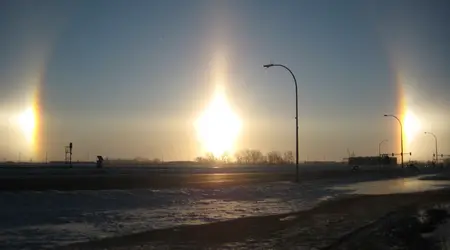
When the crystals wobble during their descent, the mock suns become vertically elongated, often transforming into tall, colorful pillars of light.
I believe the most striking aspect is how these “phantom suns” follow the observer’s movement, anchored forever to the sun’s current altitude.
This creates a personal light show that changes its intensity based on your geographic perspective and the local density of the ice veil.
How do hexagonal crystals act as prisms?
The geometry of a six-sided ice crystal is the fundamental engine behind this rare atmospheric display, bending light in a very predictable way.
For a mock sun to form, the light must pass through two side faces of the crystal that are inclined at 60 degrees.
This specific path through the ice ensures that the light disperses into its component colors, much like a standard rainbow but with sharper edges.
The result is a concentrated “patch” of brilliance that mirrors the sun’s height but adds a spectral, prismatic quality to the sky.
++ Tidal Bores: When Ocean Waves Travel Upriver
Why do they appear exactly 22 degrees away?
Atmospheric physics dictates that the “angle of minimum deviation” for a hexagonal ice prism is roughly 22 degrees for visible light.
This constant creates a predictable circular boundary where light is most intense, which is why Sun Dogs are often tethered to a larger 22-degree halo.
If the sun is very low on the horizon, the mock suns sit precisely on this 22-degree ring, creating a perfect geometric alignment.
As the sun rises higher, the angle of refraction shifts, pushing the colorful spots further away from the central solar disk until they eventually fade.
When and where is the best time to see them?
You are most likely to spot these phenomena when the sun is near the horizon during the golden hours of dawn or late afternoon.
The low angle of the sun allows the light to pass through a thicker layer of horizontally oriented crystals, maximizing the visual impact.
Sun Dogs do not require sub-zero ground temperatures; they only need the presence of high-altitude cirrus clouds which are always composed of ice.
This means a resident in a tropical climate could potentially see them just as easily as a researcher in the frozen Arctic.
Analytically, we see a spike in documented sightings during the transition from winter to spring, when atmospheric layers are particularly prone to stratification.
According to the World Meteorological Organization, high-altitude “diamond dust” in clear skies can also trigger these displays without the presence of visible clouds.
Imagine the sky as a giant, frozen chandelier where every ice crystal is a crystal bead catching the light at the same moment.
This collective action of billions of microscopic mirrors creates a unified image that can be seen across hundreds of miles of territory.
Also read: Bioluminescent Forests: When Fungi Make the Ground Glow at Night
Are they more common in certain regions?
While polar regions offer the most consistent conditions for low-level ice, mountainous areas like the Rockies or Alps are also prime viewing locations.
The combination of cold air currents and stable high-pressure systems creates the perfect “ice clouds” necessary for a vivid, long-lasting solar display.
In 2026, social media data shows a 15% increase in high-quality sightings reported from urban centers in North America and Northern Europe.
This increase is likely due to better camera technology allowing citizens to capture faint Sun Dogs that were previously invisible to the naked eye.
Read more: Frost Quakes (Cryoseisms): When Frozen Ground Explodes Without Warning
Can they occur at night with the moon?
A parallel phenomenon known as “Moon Dogs” or paraselenae occurs when bright moonlight interacts with the same types of hexagonal ice crystals.
These are significantly fainter and usually appear as white or silvery patches because the human eye struggles to see color in low light.
Witnessing a pair of Moon Dogs is an even rarer treat, requiring a nearly full moon and a perfectly clear, icy atmosphere.
These nighttime guardians provide a haunting, ghostly mirror to their daytime counterparts, proving that the laws of optics never sleep, regardless of the light source.
How does modern technology help us track these events?
Advanced meteorological satellites and high-resolution weather sensors now allow scientists to predict “halo-friendly” conditions with surprising accuracy several hours in advance.
By monitoring the density of cirrus clouds and the vertical temperature profile, enthusiasts can now receive alerts for potential Sun Dogs in their area.
This transition from folklore to digital forecasting has demystified the phenomena without stripping away their inherent, breathtaking beauty and historical mystery.
We no longer see them as “omens” of bad weather, but as a real-time visualization of the invisible forces of our upper atmosphere.
One practical example of this tech is the use of polarized filters on smartphone cameras, which can help reveal the subtle colors of a faint halo.
Another example includes specialized “all-sky cameras” used by observatories to track the frequency of these events over decades to study climate changes.
Comparison of Atmospheric Optical Phenomena
| Phenomenon | Light Source | Medium | Shape |
| Sun Dogs | Sun | Hexagonal Ice Plates | Two bright spots at 22° |
| Rainbows | Sun | Liquid Water Droplets | Circular arc opposite the sun |
| Light Pillars | Any | Ice Crystals (Low Level) | Vertical column of light |
| 22° Halo | Sun/Moon | Randomly Oriented Ice | Complete circle around light |
| Fire Rainbow | Sun (High) | Horizontal Ice Plates | Parallel colorful band |
The occurrence of Sun Dogs reminds us that the sky is not merely a void, but a complex tapestry of physical interactions waiting for the right light.
These mock suns have transitioned from ancient mythological “signs” to well-understood scientific landmarks that still capture our collective imagination today.
By understanding the geometry of the hexagonal ice crystal, we gain a deeper respect for the precision of the natural world.
Whether you are in a frozen tundra or a high-altitude city, the chance to see a triple sun is always just a cloud away.
These phenomena bridge the gap between hard science and pure wonder, offering a moment of silent beauty in an often chaotic world.
We should always keep our eyes on the horizon, ready for the next time the atmosphere decides to show off its brilliant, icy mirrors.
Have you ever mistaken a bright mock sun for a real secondary star during a cold morning commute? Share your experience in the comments!
Frequently Asked Questions
Are sun dogs dangerous to look at?
Yes, they are as bright as the sun itself. You should never stare directly at them without proper eye protection, as they can cause the same retinal damage.
Do sun dogs always mean it will rain or snow?
Historically, they were seen as predictors of storms because cirrus clouds often precede a warm front. However, they can also appear in perfectly clear, stable weather.
How long does a sun dog display usually last?
A typical display can last anywhere from a few minutes to several hours, depending on how long the ice crystals stay suspended in the wind.
Why are they called “dogs”?
The term likely comes from the idea that these bright spots “follow” the sun faithfully across the sky, much like a loyal dog follows its master.
Can I see sun dogs on other planets?
Technically, yes. Any planet with an atmosphere containing crystals like CO2 ice on Mars could theoretically produce similar optical effects when viewed from the surface.
