
The Bizarre Science Behind Negative Mass
Bizarre Science Behind Negative Mass challenges everything we know about matter, inertia, and gravity.
Anúncios
Recent theoretical physics breakthroughs and exotic matter proposals revive this strange idea but is it more than fancy math?
Curiosity about negative mass arises from attempts to explain dark matter, dark energy, or hypothetical spacetime geometries.
Some recent peer-reviewed works explore whether negative mass might emerge under extreme conditions of general relativity.
What is “negative mass” and how does it arise in theory?
What do physicists mean by “negative mass”?
In theoretical physics “negative mass” describes matter whose mass value is the negative of normal mass. Such matter would respond oppositely to forces: pushing it makes it accelerate toward the force.
Anúncios
General-relativity models show that under certain exotic stress-energy configurations violating standard energy conditions negative mass can mathematically appear.
++ Space-Time Cloaking: How Scientists Are Trying to Hide Events in Time
Are there recent theoretical models supporting negative mass?
A 2024 study demonstrated emergence of negative ADM mass within a wormhole solution combining “phantom” fields and nonlinear electromagnetism.
Another peer-reviewed paper published in 2024 argued that stable negative-mass stars are dynamically unstable under realistic conditions challenging their physical feasibility.
These diverging results show that negative mass remains speculative mathematically allowed, but physically unconstrained.
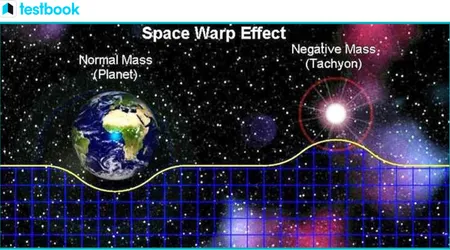
What bizarre behaviours would negative mass produce?
How does negative mass behave under force and gravity?
If you apply a push to a negative-mass object, it accelerates toward you rather than away. That flips conventional Newtonian intuition.
In gravitational contexts, a positive-mass object attracts negative-mass, while negative-mass repels everything. That could mean runaway motion: the negative mass chasing positive matter.
Also read: The Truth About Hypersonic Weapons and Plasma Shielding
What exotic physics might emerge from wormholes to “dark fluids”?
Some speculative cosmologies propose that a pervasive negative-mass “fluid” might underlie dark energy, driving cosmic repulsion and accelerated expansion.
If realized, negative mass might enable exotic phenomena: stable wormholes, warp-drive–like spacetime shortcuts, or repulsive gravity zones. However, all such notions remain purely theoretical.
Read more: How Synthetic Biology Is Creating New Life Forms
Could any experiments or observations hint at negative mass?
Have scientists ever created something like negative mass?
In 2017 Washington State University experiments produced a quantum fluid (in a Bose–Einstein condensate) behaving as if it had “negative effective mass.”
Under applied force, atoms accelerated oppositely.
Yet that “negative mass” is effective a property of the fluid’s internal quantum state not genuine gravitational negative mass. Thus, this does not validate negative-mass matter in spacetime.
Is there observational or cosmological evidence for negative mass?
So far, no astronomical observation confirms true negative-mass bodies or regions. All known masses remain positive under measurement.
Recent foundational work even shows that many theoretical negative-mass “stars” are dynamically unstable, disappearing quickly under small perturbations
Thus negative mass remains a mathematical curiosity, not an empirical reality.
Why do some scientists still take the Bizarre Science Behind Negative Mass seriously?
Because it might provide unified explanations for dark phenomena
Some cosmological frameworks propose negative-mass fluids to unify dark matter and dark energy effects offering explanations for galactic rotation curves and universal expansion.
If such matter existed, it could rewrite our understanding of cosmic structure, gravity, and spacetime a transformative possibility for theoretical physics and cosmology.
Because mathematics allows it though physics resists
General relativity’s equations admit negative mass under non-standard stress-energy conditions. That mathematical permissibility invites exploration.
But physics imposes reality checks: energy conditions, stability analyses, and observational constraints. Recent results (2024–2025) warn that negative-mass stars likely collapse or vanish, casting doubt on any persistent negative-mass matter.
Table: Hypothetical Negative Mass vs Regular Positive Mass Key Differences
| Property / Behavior | Regular Positive Mass | Hypothetical Negative Mass |
|---|---|---|
| Response to applied force | Accelerates in direction of force | Accelerates opposite direction of force |
| Gravitational interaction with positive mass | Mutual attraction | Positive mass repelled by negative mass; negative mass attracted to positive mass |
| Stability under small perturbations (star models) | Stable, long-lived | Theoretically unstable, likely collapsing or dissipating |
| Role in cosmology (dark energy / dark matter) | N/A | Proposed negative-mass “fluid” could mimic dark effects no observational confirmation |
| Experimental realization | Real objects, particles, planets, etc. | Only “effective” negative mass in quantum fluids; no gravitational negative mass yet |
Statistic of note: A 2024 analysis concluded that none of the negative-mass “star” models remain stable underscoring how fiercely physics resists negative mass as a realistic ingredient.
What are the major challenges preventing negative mass from becoming physical reality?
Stability and energy-condition violations
Negative mass requires violating standard energy conditions (like the Null Energy Condition). That generally leads to runaway instabilities or non-physical outcomes.
Recent rigorous work shows any barotropic negative-mass star collapses or rapidly destabilizes meaning even if created, such matter likely vanishes.
Lack of gravitational evidence or detection
If negative mass existed in cosmic abundance, we’d expect unusual gravitational signatures repulsive zones, anomalous motion, or missing mass effects inconsistent with dark-matter models.
None observed. Moreover, quantum-fluid analogues (like in BECs) show only effective negative mass; they do not gravitate negatively in normal spacetime.
That keeps them in the realm of exotic lab phenomena.
What practical or philosophical implications does the Bizarre Science Behind Negative Mass hold even as a thought experiment?
It pushes boundaries of physics and encourages theoretical creativity
Exploring negative mass motivates physicists to challenge assumptions, probe energy conditions, and refine general relativity.
That intellectual stretch yields deeper understanding of what physics allows even if not realized.
Analogous to mental experiments that helped develop quantum mechanics, negative-mass hypotheses can spark new ideas possibly leading to breakthroughs in quantum gravity or novel matter-energy concepts.
It influences science fiction, speculative cosmology and public imagination
Negative mass remains a staple in sci-fi from warp drives to wormholes. Its mathematical plausibility lends weight to imaginative stories.
For example, one could imagine a “negative-mass capsule” spacecraft that repels normal matter, offering propulsion without reaction mass a metaphor akin to a balloon pushing against air instead of pulling.
This analogy helps illustrate the strange physics. Though likely not physical, such ideas challenge how we think about mass, energy, space and time.
Conclusion Where does science stand, and why negative mass stays on the fringes?
The Bizarre Science Behind Negative Mass remains a compelling theoretical puzzle. Mathematics allows negative mass, and recent studies explore its properties under extreme conditions.
Yet persistent obstacles instability, violation of energy conditions, and lack of empirical evidence keep it hypothetical.
Until concrete detection or stable generation occurs, negative mass remains speculative. Nevertheless, investigating it deepens physics, sharpens cosmological models, and invites imagining radically different universes.
Do you find the idea terrifying or liberating? This question propels scientific curiosity. Share your thoughts in the comments: could negative mass ever move from math to reality?
Frequently Asked Questions
Has any object with real negative mass ever been observed?
No. All observed masses remain positive. Negative-mass proposals remain theoretical or effective (in quantum fluids).
Does the “negative mass” in lab Bose–Einstein condensates count as true negative mass?
No. Those systems exhibit “effective mass” referring to quantum behaviour under applied force, not real gravitational negative mass.
Could negative mass explain dark energy or dark matter?
Some speculative models propose a negative-mass fluid to unify dark energy and dark matter phenomena but none achieved empirical support.
What stops negative mass from being stable in our universe?
Violations of energy conditions and instability under small perturbations. Studies published in 2024 show negative-mass stars likely collapse or destabilize quickly.
Why do some physicists still research negative mass despite huge obstacles?
Because it tests the limits of gravity theory, challenges hidden assumptions, and might inspire breakthroughs in cosmology or quantum gravity.
