
The Flying Platforms of the Cold War Era
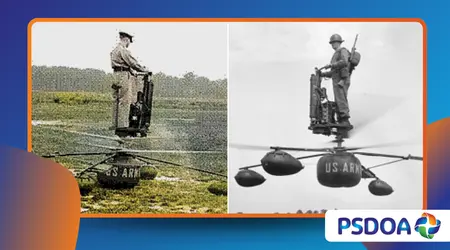
Flying Platforms of the Cold War Era represent a fascinating chapter where military ambition met the surreal aesthetics of mid-century science fiction.
Anúncios
These personal aviation devices promised to turn every soldier into a sky-borne scout, bypassing the mud and mines of traditional battlefields.
Engineers during this era believed that individual flight would redefine infantry mobility forever.
They poured millions into strange, circular vessels that looked more like kitchen appliances than cutting-edge tactical aircraft intended for the nuclear age.
What Were These Radical Flying Disc Machines?
The Hiller VZ-1 Pawnee stands as the most iconic example of the Flying Platforms of the Cold War Era.
Anúncios
This machine utilized two counter-rotating propellers housed within a circular duct, allowing a pilot to stand atop the humming engine.
Directing the craft required no complex joysticks or computers; the pilot simply leaned in the desired direction.
This kinesthetic control system aimed to make flying as intuitive as walking, reducing the heavy burden of pilot training.
How Did Kinetic Control Systems Function?
Engineers designed the VZ-1 to respond to the pilot’s center of gravity. By shifting their weight, the operator tilted the ducted fan, changing the thrust vector and propelling the platform across the landscape.
Initially, the military hoped this simplicity would allow any infantryman to take flight with minimal instruction.
However, the physical toll on the pilot’s legs and the difficulty of maintaining balance in wind soon became apparent.
++ Forgotten World Fairs That Showcased Now-Lost Tech
Why Did the Ducted Fan Design Fail?
Despite the sleek look, the aerodynamic “shroud” around the propellers created massive drag at higher speeds.
This limited the Flying Platforms of the Cold War Era to a meager top speed of about 16 miles per hour.
Small gusts of wind could easily tip the platform over, making it a dangerous liability rather than a tactical asset.
Soldiers found themselves more focused on not falling off than observing the enemy movements below them.
Also read: How 1950s Concept Cars Predicted Autonomous Driving
What Role Did the De Lackner HZ-1 Play?
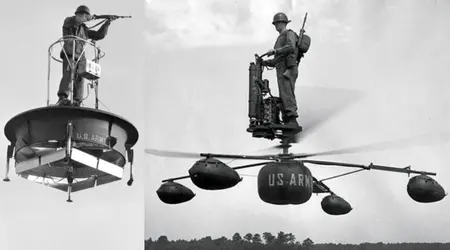
While Hiller focused on ducted fans, the De Lackner HZ-1 Aerocycle took a much more terrifying approach to flight.
It featured exposed, chin-high rotors spinning directly beneath the platform where the soldier stood, earning it a lethal reputation.
Testing showed that even a small pebble kicked up by the rotors could cause a catastrophic crash.
This “flying lawnmower” emphasized the era’s willingness to risk life for the sake of radical technological supremacy.
Read more: Forgotten Subterranean Cities Designed as War Shelters
Were These Platforms Ever Considered for Combat?
The U.S. Army initially ordered several prototypes of the Flying Platforms of the Cold War Era for reconnaissance missions.
They envisioned scouts hovering over hills to spot Soviet tank divisions without the need for large, vulnerable helicopters.
Planners eventually realized that a slow-moving soldier standing on a loud, vibrating platform was essentially a “sitting duck.”
The lack of armor and low altitude made these machines easy targets for even basic small arms fire.
Why Did the Military Abandon Personal Flight Discs?
Logistical nightmares and the rise of more versatile light helicopters eventually killed the dream of the Flying Platforms of the Cold War Era.
Maintaining hundreds of small, specialized engines across a front line proved far too expensive and complex.
As the 1960s progressed, the Pentagon shifted funding toward the Bell UH-1 Iroquois, which could carry squads rather than individuals.
The personal platform became a relic of an era that prioritized individual gimmickry over collective tactical efficiency.
What Was the Impact of Helicopter Evolution?
Rapid advancements in turbine engines allowed helicopters to become faster, more reliable, and capable of carrying heavy weapons.
This rendered the limited range and payload of the Flying Platforms of the Cold War Era obsolete within a decade.
The military decided that a single pilot moving ten men was more efficient than ten men trying to fly themselves.
Tactical doctrine moved toward air assault groups, leaving the lonely platform pilot in the dustbin of history.
How Did Stability Issues Plague the Prototypes?
Every flight of a Pawnee or Aerocycle was a battle against physics known as “aerodynamic instability.”
The higher the platform flew, the harder it became to control, often resulting in “ground effect” accidents during landing.
Research from the National Air and Space Museum confirms that the Hiller VZ-1 only reached a maximum altitude of about 33 feet.
This height was too low to avoid obstacles but too high for a safe fall during an engine failure.
What Can We Learn from the $7 Million Failure?
According to historical budget records, the U.S. government spent nearly $7 million (unadjusted for inflation) on various personal flight projects during the 1950s.
This highlights the intense desperation to find an unconventional edge during the height of the Cold War.
This massive investment yielded no operational aircraft but did advance our understanding of ducted fan aerodynamics.
Modern drones and VTOL aircraft owe their stability algorithms to the failures of these early, human-operated pioneers.
Is the Flying Platform Like a Segway in the Sky?
A flying platform is essentially a Segway with rotors; it promises revolutionary mobility but lacks the practicality for everyday use.
Just as the Segway struggled with urban terrain, the platform struggled with the chaotic environment of the open sky.
Both inventions assumed that intuitive control would overcome the need for structural safety and environmental protection.
In the end, they both remained niche curiosities rather than the “transportation of the future” they promised to be.
Do Modern eVTOLs Owe Their Existence to the Cold War?
Today’s burgeoning industry of electric vertical take-off and landing (eVTOL) vehicles is a direct spiritual successor to the Flying Platforms of the Cold War Era.
We are finally using computers to solve the stability problems that haunted Hiller’s pilots.
The core idea vertical lift for individual or small-group transport remains one of the most persistent goals in aerospace.
We are simply replacing the dangerous “lean-to-steer” method with sophisticated flight control software and redundant electric motors.
Why is Software the Missing Link for Personal Flight?
The pilots of the Flying Platforms of the Cold War Era had to manually balance the craft with their own muscles and inner ear.
Modern drones use gyroscopes and sensors to make thousands of tiny adjustments every second to stay level.
Technology has finally caught up to the visionary dreams of the 1950s, allowing for safe, stable personal flight. The “platform” has evolved into a cockpit, but the dream of hovering over the world remains identical.
How Does the Jetpack Compare to the Platform?
While the Bell Rocket Belt captured the public’s imagination, it offered only 21 seconds of flight, whereas the platforms could hover for nearly 45 minutes.
The Flying Platforms of the Cold War Era were actually far more practical, despite their awkward appearance.
The platform offered a stable base for observation that a jetpack simply couldn’t match. This distinction shows that engineers were thinking about utility, even if the execution was limited by the hardware of the time.
What is an Original Example of Modern Usage?
Consider the “Flyboard Air,” which recently crossed the English Channel, as the modern reincarnation of the Hiller Pawnee.
It uses miniature jet engines and a standing platform to achieve exactly what the Army wanted in 1955. The main difference is the power-to-weight ratio and the digital brain that keeps the pilot upright.
This contemporary example proves that the Flying Platforms of the Cold War Era were just 70 years ahead of their time.
Why Does the Public Remain Obsessed with These Designs?
We look at these machines today and see a “lost future” where the sky was as accessible as the sidewalk.
The Flying Platforms of the Cold War Era symbolize a time when anything seemed possible through the power of the internal combustion engine.
They remind us that progress isn’t always a straight line; sometimes we have to abandon an idea for decades before it becomes viable.
Is it possible that we are only now entering the true “age of the platform”?
Comparison of Cold War Personal Flight Prototypes
| Model | Lift Mechanism | Max Speed | Status | Primary Danger |
| Hiller VZ-1 Pawnee | Ducted Fans | 16 mph | Museum Piece | Aerodynamic Drag / Tip-over |
| De Lackner HZ-1 | Exposed Rotors | 75 mph | Cancelled | Blade-to-Object Contact |
| Bell Rocket Belt | Hydrogen Peroxide | 60 mph | Exhibition | 21-second Fuel Limit |
| Bensen B-8M | Gyrocopter | 85 mph | Niche / Hobby | Unpowered Descent |
| Modern eVTOL | Multi-Rotor Electric | 150+ mph | Testing (2026) | Battery Density Limits |
In conclusion, the Flying Platforms of the Cold War Era were bold, dangerous, and ultimately visionary failures that paved the way for modern drones.
They represent the peak of Cold War ingenuity, proving that the military was willing to explore every possible avenue to gain a tactical advantage.
While they never saw combat, their influence on vertical lift technology remains a cornerstone of aerospace history.
These machines serve as a reminder that the “forgotten” ideas of the past often provide the blueprints for the revolutions of tomorrow.
Would you have been brave enough to stand on a pair of spinning blades in the name of science? Share your experience in the comments!
Frequently Asked Questions
Why didn’t they put a cage around the De Lackner rotors?
Adding a cage would have increased the weight significantly, making it impossible for the small engine to lift the soldier.
The Flying Platforms of the Cold War Era were always a desperate struggle between lift capacity and safety.
Are any of these platforms still flyable today?
Most are strictly museum exhibits, such as those at the Smithsonian. Restoring one to flight status would be incredibly dangerous due to the fatigue of the 70-year-old metal and the inherent instability of the design.
Did the Soviet Union have similar flying platforms?
Yes, the USSR experimented with various “flying jeep” and platform concepts, but they faced the same stability and power-to-weight issues as the Americans. Most Soviet records from these niche projects remain classified or lost.
Could a modern electric motor make the Pawnee work?
Absolutely. Modern high-torque electric motors combined with lithium batteries and flight controllers would make the Flying Platforms of the Cold War Era extremely stable and much faster than the original gas versions.
What killed the pilot’s interest in the HZ-1?
Two major crashes during testing where the rotors Intermeshed and shattered proved the design was fundamentally flawed.
The test pilots, despite being some of the best in the world, could not overcome the mechanical risks.
