
Time Dilation in Real Life: What Happens to Astronauts?
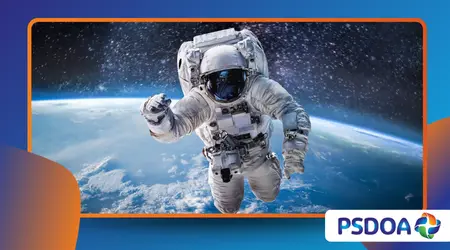
Time Dilation in Real Life is no longer a mere plot device for Hollywood blockbusters; it is a measurable reality for those orbiting our planet.
Anúncios
As we push further into the cosmos in 2025, understanding how Einstein’s relativity affects the human body becomes vital for long-term space exploration.
Astronauts living aboard the International Space Station (ISS) experience time differently than we do on Earth.
While the differences are infinitesimal, they prove that time is not a universal constant but a flexible fabric influenced by speed and gravity.
What is the Science Behind Time Dilation in Space?
The phenomenon of Time Dilation in Real Life occurs due to two distinct physical effects: velocity and gravity.
Anúncios
According to Special Relativity, as an object moves faster, time for that object slows down relative to a stationary observer.
Simultaneously, General Relativity dictates that gravity also warps time. Stronger gravitational fields slow time down.
In orbit, these two forces engage in a tug-of-war, with velocity currently winning for our astronauts on the ISS.
How Does Velocity Affect an Astronaut’s Age?
Astronauts on the ISS travel at roughly 27,600 kilometers per hour. At this incredible speed, they experience “kinematic time dilation,” which causes their internal clocks to tick slightly slower than clocks on the ground.
Because they move so fast, they return to Earth having aged a fraction of a second less than their twin siblings. It is a literal, albeit tiny, leap into the future that happens every single day they remain in orbit.
++ How Ant Colonies Mimic Human Traffic Systems
Why Does Earth’s Gravity Play a Role in Time?
General Relativity suggests that being further from a massive object like Earth makes time move faster. Since astronauts are 400 kilometers above us, Earth’s gravitational pull is slightly weaker for them than for us.
This gravitational effect actually speeds their time up. However, the slowing effect of their high velocity is stronger, meaning the net result is that they age slightly slower than we do.
Also read: The Bizarre Science Behind Negative Mass
What is the Famous “Twin Paradox” in Real Life?
The most striking example of Time Dilation in Real Life involves retired NASA astronauts Scott and Mark Kelly. Scott spent nearly a year in space while his identical twin, Mark, remained on the surface.
Upon Scott’s return, the age gap between them had widened by approximately 5 milliseconds. While they remain twins, Scott is now technically younger than he would have been had he never left the Earth’s atmosphere.
Read more: Space-Time Cloaking: How Scientists Are Trying to Hide Events in Time
How Does This Affect Deep Space Missions to Mars?
As we plan missions to Mars, the effects of Time Dilation in Real Life will become even more pronounced. A three-year round trip would result in a noticeable discrepancy between the spacecraft’s clock and Mission Control.
Navigating these differences requires incredibly precise atomic clocks. Without accounting for relativity, deep-space navigation would fail, as even a microsecond error can lead to a ship missing its planetary target by kilometers.

Why Must Our Global Technology Account for Relativity?
You might think Time Dilation in Real Life only matters to scientists, but it actually affects your daily commute. Our Global Positioning System (GPS) satellites are constantly moving and sitting in a different gravitational well.
Without relativistic corrections, the GPS on your phone would lose accuracy within minutes. This proves that Einstein’s theories are not just “ivory tower” concepts but essential components of our modern, interconnected infrastructure.
How Do GPS Satellites Use Einstein’s Theories?
GPS satellites orbit Earth at high speeds and at high altitudes. Because of their speed, their clocks lose 7 microseconds a day; because of the weaker gravity, they gain 45 microseconds.
Engineers must program the clocks to subtract the difference about 38 microseconds daily. If they didn’t, the location data on your smartphone would drift by more than 10 kilometers every single day.
What Happens if We Ignore Relativistic Corrections?
Ignoring Time Dilation in Real Life would cause a catastrophic failure in global logistics.
From autonomous vehicles to synchronized banking transactions, the world relies on the precise timing provided by satellites that “live” in a different timeframe.
Our technology must literally “predict” the future to stay in sync with our present. It is a delicate balance of physics and engineering that keeps our 21st-century world running smoothly and accurately.
What is the Role of Atomic Clocks in Measuring Dilation?
Scientists use atomic clocks, which measure the vibrations of atoms, to detect the tiniest shifts in time. These clocks are so precise they won’t lose a second in billions of years of operation.
By placing one clock at sea level and another on a mountain, researchers have proven Time Dilation in Real Life exists even on Earth. This high-precision data allows us to map the invisible contours of gravity’s effect on time.
How Does This Influence Future Spacecraft Communication?
Future interstellar communication will require “Time-Sync” protocols that can handle massive relativistic shifts. If a ship travels at a significant fraction of light speed, messages could arrive “out of order” without these corrections.
Developing these protocols is a major focus for space agencies today. We are building a communication network that must be resilient enough to bridge different temporal realities across the vastness of the solar system.
Can Humans Perceive the Effects of Time Dilation?
One might wonder if an astronaut “feels” time slowing down while they are in orbit. The answer is a definitive no; to the astronaut, their own time feels perfectly normal and consistent.
Relativity is always a comparison between two observers. This raises a profound question: If time is different for everyone depending on their movement, does a “universal now” even exist?
What is the “Time Dilation” Analogy?
Think of time as a moving walkway at an airport. If you walk on the walkway (moving through space), you reach the end (the future) faster than someone standing still on the carpet.
To you, your walking pace feels the same as always. However, to the person standing on the carpet, you are moving at an accelerated rate relative to the destination. This is how Time Dilation in Real Life functions.
How Does Space Travel Impact the Human Biological Clock?
While physics slows down the clock, the biological stress of space travel can actually accelerate cellular aging. Microgravity and radiation exposure are harsh realities that NASA monitors closely to protect our explorers.
The Kelly twin study showed changes in Scott’s telomeres the caps on our DNA. Paradoxically, while his “physical time” slowed down, his body showed signs of stress that scientists are still working to fully understand.
What Statistic Proves the Precision of Relativistic Effects?
Research published in Nature confirmed that atomic clocks can detect time dilation over a distance of just one millimeter. This incredible measurement shows that time moves slower at your feet than at your head.
This minute difference is a constant part of Time Dilation in Real Life. It proves that every living being on Earth is technically a “time traveler,” experiencing a slightly different flow of reality based on their height.
Why is This Discovery Significant for Our Evolution?
Understanding time’s flexibility changes our fundamental perception of the universe. It suggests that our common-sense view of a rigid, ticking clock is merely a local illusion caused by our slow speeds and Earth’s gravity.
As we become a multi-planetary species, this knowledge will guide how we build societies on Mars or the Moon. We are learning to live within a universe where time is a personal journey, not a shared prison.
Time Dilation Impact – ISS vs. Earth (2025 Estimates)
| Factor | ISS Astronaut (400km Altitude) | Earth Observer (Sea Level) | Resulting Effect |
| Velocity (Speed) | 27,600 km/h | 1,600 km/h (Rotation) | Astronaut time slows (Kinematic) |
| Gravitational Force | ~90% of Earth’s Gravity | 100% Gravity | Astronaut time speeds up (Gravitational) |
| Net Daily Change | -38 Microseconds | Baseline | Astronaut returns slightly younger |
| Clock Accuracy | Atomic / Relativistic Adjusted | Standard Quartz / Digital | Satellite Sync requires daily correction |
| Biological Impact | DNA/Telomere Stress | Standard Aging | Physics ages slower; Biology ages faster |
In conclusion, Time Dilation in Real Life is a foundational truth of our universe that impacts everything from the GPS in your pocket to the health of our bravest explorers.
While the milliseconds gained by astronauts seem small, they represent a massive leap in our understanding of physics.
As we venture toward the stars, we must respect the elastic nature of time and the profound ways gravity and speed shape our existence. The clock is not just a tool; it is a variable in the grandest equation of all.
We are entering an era where “when” you are is just as important as “where” you are.
Have you ever wondered how your own life would change if you lived in a place where time moved significantly slower? Share your thoughts and questions in the comments below!
Frequently Asked Questions
Does time dilation happen on airplanes?
Yes, but the effect is even smaller than on the ISS. Passengers on a long-haul flight age about a billionth of a second less than people on the ground. It is real, but it has zero impact on your lifespan.
Why do we call it “dilation”?
In physics, “to dilate” means to become wider or larger. When time “dilates,” a second becomes “wider” or longer relative to another observer. Essentially, one person’s “second” lasts longer than another person’s.
Could we use Time Dilation in Real Life to travel to the future?
Mathematically, yes. If we could build a ship that travels near the speed of light, you could go on a five-year journey and return to an Earth that has aged hundreds of years.
However, we currently lack the technology to reach such speeds.
Does time dilation affect your thoughts?
No. Your brain functions at the same rate relative to the clock in your immediate vicinity. You wouldn’t think “slower” or feel like the world is moving in slow motion; everything in your local environment stays in sync.
Is time dilation the same as time travel?
It is a form of “one-way” time travel to the future. You are moving forward through time at a different rate than someone else. However, current physics offers no way to use dilation to go backward in time.
