
Vacuum-Powered Elevators: Why They Didn’t Take Off
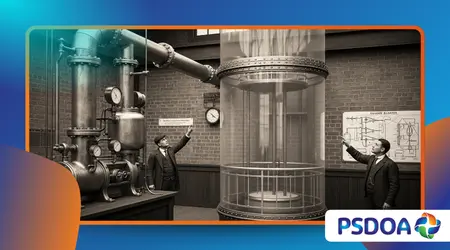
Vacuum-Powered Elevators represent a fascinating chapter in architectural history where the dream of futuristic, cable-free movement met the harsh reality of physics.
Anúncios
For decades, visionaries argued that moving humans through tubes using air pressure would revolutionize our homes, yet these devices remain a rare novelty in 2026.
Despite their sleek, sci-fi aesthetic, the global market has largely stuck with traditional traction and hydraulic systems for most residential and commercial projects.
Understanding why this pneumatic revolution stalled requires a deep dive into the engineering trade-offs and the economic barriers that eventually grounded these ambitious lifts.
The Physics of Ascent
- The Suction Principle: How air pressure differentials create the lifting force needed for vertical transport.
- Space Efficiency: The advantages of a self-supporting structure that requires no pit or machine room.
- Maintenance Realities: Examining the wear and tear on specialized seals and the noise profile of high-powered turbines.
- Market Adoption: Why the construction industry favors standardized, high-capacity cable systems over individual pneumatic units.
How does the mechanism of a pneumatic lift work?
A typical Vacuum-Powered Elevators system relies on a high-powered turbine at the top of a cylindrical shaft to remove air.
Anúncios
By creating a vacuum above the cab, the higher atmospheric pressure underneath pushes the passenger up, resembling a giant, vertical drinking straw.
To descend, the system slowly releases air back into the upper chamber, allowing gravity to lower the cab with controlled, smooth precision.
This elegant simplicity eliminates the need for heavy steel cables, counterweights, and the massive pulley systems found in skyscrapers.
What are the main technical limitations?
The most significant hurdle is the weight-to-pressure ratio, which restricts the cab’s size and the number of passengers it can carry.
Since the lift depends entirely on air pressure, making a cab larger requires exponentially more power to maintain the necessary vacuum seal.
Seal integrity is another constant battle for engineers, as even a minor air leak can cause jerky movements or complete system stalls.
If the specialized gaskets fail, the physics of the entire unit collapse, making long-term reliability more expensive than traditional alternatives.
++ The Mechanical Voting Machines That Were More Secure Than Digital Ones
Why is noise a major concern for owners?
Pneumatic turbines generate a loud, high-pitched whine that can be disruptive in a quiet residential setting without extensive and costly soundproofing.
Imagine running a commercial-grade industrial vacuum cleaner in your living room every time you want to change floors; it quickly loses its futuristic charm.
Manufacturers have attempted to solve this by installing the pump units on rooftops or in remote closets using specialized air ducts.
However, these modifications add complexity and cost, erasing the “simple installation” benefit that originally attracted buyers to the technology.
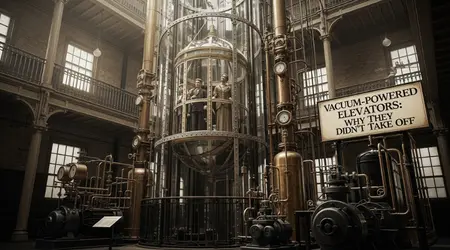
Why did these elevators fail to dominate the market?
The primary reason Vacuum-Powered Elevators didn’t take off is their inability to scale effectively for the massive height of modern buildings.
Physics dictates that the air column becomes too heavy and the vacuum too difficult to maintain beyond a few stories of travel.
Traditional cable elevators easily reach hundreds of floors because steel strength scales better than atmospheric pressure differentials ever could in a shaft.
Consequently, pneumatic lifts became trapped in a niche market for two-story homes, failing to capture the lucrative commercial high-rise sector.
Also read: The Steam Cannon: Why It Was Abandoned by Militaries
How did installation costs affect adoption?
While they don’t require a pit, the specialized transparent polycarbonate cylinders are remarkably expensive to manufacture and transport compared to standard metal parts.
The “cool factor” of a panoramic view often comes with a price tag double that of a basic residential hydraulic lift.
Maintenance also requires specialized technicians who understand pneumatic seals and turbine calibration, rather than standard elevator mechanics who are widely available.
This scarcity of service professionals makes long-term ownership a risky gamble for most homeowners and small business managers.
Read more: The Great Forgotten Plan for Bicycle Highways
What role did safety perceptions play?
Passengers often feel uneasy in a cab held up by “nothing” but air, despite the presence of mechanical safety brakes for emergencies.
The psychological comfort of seeing a thick steel cable provides a sense of security that a clear plastic tube simply cannot match.
While modern units are incredibly safe and will slowly descend during power failures, the lack of a “physical” tether remains a barrier.
In the conservative world of construction, tried-and-true mechanical systems always win over unproven, invisible forces when human lives are involved.
What is the future of air-pressure transport in 2026?
Current trends suggest that Vacuum-Powered Elevators are evolving into specialized tools for retrofitting historic buildings where digging a pit is legally impossible.
They serve a vital purpose in preserving architecture while providing much-needed accessibility for elderly residents in older European and North American cities.
Innovations in carbon-seal technology and quieter brushless motors are slowly making these units more palatable for the high-end luxury market.
However, they remain a secondary choice, a “boutique” solution rather than the new standard for the general public or urban developers.
Can magnetic levitation replace pneumatic power?
New systems like the “MULTI” elevator use magnets to move cabs horizontally and vertically, offering the same cable-free benefits without the noise.
Maglev technology handles much heavier loads and reaches greater heights, making it the more likely successor to the traditional cable-and-pulley model.
The pneumatic dream is being squeezed between the reliability of the past and the magnetic power of the future, leaving little room.
Unless there is a breakthrough in atmospheric physics or material science, the vacuum tube will likely remain a curiosity of the past.
How does the energy consumption compare?
Running a high-powered turbine to fight atmospheric pressure is significantly less efficient than using a counterweight system to balance the load.
In 2026, where energy efficiency ratings drive building certifications, the pneumatic lift’s high power draw during ascent is a major disadvantage.
Counterweights allow a motor to move a heavy cab with very little energy by balancing the mass, much like a playground seesaw.
A vacuum system has no such mechanical advantage, meaning it must “work” for every inch of height it gains.
Comparison of Residential Elevator Technologies
| Feature | Vacuum-Powered (Pneumatic) | Traditional Hydraulic | Modern Traction (Cable) |
| Max Floors | 3 – 5 Floors | 2 – 6 Floors | Unlimited |
| Pit Required | No | Yes | Yes |
| Noise Level | High (Turbine) | Moderate | Low |
| Cab Capacity | Low (1-2 people) | High | Very High |
| Energy Source | Air Pressure | Fluid Pressure | Electric Motor |
The Final Verdict on Air-Driven Travel
The story of Vacuum-Powered Elevators is a classic reminder that an elegant idea on paper must survive the brutal realities of the market.
While they offered a pit-less, cable-free alternative to traditional designs, the limitations of noise, scale, and energy efficiency proved too great.
In 2026, we value these inventions not for their dominance, but for the way they pushed us to think differently about verticality.
They remain a stunning example of human ingenuity, even if they mostly serve as a high-tech decoration in luxury beach houses.
Perhaps the vacuum tube was never meant to be our primary way up, but rather a beautiful detour in the history of transport.
Would you feel safe traveling in a transparent tube held up only by air, or do you prefer the security of steel cables? Share your experience in the comments!
Frequent Questions
Are Vacuum-Powered Elevators safe during a power outage?
Yes, they are designed to automatically return to the ground floor using a safety valve that slowly releases air pressure.
You will never be stuck between floors in a dark shaft if the electricity suddenly cuts out.
How much weight can a pneumatic lift actually carry?
Most standard residential units are capped at around 450 to 500 pounds, which usually accommodates two adults or one person in a wheelchair.
This limited capacity is a direct result of the surface area of the cab’s top seal.
Why are they always round and made of plastic?
The circular shape is essential for maintaining a perfect vacuum seal and distributing air pressure evenly across the structure’s surface.
Polycarbonate is used because it is lightweight, strong, and provides the “scenic” view that is a primary selling point.
Do these lifts require a lot of cleaning?
Static electricity on the polycarbonate walls attracts dust, which can interfere with the vacuum seals if not cleaned regularly with specialized products.
Owners must be diligent to prevent scratches that could compromise the aesthetic and the airtight integrity.
Will we ever see these in 40-story buildings?
Current physics makes this extremely unlikely due to the weight of the air column and the power required to move it.
For tall buildings, magnetic or cable systems remain vastly superior in every measurable performance category.
