
Social Snacking: How Small Interactions Reduce Loneliness

Social snacking defines how modern humans gather tiny bits of emotional connection throughout their busy, high-stress, and increasingly isolated daily routines.
Anúncios
In an era where deep, meaningful conversations feel like a luxury, these brief moments serve as essential psychological supplements.
As an experienced columnist watching society evolve in 2026, I notice that our hunger for connection has changed drastically. We no longer rely solely on long, sit-down dinners with family or intensive weekend gatherings to feel grounded and visible.
Instead, we graze on micro-connections, grabbing quick bites of warmth from unexpected sources to keep existential isolation at bay.
This psychological phenomenon mimics physical eating habits, where a small treat tides you over between heavy, structured meals.
When you lack the time or emotional energy for deep bonding, a minor interaction acts as a mental bridge. It stabilizes your mood, prevents immediate feelings of abandonment, and reminds you that you belong to a wider community.
This article explores how these minor touchpoints reshape modern mental health, offering a realistic defense strategy against the quiet epidemic of urban loneliness.
Inside This Exploration
- The Mechanics of Micro-Connections: Defining the concept and analyzing the immediate neurological impact on loneliness.
- The Digital Shift: How modern algorithms and workplace designs substitute real-world warmth with quick bytes.
- Practical Micro-Interactions: A breakdown of daily strategies to maximize your psychological well-being seamlessly.
What Is Social Snacking and How Does It Work?
What Is the Scientific Definition of This Phenomenon?
Psychologists define social snacking as the practice of seeking out brief, low-stakes interactions or using symbolic reminders of loved ones to satisfy the fundamental human need to belong.
Just as physical snacks temporarily satisfy your stomach, these quick behavioral choices provide an immediate boost to your emotional state.
This concept encompasses everything from a friendly nod with your local barista to re-reading an old text message from a close friend.
The mechanism relies on psychological substitution, allowing individuals to feel connected even when their primary support network is physically absent.
It utilizes existing memories and low-effort external stimuli to trigger positive neural pathways. For someone facing a lonely evening, looking at a family photograph works precisely like a quick metabolic fuel injection.
It keeps the emotional system running smoothly without requiring the heavy lifting of organizing a formal social gathering.
Why Do Our Brains Crave These Small Bites of Connection?
Our brains evolved in close-knit tribal settings where isolation equated to an immediate, terrifying death sentence from predators or starvation.
Consequently, the nervous system interprets sustained loneliness as physical danger, spiking cortisol levels and inducing chronic systemic stress.
When you engage in social snacking, your brain receives a quick cue of safety and acceptance, immediately dampening that primal fight-or-flight response.
These minor moments trigger subtle releases of oxytocin and dopamine, the chemical drivers of bonding, validation, and pleasure.
Think of your emotional reserve as a smartphone battery constantly draining from modern work pressures and long, solo commutes.
You cannot always plug into a high-voltage wall charger for a full, hours-long deep conversation with your best friend. These brief interactions act like portable power banks, delivering a crucial 5% charge that keeps your system online.
++ Cognitive Offloading: How We Use Tech to Replace Memory
What Does Current 2026 Data Tell Us About Loneliness?
Recent behavioral data highlights a striking paradox: we are more digitally interconnected than ever, yet global loneliness indexes continue to peak.
Sociological studies tracking urban environments show that traditional communal spaces, like local clubs or neighborhood associations, have experienced massive declines.
This structural shift leaves a massive emotional void that individuals must actively fill through deliberate, self-guided daily habits.
A landmark study by the World Health Organization (WHO) recently categorized loneliness as a pressing global health threat, matching the mortality risks of smoking.
Their data proves that individuals who actively integrate minor daily touchpoints into their routines report significantly lower stress levels.
These small bits of recognition act as preventative medicine, stopping temporary isolation from spiraling into debilitating clinical depression.
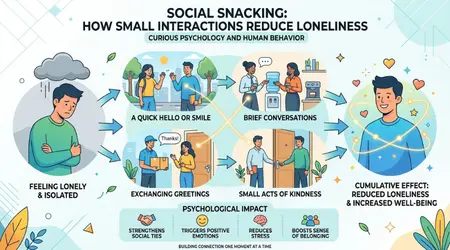
Why Do Small Interactions Reduce Loneliness?
How Do Everyday Strangers Impact Our Well-Being?
Interactions with casual acquaintances or complete strangers carry a unique psychological freedom because they require zero emotional baggage or history.
When you joke with a cashier, you are not managing relationship expectations, past arguments, or future obligations.
You simply exist in a pure, pleasant moment of shared humanity that validates your immediate presence in the physical world.
These brief encounters break the monotonous, internal loop of negative thoughts that often plagues an isolated mind.
They force you to look outward, engage with your immediate surroundings, and realize that the world is generally cooperative.
This external validation proves that you are visible, recognized, and valued by the human beings sharing your immediate geographic space.
Also read: Why People Believe Their Pets Understand Them
What Is the Difference Between Deep Bonding and Quick Snacks?
Deep bonding requires vulnerability, significant time investments, emotional energy, and reciprocal long-term commitment, forming the absolute foundation of our psychological resilience.
However, expecting every single human interaction to carry that immense weight is unrealistic and exhausting for the modern professional.
Social snacking serves a completely different, complementary purpose by filling the long gaps between those profound, intimate conversations.
| Interaction Type | Emotional Investment | Main Benefit | Daily Frequency |
| Deep Bonding | High | Long-term security, core validation | Low (Weekly/Monthly) |
| Social Snacking | Low | Immediate mood boost, situational safety | High (Multiple times daily) |
While you cannot survive healthily on physical snacks alone, they are incredibly useful when a full meal is temporarily unavailable.
Similarly, micro-interactions keep your spirit afloat during hectic work weeks when your close friends are busy managing their own chaotic lives.
They balance the emotional budget, ensuring you never hit absolute zero while waiting for deep, rejuvenating social connections.
Read more: The Psychology of Cancel Culture: Punishment vs. Justice
Why Are Low-Stakes Conversations So Healing?
Low-stakes conversations remove the performance anxiety that frequently ruins modern socializing, especially for individuals suffering from mild social anxiety.
There is no fear of judgment, no complex social hierarchy to navigate, and no pressure to appear incredibly successful or interesting You are simply two humans exchanging a passing comment about the unusual weather or a delayed subway train.
This lack of pressure allows your nervous system to relax and absorb the pure benefit of connection without defense mechanisms. It reminds you that connecting with others does not always have to be a complex, high-stakes project.
These effortless moments build social confidence, gradually chipping away at the invisible walls of isolation that urban life creates.
How Can We Implement Micro-Interactions Daily?
How Do We Turn Routine Errands into Connection Points?
You can easily transform mundane daily chores into active opportunities for psychological nourishment by making tiny, deliberate adjustments to your behavior.
Instead of staring at your phone while ordering coffee, look the barista in the eye, smile, and ask how their shift is going. Comment genuinely on a unique book someone is reading on the bus, or simply thank the janitor cleaning your office building.
These choices require less than thirty seconds but completely alter the chemical trajectory of your day, lifting your spirits instantly.
They shift your role from a passive, invisible observer of life to an active, engaged participant in a shared environment.
Over a week, these tiny moments accumulate into a substantial psychological buffer that effectively shields you against feelings of isolation.
How Does the Digital World Facilitate This Behavior?
While social media often receives blame for causing isolation, it can become an excellent tool for social snacking if used mindfully.
Instead of passively scrolling through endless feeds, send a quick, funny meme to an old college roommate without expecting a long conversation.
Leave a specific, supportive comment on an acquaintance’s pet photo, or drop a quick audio message to say you remembered them.
The secret lies in shifting your digital behavior from mindless, passive consumption to active, intentional, and outbound micro-communication.
This approach utilizes technology to maintain loose threads of connection across time zones and busy schedules without demanding hours of undivided attention.
It turns your smartphone into a tool for genuine, bite-sized warmth rather than an endless engine of social comparison.
What Are the Pitfalls of Relying Only on This Habit?
The primary danger of this behavior occurs when an individual attempts to replace deep, vulnerable relationships entirely with superficial micro-interactions.
Just as eating only potato chips will eventually ruin your physical health, relying solely on casual chats will leave you emotionally malnourished.
Micro-connections are supplements, not substitutes, for the heavy, foundational relationships that human beings fundamentally require to thrive.
When life hits a major crisis, a casual chat with a barista will not provide the profound comfort of a true friend. Recognizing this boundary ensures you use casual encounters correctly as a way to maintain daily wellness, not as an escape from intimacy.
Balance your emotional diet by enjoying casual interactions daily while consistently protecting time for deep, meaningful bonds.
Frequently Asked Questions
Can casual interactions truly replace close friendships?
No, they cannot replace them under any circumstances.
Micro-interactions act as temporary emotional supplements that sustain your mood between deeper connections, but you still need vulnerable, long-term friendships for true psychological resilience.
How many micro-interactions do I need daily to feel a difference?
Research suggests that just three to five brief, positive touchpoints a day like a smile, a quick joke, or a thoughtful text can measurably lower stress levels.
Does digital interaction count as an effective emotional snack?
Yes, provided it is active and direct. Sending a funny picture or a supportive message counts, whereas passively scrolling through a stranger’s profile does not provide any psychological benefit.
How do I start doing this if I suffer from social anxiety?
Start incredibly small. You do not need to chat; simply making brief eye contact, nodding politely to a passerby, or offering a quick “thank you” to a cashier is enough to stimulate positive neural pathways safely.
Are you ready to change your daily routine? Try leaving your phone in your pocket during your next coffee run and see who you notice. Share your favorite way to grab a quick emotional snack in the comments below!
