
The Kingdom of Aksum: Africa’s Forgotten Superpower

Kingdom of Aksum researchers recently uncovered remarkably preserved structural foundations in northern Ethiopia, bringing Africa’s forgotten global superpower back into modern headlines.
Anúncios
This monumental archaeological breakthrough reminds the world that sub-Saharan Africa once anchored a civilization equal to Rome, Persia, and China.
For centuries, this geopolitical giant dominated trade routes across the Red Sea, managed complex international alliances, and developed an elite economic network.
Despite its massive historical footprint, modern textbooks routinely neglect this sprawling empire, leaving its grand legacy largely buried beneath centuries of Eurocentric historical narratives.
Global trade networks traditionally focus heavily on Mediterranean empires, yet East Africa held the actual key to ancient intercontinental commerce.
The empire functioned as the vital maritime bridge connecting the Roman Empire with wealthy Indian markets, controlling the flow of luxury goods.
By regulating these massive commercial channels, the civilization built immense wealth, dictated local regional politics, and established an sophisticated urban culture.
Today, contemporary historians are aggressively re-evaluating global antiquity, rightfully restoring this African empire to its proper place among mankind’s greatest civilizations.
Quick Chapter Guide
- The Origins: Uncovering the roots of an ancient superpower.
- The Pillars of Power: Examining the architecture and economy that sustained the empire.
- The Modern Legacy: Understanding why this history matters in 2026.
What Was the Geopolitical Scale of This Empire?
The global footprint of the Kingdom of Aksum spanned across modern-day Ethiopia, Eritrea, Djibouti, Somalia, and parts of the Arabian Peninsula.
At its absolute territorial peak during the fourth century, the empire successfully projected military power across the Red Sea, conquering neighboring kingdoms.
This strategic expansion guaranteed total control over the crucial Bab-el-Mandeb strait, a vital bottleneck for global maritime trade.
Think of this sprawling territory as the ancient equivalent of the modern Suez Canal, where dominating the physical passage meant controlling the world’s economic pulse.
Ambitious territorial conquests allowed the monarchs to exact heavy tributes from subordinate regions, rapidly multiplying the royal treasury’s wealth.
The sheer geographical diversity of the realm provided stable access to various rich microclimates, securing agricultural abundance throughout severe seasonal shifts.
Royal administrators established heavily fortified outposts along key inland trade pathways, protecting valuable merchant caravans from nomadic raiders.
Consequently, this vast geographic expansion transformed a local agricultural society into a highly organized, multi-ethnic administrative state.
Where Did the Royal Wealth Come From?
Unprecedented wealth poured into the capital through the bustling port city of Adulis, located on the strategic coast of the Red Sea.
Merchants from distant lands flocked to this trading hub, eagerly exchanging Mediterranean wines and Roman glassware for premium African commodities.
The empire controlled the global supply of highly coveted luxury items, including pure gold, wild animal skins, and aromatic frankincense.
This lucrative commercial monopoly generated massive tax revenues, funding grand public construction projects and a permanent, highly trained standing army.
++ Marine Snow: The Strange Underwater Blizzard in Deep Oceans
How Did They Manage Diverse Populations?
Governing a massive, multi-ethnic population required an innovative administrative approach that successfully blended localized autonomy with absolute imperial loyalty.
The central government permitted conquered kings to retain their regional authority, provided they paid annual financial tributes to the ruling monarch.
This practical arrangement minimized costly internal rebellions while ensuring the efficient flow of critical resources directly to the primary capital.
Imperial decrees were routinely published in multiple languages, including Ge’ez, Sabaean, and Greek, demonstrating a sophisticated grasp of international diplomacy.
Also read: Dust Veils: Atmospheric Layers That Turn Sunsets Purple
Why Did the Capital Move Inland?
Strategic positioning forced the founders to establish their primary capital on a high, fertile plateau inland from the scorching coast.
This elevated location offered excellent natural defenses against foreign naval invasions while providing a temperate, healthy climate for the elite.
Abundant local timber and deep stone quarries fueled an architectural boom, allowing master builders to erect massive stone palaces.
Over the centuries, this secure inland hub evolved into a highly sacred religious center, eventually outlasting the coastal ports.
How Did Innovation Shape Their Daily Life?
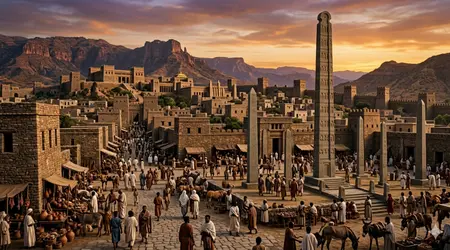
The brilliant engineers of the Kingdom of Aksum revolutionized ancient architecture by carving monolithic stelae out of single blocks of solid granite.
These soaring stone obelisks, reaching up to one hundred feet high, served as majestic grave markers for the imperial elite.
Remarkably, workers transported these multi-ton volcanic rocks across miles of rugged terrain without the aid of modern machinery or draft animals.
This extraordinary engineering feat mirrors the construction of the Egyptian pyramids, showcasing a profound mastery of physics, logistics, and human organization.
In addition to monumental architecture, the empire implemented sophisticated agricultural systems, utilizing advanced terrace farming along treacherous, steep mountain slopes.
Farmers constructed intricate networks of stone retaining walls to catch precious rainwater and prevent catastrophic soil erosion during intense monsoons.
They engineered massive underground cisterns and surface dams, ensuring a reliable water supply for crops during prolonged periods of drought.
This brilliant mastery of scarce natural resources allowed the kingdom to sustain dense, thriving urban populations for nearly a millennium.
Read more: Mammatus Clouds: The Bubble-Shaped Storm Clouds Explained
Who Minted the Imperial Coins?
King Endubis made the radical decision to issue standardized gold, silver, and bronze coinage around the year 270 of the common era.
This bold monetary move placed the Kingdom of Aksum among an elite group of ancient states possessing their own official currency system.
The meticulously minted coins featured inscriptions written in Greek, the undisputed international language of commerce throughout the ancient Mediterranean world.
This sophisticated economic strategy facilitated seamless international trade transactions, projecting imperial prestige directly into distant foreign marketplaces.
What Was the Written Language?
Developing an independent indigenous writing system known as Ge’ez marked a monumental intellectual achievement for this vibrant East African civilization.
This script evolved from older South Arabian roots but uniquely incorporated vital vowel markings, making it an advanced, highly precise written language.
Scribes used this sophisticated script to meticulously document royal military victories, manage complex trade inventories, and translate sacred religious texts.
Ge’ez ultimately became the foundational liturgical language of the Ethiopian Church, preserving vital historical records through successive generations.
How Did Christianity Become Official?
King Ezana altered the course of African history by formally adopting Christianity as the official state religion during the fourth century.
This momentous decision occurred around the same time Roman Emperor Constantine embraced the faith, showing the kingdom’s cultural synchronicity with Europe.
Instead of adopting foreign styles, local craftsmen blended Christian imagery with traditional African motifs, creating a distinctly unique religious aesthetic.
This monumental religious shift unified the diverse empire under a shared spiritual identity, strengthening the monarch’s divine political authority.
Why Did This Superpower Eventually Decline?
Environmental degradation triggered the slow, painful unraveling of this once-invincible empire over several consecutive generations.
Centuries of intensive agriculture, combined with massive timber harvesting for iron smelting, completely stripped the once-fertile hillsides of protective forest cover.
Torrential seasonal rains rapidly washed away the exposed, un-terraced topsoil, leaving the agricultural heartland severely depleted and prone to famine.
This ecological collapse reduced crop yields significantly, rendering the state incapable of feeding its massive, restive urban populations.
Shifting global trade dynamics further isolated the crumbling capital as rival Islamic empires rapidly expanded across North Africa and the Middle East.
Emerging naval powers seized total control of the Red Sea shipping lanes, effectively choking off the vital maritime commerce of Adulis.
Cut off from lucrative international markets, the imperial economy collapsed, destroying the royal family’s ability to fund their military forces.
The Kingdom of Aksum lost its geopolitical dominance, gradually retreating inward into the isolated, protective embrace of the Ethiopian highlands.
Who Was Queen Gudit?
Fourteenth-century oral traditions vividly describe Queen Gudit, a non-Christian monarch who led a devastating military rebellion against the weakened capital.
According to historical accounts, her fierce armies systematically destroyed ancient monuments, burned grand royal palaces, and slaughtered the ruling elite.
This violent internal uprising shattered the remaining centralized administrative structures, scattering the surviving populace into remote mountain villages.
While some modern historians debate the exact timeline of her reign, her devastating impact symbolizes the definitive end of imperial unity.
How Did Climate Change Hurt?
A major prolonged shift in global weather patterns severely disrupted the reliable monsoons that had long sustained East African agriculture.
The predictable summer rains diminished significantly, triggering consecutive decades of catastrophic droughts across the high plateaus.
Without adequate water reserves, the sophisticated irrigation systems failed, causing widespread starvation and the abandonment of major urban centers.
This severe climatic crisis proved that even the most advanced civilizations remain deeply vulnerable to sudden environmental shifts.
Where Did the Survivors Go?
Desperate survivors migrated southward into the rugged, highly defensible valleys of central Ethiopia, seeking refuge from coastal raiders and famine.
These displaced communities carefully preserved their sacred religious traditions, sophisticated agricultural techniques, and ancient Ge’ez literacy throughout the chaos.
This cultural preservation laid the foundational groundwork for the medieval Zagwe and Solomonic dynasties, ensuring a direct historical link. The imperial capital faded into a quiet, sacred village, but the cultural soul of the superpower endured.
Comparative Architectural Scale
The following analytical table contextualizes the structural and technological milestones of this empire against its global contemporaries during late antiquity.
| Empire | Primary Architecture | Monetary Base | Script Type | Key Harbor |
| Aksumite | Monolithic Granite Stelae | Imperial Gold/Silver | Ge’ez | Adulis |
| Roman | Concrete Arches & Domes | Gold Aureus / Denarius | Latin | Ostia |
| Sasanian | Vaulted Brick Palaces | Silver Drachm | Pahlavi | Siraf |
Restoring Africa’s Rightful Legacy
The rich history of this forgotten empire shatters the persistent, Eurocentric myth that sub-Saharan Africa existed in complete isolation from the ancient civilized world.
This sophisticated state minted its own currency, engineered monumental stone structures, and engaged in complex international diplomacy with distant Eurasian superpowers.
Acknowledging their historical achievements forces a total rewrite of global antiquity, highlighting Africa’s foundational role in shaping interconnected global commerce.
By exploring these forgotten ruins, we gain a much deeper, more authentic understanding of our shared human story.
Modern archaeology continues to unearth fascinating artifacts that prove the enduring brilliance of this unique East African civilization.
As global researchers uncover more hidden structures in 2026, the world must finally recognize this empire’s profound historical weight.
Let us actively challenge outdated historical narratives by sharing these remarkable stories of African ingenuity with the world. What steps will you take to expand your historical horizons?
Share your thoughts and continue exploring the fascinating depths of our global past in the comments section below!
Frequently Asked Questions
Did the empire use slaves to build the giant stone stelae?
Current archaeological evidence suggests that highly skilled, paid craftsmen and state-directed laborers engineered these monuments, rather than massive armies of slaves.
Is the biblical Ark of the Covenant actually kept in Aksum?
The Ethiopian Orthodox Church asserts that the Ark rests within the Chapel of the Tablet at the Church of Our Lady Mary of Zion, under the strict guard of a single, lifelong virgin monk.
What caused the unique architecture of the stelae?
The stone carvers intricately chiseled the solid granite slabs to accurately replicate multi-story wooden palaces, complete with highly detailed false windows, doors, and structural beams.
