
Gigantic Jets: Lightning That Shoots Into Space
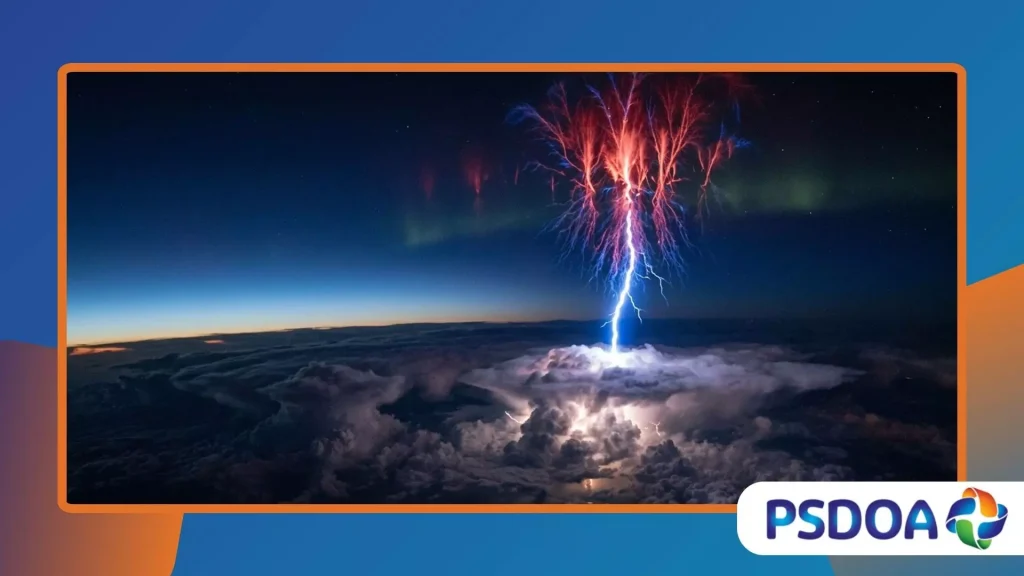
Gigantic jets redefine our scientific understanding of atmospheric electricity by bridging violent tropospheric thunderstorms directly with the mysterious lower ionosphere above.
Anúncios
Observers frequently mistake these rare luminous discharges for standard upward lightning, yet their scale reaches astounding altitudes of eighty kilometers.
Advanced optical cameras deployed globally now capture these crimson vertical pillars flashing across the nocturnal horizon with breathtaking velocity.
Exploring this upper atmospheric phenomenon reveals hidden electrical connections between our planetary weather systems and outer space.
Researchers continue analyzing how intense tropical storm cells generate enough electrical potential to launch plasma upward into near-vacuum layers.
Think of these discharges as towering electrical chimneys venting subterranean atmospheric pressure straight toward the edge of space.
Capturing clear imagery requires dedicated night-vision equipment operated by patient meteorologists stationed far away from city light pollution. Are you ready to discover what drives these colossal bolts into the dark skies?
Navigating Upper Atmospheric Electrical Phenomena
- Tracing the discovery milestones of rare transient luminous events in meteorology.
- Analyzing the physical mechanisms driving vertical plasma columns toward the ionosphere.
- Evaluating advanced satellite and ground-based optical tracking equipment arrays.
- Understanding how upper electrical discharges impact global electromagnetic resonance fields.
What Are Gigantic Jets and How Do They Form?
Gigantic jets represent the largest and most powerful class of transient luminous events occurring within Earth’s turbulent atmosphere.
Unlike conventional cloud-to-ground lightning flashes, these vertical electrical discharges shoot upward from thunderstorm cloud tops into the ionosphere.
Imagine a compressed energy spring suddenly releasing stored electrical tension straight toward the vacuum of orbital space.
High-speed cameras show crimson tendrils branching outward like fiery trees as they surge past the mesosphere.
Scientific studies published by the American Geophysical Union confirm that these massive events trigger when positive charge accumulates rapidly aloft.
This localized charge imbalance forces electrical breakdown across extreme altitude gradients that normally insulate the upper air.
Atmospheric physicists record peak currents exceeding tens of kilonewtons within milliseconds of initial upward breakdown. Witnessing this raw power reminds observers how little we truly understand about planetary electrical circuits.
How Do Upward Discharges Differ From Regular Lightning?
Standard lightning travels downward or horizontally between clouds to neutralize localized electrical charges within the troposphere.
In contrast, upper atmospheric jets bridge cloud tops directly with the ionosphere eighty kilometers higher. This vertical pathway bypasses normal lower-air resistance boundaries entirely.
++ Marine Snow: The Strange Underwater Blizzard in Deep Oceans
What Atmospheric Conditions Trigger These Events?
Severe tropical convective systems featuring exceptionally high cloud tops provide the necessary electrostatic charging engine.
Strong updrafts concentrate immense ice crystal friction, building massive charge differentials required for upward breaching. These storms usually erupt over tropical oceans or distant continental plains.
Also read: Dust Veils: Atmospheric Layers That Turn Sunsets Purple
Why Do They Exhibit Deep Crimson Colors?
Light emissions shift from blue at lower altitudes to deep red higher up due to nitrogen molecule excitation.
Low atmospheric density at eighty kilometers alters how excited gas molecules release photon energy during collisions. This distinct coloration identifies the exact altitude of the plasma discharge.
How Do Scientists Capture and Study These Events?
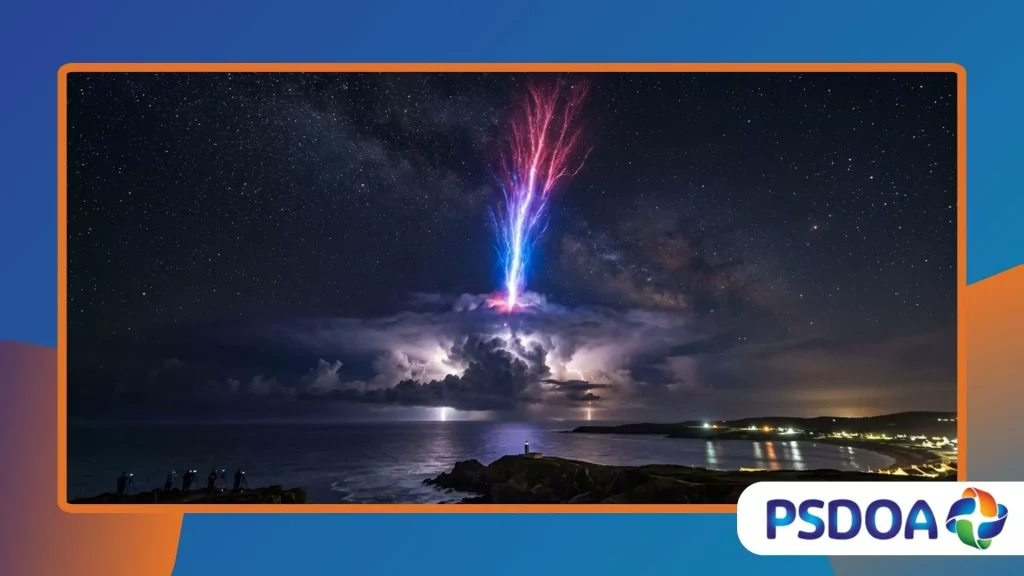
Detecting gigantic jets requires sophisticated low-light camera arrays operating continuously across remote dark-sky observation stations worldwide.
Because these luminous flashes last mere fractions of a second, automated trigger algorithms capture rapid optical shifts instantly.
Think of these cameras as patient sentinels watching an invisible theater for rare theatrical performances.
Space-based sensors aboard orbiting satellites now supplement ground networks by providing unobstructed downward perspectives of storm tops.
Data analysis from global meteor radar stations shows a strong correlation between intense solar activity and upper atmospheric discharges.
Researchers publish real-time alerts whenever major geomagnetic storms disturb the ionosphere, signaling prime monitoring windows for field teams.
This collaborative tracking infrastructure transforms fleeting atmospheric anomalies into thoroughly documented scientific data. Every successful capture expands human knowledge regarding near-Earth space weather dynamics.
Read more: Mammatus Clouds: The Bubble-Shaped Storm Clouds Explained
What Role Do Low-Light Cameras Play?
Specialized charge-coupled device cameras amplify faint photons streaming from high-altitude plasma columns against pitch-black backgrounds.
Without this optical amplification, human eyes would miss the crimson flashes completely in the night. Technology makes the invisible atmospheric realm visible.
How Do Satellites Monitor Global Storms?
Orbiting meteorological platforms scan entire continental storm systems simultaneously using ultraviolet and infrared sensor bands.
These space instruments map the exact geographic coordinates where upper electrical energy punches through the stratosphere. Global coverage ensures no major event goes unnoticed.
Why Are Citizen Scientists Crucial for Research?
Amateur astronomers operating backyard night-vision rigs often report unexpected jet events that automated instruments overlook entirely.
Community science networks provide vital geographic redundancy and rapid validation for professional meteorological databases. Public collaboration accelerates atmospheric discovery.
Why Do Gigantic Jets Matter to Global Atmospheric Science?
Investigating gigantic jets helps researchers map complex electromagnetic coupling mechanisms linking terrestrial weather directly to space weather phenomena.
These massive upward discharges transfer substantial electrical current into the lower ionosphere, altering global circuit conductivity balances.
Imagine Earth’s entire atmosphere functioning like a massive capacitor discharging excess energy into upper conductive layers.
Understanding this circuit improves satellite communications safety and navigation accuracy during severe geomagnetic storms.
Recent aeronomy reports indicate that upper atmospheric lightning alters chemical composition by creating transient nitrogen oxides aloft.
Although individual events remain brief, their cumulative global frequency impacts upper stratospheric ozone chemistry noticeably.
Scientists use these observations to refine numerical models predicting climate variations driven by solar-terrestrial interactions.
Unlocking the secrets of these towering flashes safeguards our modern technological infrastructure against unexpected electromagnetic disruptions.
How Do They Influence Satellite Communications?
Sudden ionospheric disturbances caused by powerful vertical discharges can disrupt high-frequency radio wave propagation across continents.
Aviation and maritime communication networks monitor these transient events to prevent unexpected signal degradation during storms. Atmospheric stability directly impacts global data transmission reliability.
What Connection Exists With Sprite Lightning?
While sprites flash horizontally across mesospheric altitudes above storms, gigantic jets establish direct vertical bridging channels.
Sprites follow secondary breakdown responses, whereas jets initiate the primary upward connection from cloud tops. Both phenomena reveal the hidden electrical power of severe weather.
Can Space Weather Trigger Atmospheric Discharges?
Incoming solar wind streams and coronal mass ejections compress Earth’s magnetic field, destabilizing upper atmospheric charge balances.
This extraterrestrial pressure creates optimal conditions for massive upward lightning strikes during major geomagnetic storms. Space and weather merge seamlessly aloft.
Atmospheric Electrical Phenomena Comparison Matrix
The structured table below contrasts classic cloud-to-ground lightning with rare upper atmospheric luminous events.
| Phenomenon Type | Altitude Range | Primary Color Emission | Physical Mechanism |
| Cloud-to-Ground Lightning | 0 to 15 kilometers | Brilliant white-blue | Tropospheric charge neutralization |
| Mesospheric Sprites | 50 to 90 kilometers | Reddish-orange hues | Secondary dielectric breakdown above storms |
| Upper Atmospheric Jets | 15 to 80 kilometers | Deep red to blue | Direct upward plasma surge into ionosphere |
Decoding the Mysteries of Our Upper Skies
Exploring gigantic jets demonstrates how much dynamic energy remains hidden just beyond our ordinary daily perception of weather.
By combining advanced satellite telemetry with dedicated ground-based optical tracking, researchers continue unraveling Earth’s complex atmospheric electrical circuits.
These towering crimson pillars remind us that our planet maintains an active, invisible connection with outer space itself. Take a moment to look up at the next nocturnal thunderstorm rolling across your horizon.
What other hidden wonders await discovery in our upper skies? Share your thoughts in the comments below!
Frequently Asked Questions
Can commercial airline passengers see these upper atmospheric flashes?
Commercial passengers rarely spot these events because standard aircraft cruise below tropospheric storm tops that block direct upward sightlines.
However, pilots flying high-altitude routes near severe tropical convective cells occasionally witness distant crimson pillars flashing against the night sky.
How long do these vertical lightning discharges last?
Most individual events endure for less than one second, typically flashing in rapid pulses lasting between ten and five hundred milliseconds.
Their extreme speed makes direct human observation nearly impossible without specialized high-speed optical recording equipment.
Are these high-altitude events dangerous to spacecraft?
Orbital spacecraft operating inside the thermosphere fly well above the eighty-kilometer ceiling where these vertical plasma columns terminate.
While the surrounding ionosphere experiences brief localized electromagnetic disturbances, active satellites remain safe from direct physical damage.
