
The Forgotten Desert Civilizations of Central Asia
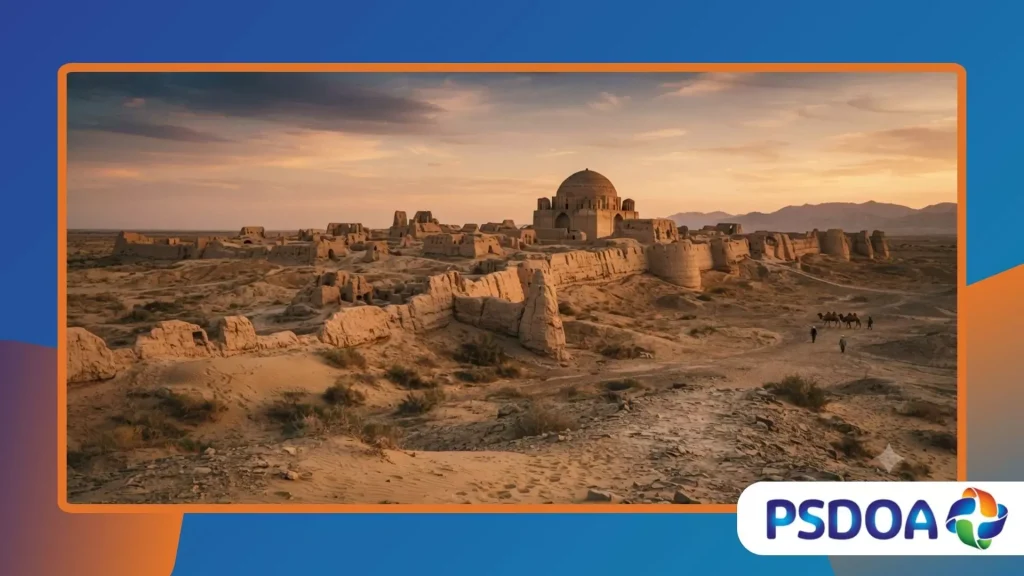
Forgotten desert civilizations of Central Asia once sustained thriving metropolitan networks across arid wastelands that modern travelers mistakenly dismiss as barren wasteland.
Anúncios
Shifting sand dunes swallowed sophisticated irrigation empires, ancient trading hubs, and brilliant bronze-age societies that linked China to the Mediterranean world.
Archaeological excavations continuously unearth buried palaces, advanced water management systems, and priceless artifacts revealing complex urban lifestyles.
Examining these vanished desert societies redefines our understanding of global human ingenuity and historical resilience.
Modern researchers utilize satellite remote sensing to map ancient oasis routes hidden beneath the vast Kyzylkum and Karakum sands.
These technological breakthroughs expose lost urban grids that flourished long before medieval Silk Road caravans crossed the horizon.
Unlocking these historical secrets offers vital lessons for managing fragile water resources in twenty-first-century arid regions.
Are you ready to explore the hidden empires buried beneath the shifting Central Asian sands?
Navigating Lost Oasis Empires
- Tracing ancient subterranean water canal engineering systems across hyper-arid deserts.
- Uncovering Bronze Age urban centers hidden beneath Karakum sand dunes.
- Analyzing trade networks connecting nomadic tribes with sedentary imperial dynasties.
- Evaluating modern satellite archaeology discoveries revealing forgotten Central Asian settlements.
What Are the Hidden Oases of the Karakum Desert?
Forgotten desert civilizations of Central Asia built extraordinary urban hubs within the seemingly inhospitable Karakum Desert through brilliant hydrological engineering.
The Margiana Archaeological Complex, discovered by Soviet researchers, revealed fortified royal palaces, fire temples, and intricate irrigation canals.
Think of these desert metropolises as lush green islands defying an ocean of sand through sheer community grit.
Advanced bronze-age artisans manufactured exquisite ceramics and gold jewelry that rivaled ancient Mesopotamia and Egypt.
Recent archaeological field surveys published in international heritage journals confirm that these sophisticated settlements traded actively with the Indus Valley.
Prolonged climate shifts and river course changes eventually forced inhabitants to abandon their urban centers to the encroaching sands.
Modern historical analysis transforms our perspective of Central Asia from a mere nomadic transit zone into a cradle of urban innovation. Every ruined mud-brick wall whispers stories of brilliant adaptation and eventual ecological collapse.
How Did Ancient Engineers Harness Desert Water?
Inhabitants constructed complex underground gravity-fed channels called qanats that transported melting mountain snow safely beneath scorching evaporation zones.
This ingenious hydraulic system irrigated expansive wheat fields and orchards without losing precious water to desert heat. Engineering mastery sustained dense urban populations in hostile environments.
++ The Kingdom of Aksum: Africa’s Forgotten Superpower
Why Did Bronze Age Capitals Collapse?
Severe regional climate desiccation dried up vital river tributaries, destroying the agricultural foundation necessary to support urban centers.
Neighboring nomadic migrations and shifting trade routes further destabilized local political authorities, prompting mass urban abandonment. Nature reclaimed what human sweat had temporarily conquered.
Also read: The Ancient City Hidden Beneath Modern Mexico City
What Treasures Lie Buried Beneath the Sand?
Excavations reveal intricately carved stone pillars, delicate ivory cosmetics containers, and monumental royal structures buried under centuries of dust.
These tangible artifacts prove that high-culture arts flourished far away from traditional river valleys. Every recovered item restores a lost voice to human history.
How Did the Silk Road Transform Arid Trading Networks?
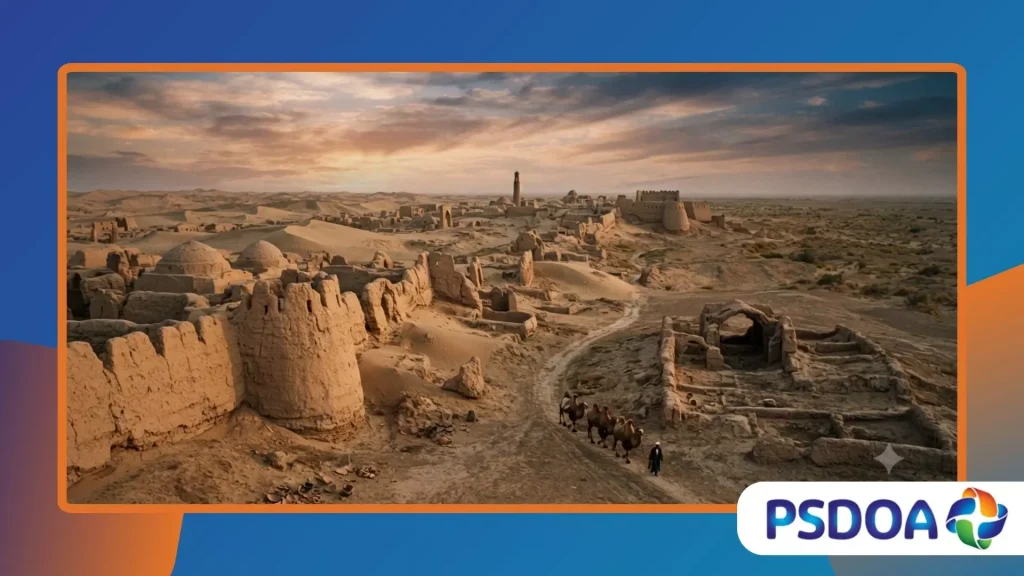
Forgotten desert civilizations of Central Asia served as the indispensable commercial backbone connecting imperial Rome, Persia, and Han dynasty China through dangerous terrain.
Oasis cities like Merv and Khorezm functioned as bustling multicultural crossroads where merchants exchanged silk, spices, glass, and philosophical ideas.
Imagine a high-stakes desert relay race where survival depended entirely on local oasis hospitality and protected trade routes.
Guarded fortress outposts maintained regional security against aggressive nomadic incursions across harsh frontier landscapes.
Historical archives document that Merv briefly stood as one of the largest cities in the world during the twelfth century.
Devastating Mongol conquests ultimately shattered these brilliant urban networks, leaving magnificent mosques and fortresses to crumble into desert dust.
Contemporary heritage conservation teams now race against wind erosion to protect these fragile archaeological treasures. Preserving ancient architecture honors the cosmopolitan heritage of Central Asian crossroads.
Read more: Operation Northwoods: The Declassified False Flag Proposal
What Role Did Oasis Outposts Play?
Strategic desert stations provided weary merchants with fresh water, secure lodging, veterinary care, and vital trade taxation services.
These fortified hubs protected valuable camel caravans from bandits operating across remote mountain passes and dune seas. Commerce thrived because security infrastructure was reliable.
Why Was Cultural Exchange So Vibrant?
Diverse religious traditions including Buddhism, Zoroastrianism, Nestorian Christianity, and early Islam converged peacefully within bustling Central Asian market squares.
Merchants shared scientific texts, mathematical concepts, and artistic techniques alongside physical commodities. Tolerance fueled regional intellectual renaissance.
How Did Mongol Invasions Alter the Landscape?
The thirteenth-century campaigns of Genghis Khan inflicted catastrophic structural damage on sophisticated irrigation networks and major urban capitals.
Smashed dams and destroyed agricultural canals transformed blooming agricultural oases back into barren desert wastelands permanently. Recovery took centuries of dedicated human rebuilding.
What Does Modern Satellite Archaeology Reveal Today?
Forgotten desert civilizations of Central Asia are finally yielding their deepest secrets thanks to advanced satellite remote sensing and drone mapping technologies.
Archaeologists can now detect subterranean stone foundations, buried road networks, and ancient agricultural field boundaries invisible from ground level.
Consider satellite archaeology as an X-ray machine scanning the scarred body of the earth to reveal forgotten skeletal structures.
This non-invasive scientific approach accelerates discovery while protecting fragile ruins from premature excavation damage.
Field researchers operating in Uzbekistan and Turkmenistan have mapped dozens of previously unknown medieval towns clustered along dried riverbeds.
These high-tech discoveries prove that ancient populations were far larger and more interconnected than nineteenth-century historians ever imagined.
Technology bridges the vast gap between forgotten antiquity and modern historical curiosity. Every digital scan rewrites standard textbook narratives.
How Does Remote Sensing Detect Ruins?
Specialized multispectral satellite cameras capture subtle variations in soil moisture and vegetation health above buried architectural stone foundations.
Ancient mud-brick walls retain different thermal properties than surrounding sand, creating distinct signatures visible from orbit. Science turns invisible history into clear visual maps.
Why Are Desert Climates Ideal for Preservation?
Arid desert environments feature low humidity and minimal rainfall, protecting organic materials like textiles, wood, and paper from rotting.
Unlike damp tropical jungles that consume ruins rapidly, dry sand acts as an exceptional natural preservation vault. Artifacts remain remarkably intact over millennia.
What Challenges Face Modern Field Researchers?
Shifting sand dunes continually rebury newly discovered sites, requiring rapid digital documentation before natural elements erase the physical evidence.
Political borders, remote terrain, and restricted funding also complicate international archaeological expeditions across Central Asia. Dedication drives scientists to overcome every obstacle.
Archaeological Site Comparison Matrix
The structured table below contrasts major ancient Central Asian desert settlements based on their historical era, primary function, and current preservation status.
| Archaeological Site | Historical Era | Primary Functional Role | Current Preservation Status |
| Margiana (Gonur Tepe) | Bronze Age (2200 BCE) | Royal capital and fire-temple complex | Partially excavated, protected ruins |
| Merv (Antiochia) | Classical to Islamic Era | Global Silk Road trade and cultural hub | UNESCO World Heritage, vulnerable ruins |
| Khorezm Fortress Belt | Iron Age to Middle Ages | Desert defense and agricultural oasis | Scattered mud-brick ruins in desert |
Unveiling the Resilient Legacy of Arid Empires
Forgotten desert civilizations of Central Asia demonstrate that human ingenuity can transform hostile, hyper-arid environments into vibrant centers of civilization and trade.
By exploring these buried oases, we honor the ancient architects, engineers, and merchants who bridged distant worlds across unforgiving sand seas.
History teaches us that societies rise and fall based on their ability to sustainably manage precious natural resources.
Take a moment to reflect on the hidden layers of history resting beneath our feet today.
Which ancient desert culture inspires your curiosity the most? Share your perspective in the comments below!
Frequently Asked Questions
How were ancient cities supplied with water in waterless deserts?
Ancient populations built underground tunnel systems called qanats that tapped into distant mountain aquifers, delivering water via gravity without evaporation loss.
They also constructed massive stone reservoirs to capture seasonal flash floods.
Why did famous Silk Road cities eventually become abandoned?
Shifting river courses, devastating foreign invasions, and the rise of oceanic maritime trade routes gradually starved inland desert oases of economic vitality and water.
Once irrigation networks failed, populations migrated to greener regions.
Can travelers visit these archaeological sites in Central Asia today?
Yes, many major sites in Turkmenistan, Uzbekistan, and Kazakhstan welcome cultural tourists accompanied by licensed local guides.
Exploring these remote desert monuments offers an unforgettable journey into lost human history.
