
Nebra Sky Disc: The Artifact That Rewrote Ancient Astronomy
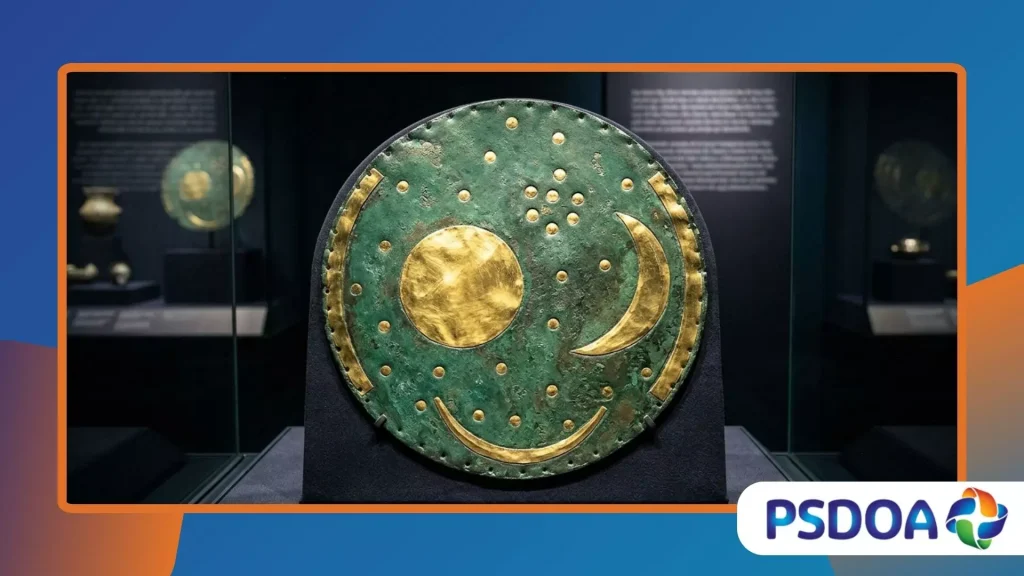
Nebra Sky Disc discovery revolutionized our understanding of Bronze Age prehistoric astronomy and advanced technological capabilities across ancient Europe.
Anúncios
Unearthed illegally by metal detectorists in Germany’s Ziegelroda Forest, this extraordinary bronze artifact stunned international archaeological communities.
Modern scientific analyses confirm that the disc represents the oldest concrete physical depiction of cosmic phenomena known to humanity.
This remarkable relic bridges primitive superstition with sophisticated empirical celestial calculation.
Unlocking the historical secrets hidden within this metallic masterpiece requires examining its complex metallurgical composition and astronomical alignments.
Historians and archaeoastronomers continue debating how ancient craftsmen calculated lunar months without modern mathematical tools.
Think of this bronze circle as an ancient portable planetarium guiding early agricultural planting cycles. Are you ready to explore how a buried metallic disc rewrote our ancient historical timeline?
Navigating Bronze Age Archaeoastronomy Discoveries
- Investigating the illegal excavation and dramatic police recovery of the legendary bronze relic.
- Analyzing copper and gold metallurgical origins using advanced mass spectrometry testing.
- Evaluating precise horizon arc alignments matching solstice observations in Central Europe.
- Documenting UNESCO Memory of the World register status and modern museum preservation.
What Is the Archaeological Significance of This Bronze Relic?
Nebra Sky Disc represents a monumental leap in prehistoric cognitive development, proving that Bronze Age societies possessed advanced observational astronomy skills.
Crafted around 1600 BCE, the metallic artifact features inlaid gold leaf representations of the sun, lunar crescent, and star clusters.
Imagine ancient stargazers standing atop Mittelberg hill tracking precise solar solstices to govern their agricultural planting schedules.
Archaeological research published by the State Museum of Prehistory in Halle confirms its unprecedented status as a cultural treasure.
Scientific investigations reveal that the disc underwent multiple symbolic modifications over centuries as religious and astronomical beliefs evolved within the community.
The addition of horizon arcs and a solar bar transformed a simple celestial map into a sophisticated calendrical instrument.
When looters unearthed the artifact in 1999, they nearly destroyed a priceless piece of European heritage before international sting operations recovered it.
Preserving such artifacts safeguards our collective understanding of human intellectual progress.
How Did Archaeologists Authenticate the Discovery?
Forensic soil analysis matched microscopic traces adhered to the bronze surface directly with the exact mineral composition of the Ziegelroda Forest discovery site.
This undeniable geological fingerprint silenced initial skepticism regarding the artifact’s authenticity.
++ The Kingdom of Aksum: Africa’s Forgotten Superpower
Why Is the Pleiades Star Cluster Depicted?
The golden dot cluster inlaid on the bronze surface corresponds precisely with the Pleiades constellation as visible from Central Europe during the Bronze Age.
Ancient farmers used this stellar marker to time spring sowing and autumn harvest seasons.
Also read: The Ancient City Hidden Beneath Modern Mexico City
What Role Did Metal Analysis Play?
Isotopic testing demonstrated that the copper originated from Austrian Alpine mines while the gold came from Cornwall, proving extensive European trade networks existed.
Long-distance commerce thrived millennia before written history recorded international treaties.
How Did Ancient Craftsmen Manufacture This Celestial Artifact?
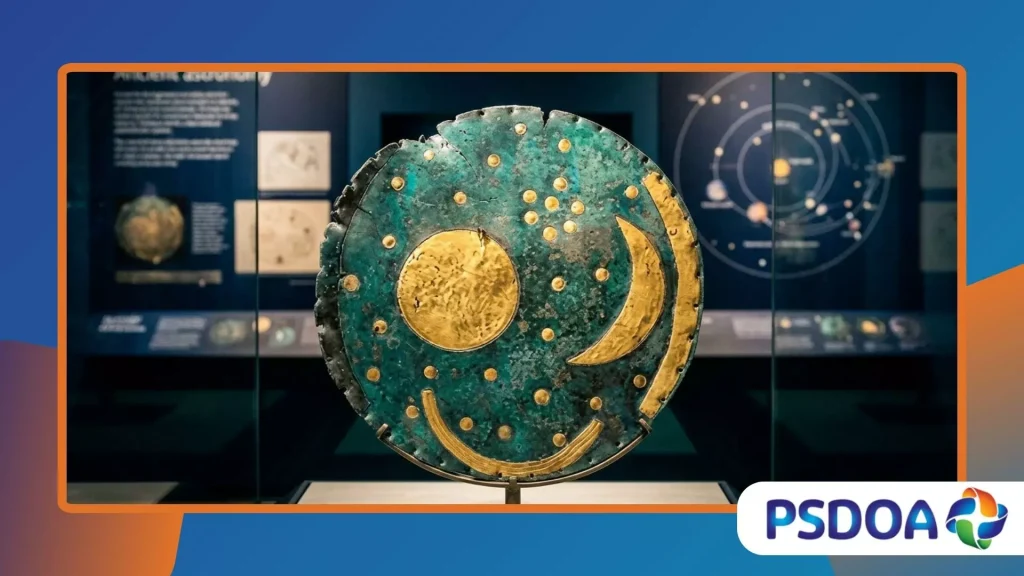
Nebra Sky Disc construction demanded exceptional metallurgical mastery, combining hammered sheet bronze with intricate gold inlay techniques previously thought nonexistent then.
Artisans hammered raw bronze into a thin circular plate before carefully chiseling shallow grooves to inlay pure gold leaf elements.
Think of this intricate metalworking process like a master jeweler setting precious gemstones into an ancient ceremonial crown.
Modern archaeoastronomy experiments demonstrate that creating such a sophisticated instrument required specialized workshop collaboration.
Detailed metallurgical studies show that the metal disk contains high levels of arsenic bronze, which hardens the alloy during hammering and cold working.
Craftsmen polished the dark patinated surface to create a striking visual contrast against the glowing gold sun and stars.
Every meticulous hammer strike reflected a profound spiritual connection between early humans and the vast nighttime sky. Craftsmanship met celestial devotion in a brilliant display of prehistoric ingenuity.
Read more: Operation Northwoods: The Declassified False Flag Proposal
How Were Gold Sheets Attached to Bronze?
Craftsman mechanically pressed thin gold foil strips into undercut grooves chiseled into the bronze plate, locking the metal securely through friction.
This ancient inlay technique ensured the symbols remained intact through centuries of ritual handling.
Why Was Arsenic Bronze Chosen by Makers?
Early European metalworkers utilized natural arsenic-copper ores because the resulting alloy retained structural rigidity and resisted deformation better than pure copper.
This chemical advantage allowed for thinner, lighter ceremonial plates.
What Tooling Technology Existed in 1600 BCE?
Prehistoric artisans relied on polished flint chisels, bone hammers, and stone anvils to shape and texture the heavy bronze sheet metal with astonishing precision.
Their manual dexterity rivals modern fine metalworking standards.
What Do the Celestial Symbols on the Plate Actually Mean?
Nebra Sky Disc features precise astronomical iconography that maps lunar cycles, solar solstices, and critical seasonal navigational markers.
The prominent golden crescent represents the waxing moon, while the circular disc signifies either the full sun or a solar eclipse.
Imagine standing on an ancient horizon marker where aligning these golden symbols predicted seasonal changes with astonishing accuracy.
Researchers emphasize that combining solar and lunar calendars required centuries of generational observation and meticulous data tracking.
Academic studies in archaeoastronomy indicate that the angle between the horizon arcs matches the exact sunset and sunrise positions during summer and winter solstices.
This precise geometric correlation confirms that the artifact served as a functional sighting instrument for ancient priests and chieftains.
Understanding these celestial codes transforms our perception of prehistoric societies from primitive tribes into keen cosmic observers. Science and myth intertwined seamlessly in ancient religious rituals.
How Does the Disc Track Lunar Cycles?
By calculating the exact sixteen-degree arc between the horizon lines, ancient astronomers synchronized their lunar calendar with solar years to maintain seasonal accuracy.
This mathematical correction prevented agricultural disasters caused by calendar drift.
Why Were Horizon Arcs Added Later?
Generational knowledge accumulation likely prompted ancient craftsmen to retrofit the original star map with horizon boundary markers to improve calendrical tracking precision.
Artifact modification reflects evolving scientific understanding.
What Was the Ritual Purpose of the Object?
Tribal leaders used the illuminated metallic disc during sacred winter solstice ceremonies to legitimize their divine right to rule through cosmic harmony.
Religious authority derived directly from mastering celestial predictability.
Prehistoric Artifact Analysis Comparison Matrix
The structured table below contrasts traditional archaeological assumptions with modern scientific findings regarding European Bronze Age astronomy.
| Analytical Dimension | Traditional Prehistoric Assumption | Modern Scientific Discovery |
| Technological Capability | Primitive manual tools with zero advanced astronomy | Sophisticated metalworking and precise solar-lunar tracking |
| Trade Networks | Isolated regional tribal communities | Extensive international commerce spanning Alpine copper and Cornish gold |
| Astronomical Knowledge | Basic seasonal folklore without mathematical precision | Calculated horizon arc alignments matching solstice positions |
Preserving the Astronomical Legacy of Our Ancestors
The Nebra Sky Disc stands as a timeless testament to human curiosity, proving that ancient minds gazed upward with sophisticated scientific wonder.
By decoding its metallic symbols, modern researchers continue bridging the vast temporal gap between prehistoric ingenuity and contemporary space exploration.
Preserving such priceless archaeological treasures ensures that future generations respect our shared intellectual heritage.
Take a moment to reflect on how humanity has tracked the stars across millennia. Which ancient historical discovery fascinates your imagination the most? Share your perspective in the comments below!
Frequently Asked Questions
Where is the Nebra Sky Disc currently housed for public viewing?
The authentic artifact is permanently exhibited at the State Museum of Prehistory in Halle, Germany, where advanced climate-controlled security vaults protect its fragile bronze structure.
How was the artifact originally discovered by looters?
Two treasure hunters using illegal metal detectors unearthed the bronze disc alongside swords and axes atop Mittelberg hill in 1999 before police recovered it in Basel.
Does the artifact display any modern forgeries or alterations?
While ancient craftsmen modified the disc by adding horizon arcs and edge holes over centuries, extensive forensic testing confirms its absolute Bronze Age authenticity.
Why is the disc considered more advanced than Stonehenge?
Unlike stationary stone monuments tied to a single geographic location, the portable bronze plate allowed portable celestial calculations across different latitude points.
Can visitors purchase exact replicas of the celestial disc?
Authorized museum gift shops and educational institutions offer certified bronze and gold-leaf replicas for academic study and historical collection purposes.
