
The Walking Machines Designed Before Modern Robotics
Walking machines designed before modern robotics represent one of history’s most fascinating intersections of classical mechanics, human curiosity, and visionary engineering.
Anúncios
Long before silicon microprocessors, artificial intelligence, and electro-mechanical actuators transformed autonomous locomotion, pioneering inventors developed intricate mechanical legs powered strictly by steam, spring-wound gear trains, and manual levers.
These early kinetic experiments aimed to overcome treacherous physical terrain that traditional wheeled locomotion simply could not navigate efficiently.
By analyzing these centuries-old blueprints through a modern engineering lens, we discover how foundational mechanical principles paved the way for today’s advanced multi-legged autonomous platforms.
In this deep exploration, we will cover the following key topics:
- What Mechanical Principles Driven Early Walking Machines?
- How Did Steam and Clockwork Replace Biological Legs?
- Why Did Historical Engineers Choose Legs Over Wheels?
- Essential Historical Walking Artifacts Compared
- The Future Horizon of Bio-Inspired Mechanical Engineering
- Frequently Asked Questions About Historical Walking Machines
The pursuit of artificial locomotion has always required an intimate understanding of kinetic geometry and structural dynamics.
Historical innovators like Leonardo da Vinci and Pafnuty Chebyshev recognized that duplicating biological gaits demanded sophisticated linkages capable of transforming simple rotational torque into complex linear footpaths.
As modern engineers re-examine these foundational mechanisms, they find that historical developers solved intricate balance and gait-coordination challenges using purely mechanical feedback loops.
This rich heritage demonstrates that physical intelligence embedding movement logic directly into mechanical design was actively flourishing long before software algorithms existed.
What Mechanical Principles Driven Early Walking Machines?
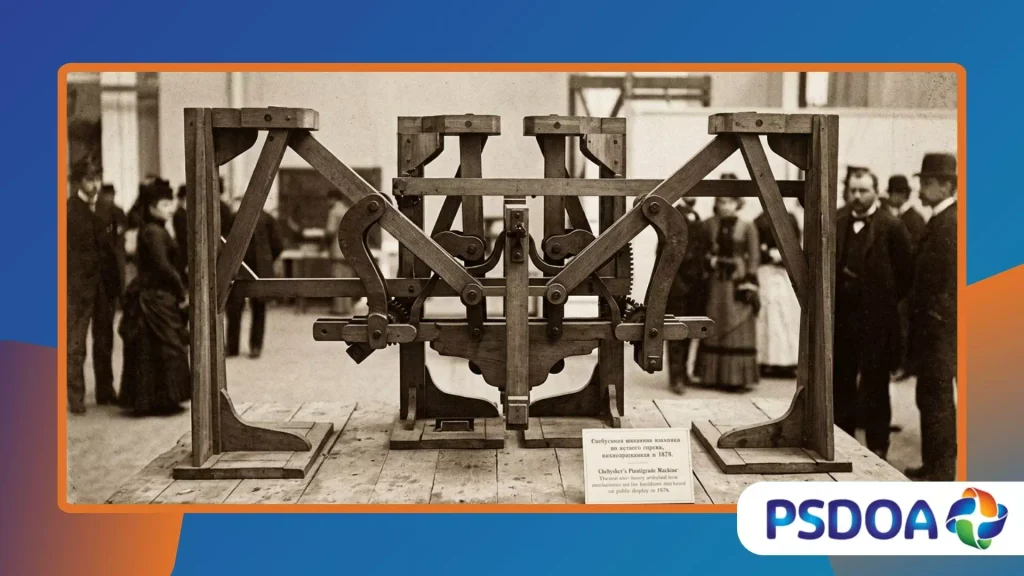
Understanding the physical foundations of historical legged mechanisms reveals how early engineers achieved complex locomotion without modern computing power.
These systems relied entirely on clever geometry, structural load distribution, and mechanical timing.
How Did Classical Kinematic Linkages Create Articulated Gait Curves?
Classical kinetic systems translated simple rotational input into natural stepping profiles through meticulously calculated joint networks and rigid bar assemblies.
Mathematical pioneer Pafnuty Chebyshev demonstrated this breakthrough in the late nineteenth century with his famous Plantigrade Machine, which utilized a precise four-bar mechanism to maintain a flat, uniform foot trajectory while minimizing vertical friction loss.
Engineers utilized these closed-chain linkages to ensure that the machine’s center of gravity remained remarkably stable throughout the entire stride phase.
By combining mechanical gear synchronization with rigid spatial constraints, these historical walking machines designed before modern robotics achieved smooth, repeatable forward motion long before electronic sensor arrays were conceived.
To visualize this remarkable achievement, imagine a mechanical grandfather clock suddenly gaining limbs and stepping across a cobblestone workshop floor with rhythmic precision.
These pioneering mechanisms proved that physical geometry alone could perform complex spatial calculations without needing a single line of digital code.
++ Forgotten Military Robots From WWII
Why Was Weight Balance and Mechanical Equilibrium So Critical?
Maintaining continuous static balance presented a massive physical hurdle for early engineers who lacked real-time electronic gyroscopes or automated tilt control devices.
Designers compensated for this limitation by creating multi-legged mechanical layouts that kept the center of mass securely inside the support polygon formed by the ground-contact feet at all times.
Heavy iron components, pressure boilers, and structural brass chassis required strategic positioning to prevent disastrous tipping during forward stride cycles.
Mechanical counterweights, inertia flywheels, and opposing spring assemblies were systematically embedded into the framework to absorb sudden physical shocks and distribute structural weight evenly across every active limb.
How Did Steam and Clockwork Replace Biological Legs?
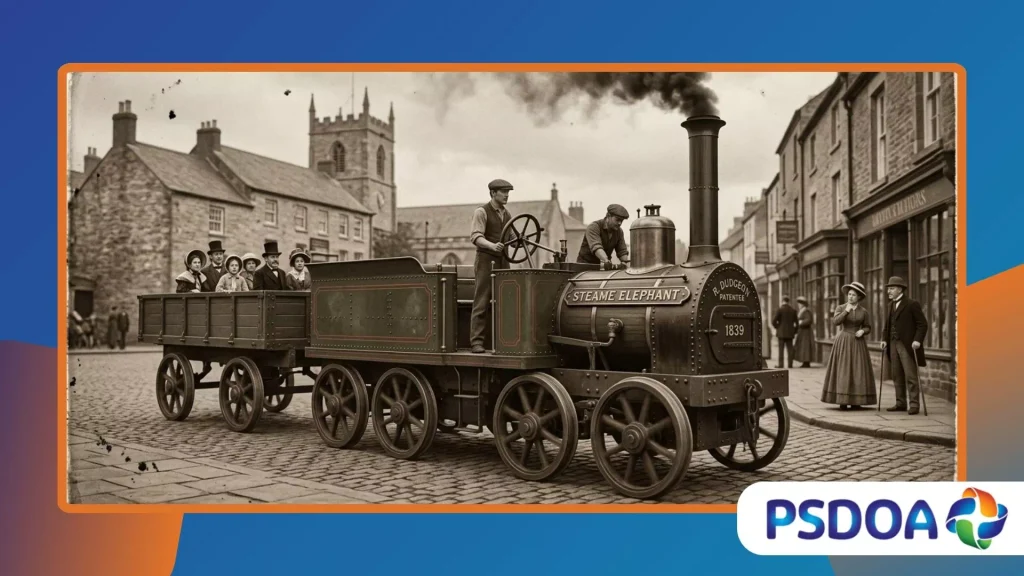
The Industrial Revolution provided new energy sources that transformed static mechanical concepts into powerful, self-propelled walking machines.
Steam pressure and spring tension offered unprecedented mechanical force for heavy kinetic experiments.
How Did Heavy Steam Engines Power Kinetic Walking Experiments?
During the mid-nineteenth century, steam power enabled visionary inventors to construct massive, self-propelled terrestrial vehicles capable of carrying heavy structural payloads across uncharted terrain.
American inventor Lewis Rygg patented a steam-powered mechanical horse in 1893 that used internal gear systems and high-pressure steam cylinders to actuate heavy iron leg linkages rhythmically.
These heavy industrial experiments proved that thermal combustion could generate sufficient mechanical force to lift and step weighted limbs over severe physical obstructions.
Despite their incredible mechanical output, these early steam quadrupeds required constant manual boiler adjustments and meticulous mechanical lubrication to maintain operational reliability.
Read more: The Clockwork Airplane That Never Got Off the Ground
How Did Internal Clockwork Springs Provide Compact Locomotive Power?
For smaller domestic or experimental walking mechanisms, high-tension clockwork mainsprings and brass gear trains offered a compact, self-contained energy source.
European craftsmen constructed intricate mechanical automata during the eighteenth and nineteenth centuries that effortlessly simulated human and animal stepping movements across smooth surfaces.
These compact mechanisms relied on precisely regulated escapements and custom-cut eccentric cams to regulate stepping speeds and prevent internal gears from unspooling uncontrollably under tension.
By analyzing these tiny horological marvels, modern researchers gain invaluable insights into how early artisans integrated compact power storage directly into lightweight mechanical chassis.
Also read: How We Nearly Had a Global Pneumatic Mail System
Why Did Historical Engineers Choose Legs Over Wheels?
While wheels dominated flat roadways, rough natural landscapes demanded alternative locomotion methods. Early innovators turned to articulated leg mechanisms to conquer untamed environments.
Why Were Legged Systems Superior for Rough and Unpaved Terrain?
Before modern paved highway networks existed, unpaved muddy roads, rocky inclines, and unstable soil rendered traditional narrow carriage wheels completely ineffective.
Articulated leg mechanisms provided distinct discrete ground contact points, allowing heavy machines to step cleanly over deep potholes, fallen logs, and soft mud without getting bogged down.
Historical field testing documented that legged walking mechanisms conserved structural energy on uneven ground by preventing the continuous ground-sinkage drag that severely plagued conventional heavy wheels.
Consequently, early industrial pioneers viewed articulated walking legs as the definitive future solution for cross-country agricultural transport and industrial haulage across raw, unmapped frontiers.
What Role Did Biomimicry Play in Classical Engineering Design?
Early mechanical designers regularly looked to horse anatomy, avian leg dynamics, and insect locomotion for structural inspiration when drafting their dynamic mechanical systems.
By carefully observing biological tendon attachments, joint articulation angles, and weight distribution methods, natural historians and mechanical engineers created functional artificial limbs that closely mirrored natural movement patterns.
These bio-inspired designs demonstrated that natural evolutionary features could be translated into durable iron levers, brass joints, and hardened steel connecting rods.
This early cross-pollination between natural biology and classical mechanical engineering established the vital foundation for contemporary bionic design methodologies.
Essential Historical Walking Artifacts Compared
To better understand the evolution of early dynamic locomotion, the following table compares key parameters of historical walking machines developed prior to modern electronic robotics.
| Machine Name & Year | Primary Power Source | Key Kinematic Innovation | Primary Terrain Objective |
| Chebyshev Plantigrade (1878) | Manual / Crank Drive | Four-bar kinetic linkage generating flat stepping path | Smooth surface balance demonstration |
| Rygg Mechanical Horse (1893) | High-Pressure Steam Engine | Lever-actuated quadrupedal stride coordination | Off-road agricultural haulage |
| Dudgeon Steam Elephant (1839) | Dual Steam Boilers | Heavy-duty articulated steam-driven walking legs | Heavy industrial load transport |
| Jaquet-Droz Automata (1774) | Wound Clockwork Springs | Micro-cam regulated bipedal stepping balance | Intricate indoor demonstration |
| Gheorghe’s Walking Frame (1912) | Internal Combustion | Linked mechanical web for multi-point contact | Rough military logistics terrain |
This historical comparison illustrates the wide diversity of kinetic mechanisms created long before modern microcontrollers, digital sensor feedback systems, or pneumatic servo valves were ever introduced.
The Future Horizon of Bio-Inspired Mechanical Engineering
As modern robotics continues to evolve, engineers are increasingly turning back to classical mechanical principles to build more efficient, resilient, and adaptable autonomous systems.
How Do Modern Systems Benefit from Classical Kinematic Logic?
Contemporary mechanical engineering teams are actively rediscovering that embedded physical intelligence can significantly reduce computational strain on digital processors in modern autonomous walking platforms.
By combining passive mechanical compliance with historical link geometry, modern multi-legged robots can effortlessly absorb environmental bumps and impacts without requiring high-speed electronic intervention.
Today, researchers actively re-examine these foundational walking machines designed before modern robotics to extract clever gear setups, unpowered joint linkages, and passive equilibrium techniques that optimize power consumption in modern autonomous quadrupeds.
Integrating classical mechanical logic with modern microprocessors yields highly resilient, energy-efficient robotic platforms capable of traversing extreme environments reliably.
Would you like to explore how these classical kinetic principles can be directly integrated into your next mechanical engineering project or educational research framework?
Frequently Asked Questions About Historical Walking Machines
What was the main reason early walking machines were not widely adopted commercially?
Early walking mechanisms faced severe physical limitations due to the heavy weight of steam boilers, high joint friction, and the lack of real-time automated balance systems.
While these systems performed remarkably well in controlled demonstrations, they required constant manual lubrication, frequent maintenance, and proved far less reliable than early tracked or broad-wheeled steam tractors for everyday industrial work.
Did early walking machines utilize any form of automated feedback?
Although they lacked electronic microcontrollers, early walking machines relied on clever passive mechanical feedback loops.
Designers utilized mechanical governors, spring-loaded counterweights, balanced inertia flywheels, and rigid kinetic linkage constraints to automatically correct minor balance disruptions and stabilize foot paths without requiring human pilot intervention during operation.
Who was the most influential pioneer in developing classical walking linkages?
Russian mathematician and engineer Pafnuty Chebyshev is widely regarded as one of the most influential pioneers in this specialized field.
His creation of the Plantigrade Machine in 1878 mathematically proved that a four-bar linkage mechanism could convert continuous rotational motion into a smooth, flat linear walking stride, laying the foundation for modern kinematic leg theory.
How did steam-powered walking machines handle steering and direction changes?
Steering early steam-driven walkers was a complex mechanical task that required independent clutch systems or differential gearing connected to opposing leg banks.
By altering the gear ratio or slowing down the stride frequency on one side of the machine, the pilot could cause the vehicle to pivot gradually toward the desired direction of travel.
Are classical mechanical walking principles still used in modern engineering?
Yes, modern roboticists frequently incorporate classical passive dynamics and kinematic linkage geometries into contemporary walking systems.
By embedding motion logic directly into the mechanical structure a concept known as physical intelligence modern quadrupeds and bipeds achieve greater energy efficiency and superior terrain adaptability while dramatically reducing reliance on complex software calculations.
