
Paternoster Lift: The Elevator That Never Stops Moving
Paternoster Lift technology challenges everything modern commuters expect from vertical transportation by eliminating doors, call buttons, and waiting times in favor of an endless loop of open cabins.
Anúncios
Step into a historic civic building in Prague, Berlin, or Leicester today, and you might watch office workers casually hop onto a moving wooden box while it glides steadily past the floor landing without ever slowing down.
Built on a simple chain-driven loop reminiscent of rosary beads, this nineteenth-century engineering marvel moves passengers continuously between floors at a brisk walking pace.
While modern safety codes halted new installations decades ago, dozens of surviving units remain legally active across Europe in 2026, preserved by passionate engineers, municipal heritage boards, and daily riders who refuse to trade kinetic efficiency for sterile automation.
What You Will Discover Inside This Guide:
- Core Mechanics and Origins: How a continuous chain system replaced traditional elevator cables and where the rosary-inspired name originated.
- Operational Architecture: Why the loop mechanism moves passengers faster during peak office hours than modern computerized dispatch systems.
- Safety Realities and Regulatory Shifts: What happens at the top and bottom turnarounds and why strict European accessibility laws ended new construction.
- Surviving Global Landmarks: Where travelers and architecture enthusiasts can still ride an authentic, functioning unit in 2026.
What Is a Paternoster Lift and How Did It Begin?
How Did the Paternoster Lift Get Its Unusual Name?
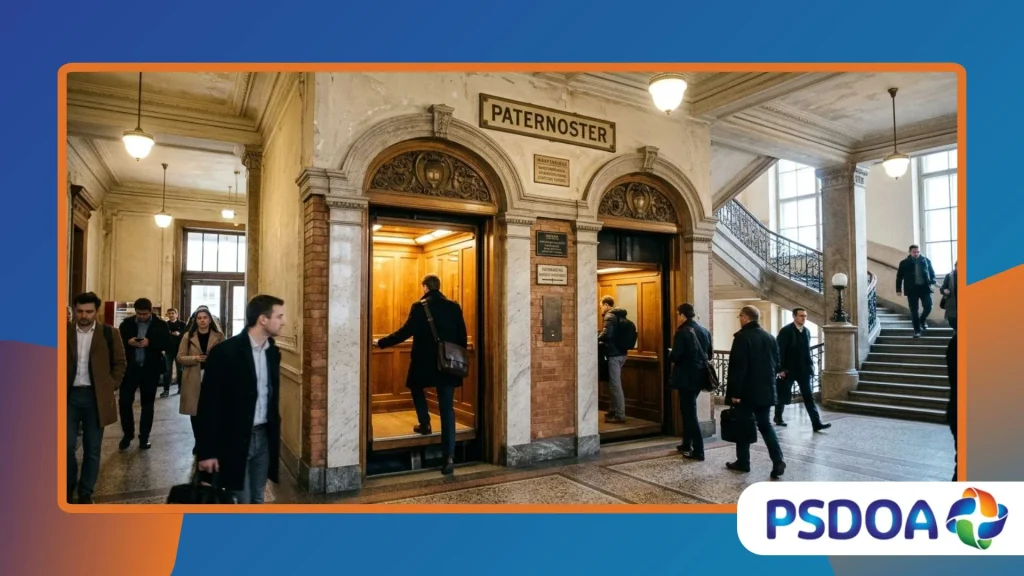
Paternoster Lift designs take their name directly from the Latin opening words of the Lord’s Prayer, Pater Noster, because the continuous loop of open compartments closely resembles the beads of a Catholic rosary slipping through praying fingers.
British architect Peter Ellis first built an early precursor in 1868 at Oriel Chambers in Liverpool, though Liverpool engineer Peter Hart patented the true continuous cyclic elevator design in 1877.
Dartford-based engineering firm J & E Hall subsequently commercialized the invention in 1884, installing the first major working model in a London office building.
Rather than relying on heavy counterweights and winding drums, early builders envisioned a vertical conveyor belt capable of absorbing relentless morning foot traffic without mechanical pauses.
Picture a Ferris wheel stretched vertically inside a narrow brick shaft, rotating steadily while passengers step on and off at every level.
That single mental image captures the entire operational philosophy behind Hart’s breakthrough patent, which prioritized uninterrupted human flow over individual cabin privacy.
During the rapid urbanization of late Victorian London and industrial Berlin, steam-powered hydraulic lifts struggled to keep pace with booming commercial registries and sprawling municipal bureaucracies.
By removing doors and operator levers altogether, engineers created a self-service transit loop that moved clerks, messengers, and executives effortlessly across six or seven stories.
How Does a Continuous Loop Elevator Move Without Stopping?
An electric motor mounted in the penthouse machine room drives two massive heavy-duty roller chains that loop endlessly over giant sprocket wheels at the top and bottom of the building shaft.
Open-fronted wooden cabins, typically sized for one or two standing passengers, hang suspended from pivot pins attached directly to these parallel chains.
As the motor turns at a steady, calibrated speed of roughly 0.3 to 0.4 meters per second, one side of the shaft carries cabins steadily upward while the adjacent side lowers descending cabins simultaneously.
Guide rails keep each compartment level and stable throughout its vertical travel, preventing any uncomfortable swaying as riders step across the narrow threshold gap.
Have you ever wondered what happens if a distracted rider forgets to step off at the top floor?
Instead of crashing into the ceiling, the cabin simply carries the passenger smoothly across the upper horizontal turnaround loop, passing right past the exposed drive gears before descending down the opposite shaft.
This seamless semicircular transfer relies on dual-pin suspension geometry that keeps the cabin floor completely horizontal even while traversing the curved top and bottom tracks.
Because both ascending and descending shafts operate simultaneously on a single motor loop, the balanced weight of opposing cabins dramatically reduces electrical draw compared to conventional traction elevators.
++ M-497 Black Beetle: America’s Forgotten Jet-Powered Train
Why Did Architects Favor This Design in Early Skyscrapers?
Early twentieth-century commercial architects across Central Europe embraced the Paternoster Lift because it solved a critical bottleneck in mid-rise civic halls, publishing houses, and corporate headquarters.
Before computerized group-control algorithms existed, conventional elevators required full-time human operators and suffered severe congestion whenever hundreds of employees arrived at 9:00 AM sharp.
A continuous cyclic lift could transport up to 600 passengers per hour in a fraction of the floor space required by a multi-car elevator bank.
For busy municipal buildings like Prague City Hall or the IG Farben Building in Frankfurt, uninterrupted circulation meant clerks never wasted productive hours staring at closed brass doors.
Construction crews also appreciated the mechanical simplicity and compact footprint of cyclic shafts during the interwar building boom.
Without complex relay banks, floor-leveling switches, or heavy steel door assemblies, maintenance technicians could inspect every chain link, bearing, and wooden floorboard visually during routine off-hours checks.
Building owners gained predictable energy consumption and decades of uninterrupted durability, with many original German and Czech installations operating reliably through two world wars.
That remarkable mechanical longevity explains why several pre-1939 units still carry civil servants and visitors every weekday morning in 2026.
Why Were New Paternoster Lifts Banned Despite Their Efficiency?
What Safety Risks Ended Commercial Installation?
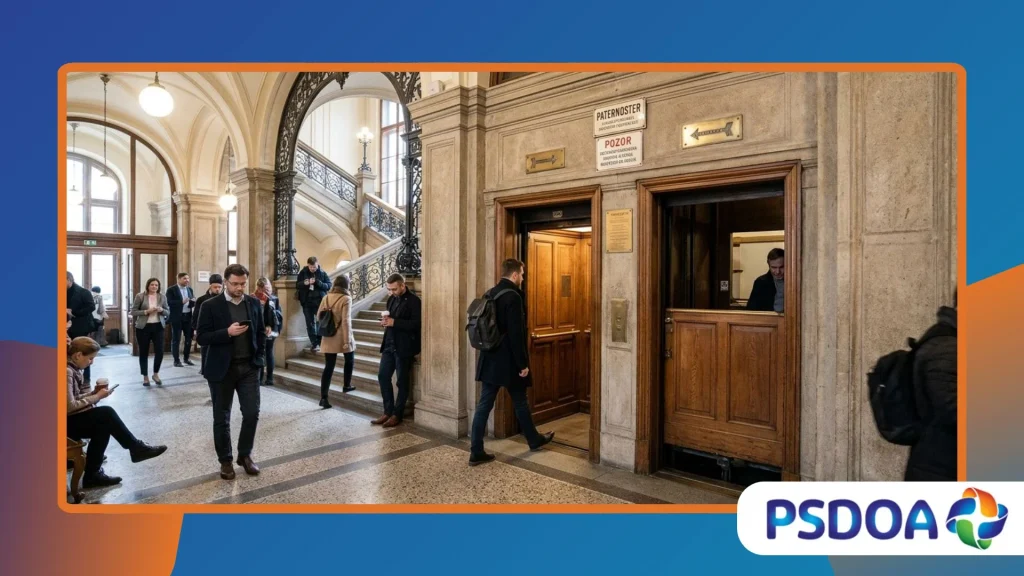
Regulatory authorities across Western Europe halted new installations in the mid-1970s primarily because open, doorless cabins demand constant physical agility and split-second timing from every passenger.
According to historical safety records compiled by the German Technical Inspection Association (TÜV), most recorded incidents involved hurried riders misjudging the step onto a moving platform or dropping bulky luggage across the threshold gap.
Unlike modern elevators equipped with infrared light curtains and interlocking hoistway doors, a cyclic lift relies on hinged safety flaps along the landing sill to prevent shearing injuries.
While hinged floorboards deflect upward if a foot or umbrella catches the edge, severe accidents still occurred when inexperienced visitors panicked mid-step.
Public liability standards shifted decisively in 1974 when West Germany amended its elevator safety ordinances to prohibit new continuous passenger lifts in commercial developments.
A fatal accident in Newcastle upon Tyne in 1989 further accelerated regulatory scrutiny in the United Kingdom, prompting university administrators and hospital boards to decommission aging campus units.
Insurance underwriters increasingly viewed doorless vertical transport as an unacceptable hazard for untrained visitors, children, and elderly citizens navigating public spaces.
Even though daily commuters mastered the rhythmic step effortlessly, modern building codes could no longer justify an open shaft moving past crowded corridors.
++ Information Kiosks That Predicted the Internet Age
How Do Modern Accessibility Laws Conflict With Cyclic Elevators?
Contemporary universal design mandates make it structurally impossible for a doorless, non-stop elevator to satisfy modern disability access regulations.
Under legislation such as the European Accessibility Act and national building standards across Germany, the United Kingdom, and the Czech Republic, every public vertical transit system must accommodate wheelchair users, visually impaired travelers, and individuals using mobility aids.
A cabin that never pauses cannot allow a wheelchair user to roll safely across the threshold, nor can it provide tactile floor announcements or Braille call panels.
Consequently, every building operating a historic cyclic lift today must also maintain an adjacent conventional elevator to comply with legal accessibility requirements.
Consider a modern corporate headquarters in Berlin where a visiting architect using a power wheelchair arrives for a third-floor design review alongside a colleague who regularly rides the building’s 1928 cyclic lift.
While the colleague steps smoothly onto the moving wooden cabin, the visiting architect requires a compliant enclosed lift with level floor stops, audio chimes, and wide automatic doors.
Regulatory inspectors enforce this dual-system standard strictly, ensuring heritage preservation never compromises equal public access.
By pairing preserved cyclic units with modern accessible lifts, historic buildings honor architectural history without excluding any member of the public.
Also read: The Walking Machines Designed Before Modern Robotics
Why Have Enthusiasts Fought to Save Remaining Units?
Whenever municipal authorities propose permanently shutting down a historic Paternoster Lift, architects, historians, and loyal commuters routinely mobilize fierce preservation campaigns to keep the chains turning.
In 2015, when the German Federal Ministry of Labour attempted to restrict public access to cyclic lifts under updated workplace safety rules, public outcry and media pressure forced lawmakers to reverse the ban within weeks.
Defenders argued that properly maintained units with emergency stop cords, clear instructional signage, and modern sensor upgrades pose minimal risk to informed adults.
Preservationists view these kinetic machines not as dangerous relics, but as living industrial monuments that foster a rare sense of shared urban rhythm.
Engineering guilds in Prague and Stuttgart have invested heavily in retrofitting surviving installations with concealed optical sensors, emergency brake relays, and upgraded motor controllers.
These discreet safety enhancements halt the entire drive chain instantaneously if an object or person crosses a restricted zone near the top or bottom turnarounds.
Thanks to such targeted modernization, heritage authorities classify working cyclic lifts alongside historic streetcars and mechanical clock towers as protected cultural infrastructure.
Riders who use them daily often describe the brief, doorless journey as a refreshing human ritual in an era dominated by touchscreens and automated barriers.
Where Can You Still Ride a Paternoster Lift Today?
Which European Cities Maintain Active Historic Units?
Roughly 250 functioning units remain active worldwide today, with the highest concentration preserved inside municipal halls, universities, and ministries across Germany and the Czech Republic.
Germany alone accounts for more than 200 operational installations, including famous working examples inside Berlin’s House of Ministries, Stuttgart City Hall, and Hamburg’s historic Kontorhaus district.
Prague ranks as the second great stronghold of cyclic vertical transit, boasting dozens of well-maintained units inside Prague City Hall, the Czech Technical University, and the Lucerna Palace complex.
Visitors walking into these landmarks can still watch locals step aboard with practiced ease, often carrying briefcases and morning coffees without spilling a drop.
Outside Central Europe, only a handful of surviving installations continue daily passenger service under strict heritage supervision.
In the United Kingdom, the University of Leicester’s Attenborough Tower famously operated one of Britain’s last active cyclic lifts until its scheduled decommissioning in 2017, leaving the Arts Tower at the University of Sheffield as the country’s premier functioning showcase.
Denmark also preserves a notable active installation at Christiansborg Palace in Copenhagen, where members of the Danish Parliament ride the open cabins between legislative offices.
Each of these surviving sites attracts architecture students, transit historians, and curious travelers eager to experience nineteenth-century kinetic engineering firsthand.
How Do Paternoster Lifts Compare to Modern Elevators?
Comparing a Victorian cyclic lift against a contemporary high-speed traction elevator highlights a fascinating trade-off between continuous low-rise throughput and high-altitude safety.
While modern destination-dispatch systems use predictive algorithms to group passengers traveling to upper floors of supertall towers, they still require waiting time, door cycles, and heavy counterweights.
In contrast, a continuous chain lift operates with zero dispatch delay for buildings under ten stories, delivering predictable passenger flow regardless of sudden hallway crowds.
Reviewing their core technical specifications side by side clarifies why cyclic lifts excelled in mid-rise civic buildings yet could never scale to modern skyscrapers.
| Feature / Specification | Paternoster Lift (Historic Cyclic) | Modern Traction Elevator |
|---|---|---|
| Operating Mechanism | Continuous endless roller chains | Steel ropes or belts with counterweight |
| Travel Speed | 0.3 to 0.4 meters per second | 1.5 to 20+ meters per second |
| Cabin Doors | None (completely open front) | Automatic interlocking sliding doors |
| Average Wait Time | 0 to 5 seconds (next cabin arrives) | 15 to 45 seconds depending on traffic |
| Passenger Capacity | 1 to 2 standing persons per cabin | 8 to 30+ persons per enclosed car |
| Accessibility Compliance | Not wheelchair accessible | Fully ADA / European Accessibility compliant |
| Building Height Limit | Typically 5 to 12 stories maximum | Unlimited (100+ stories possible) |
What Etiquette and Rules Apply When Riding One Today?
Stepping onto a moving compartment for the first time requires calm focus, clear spatial awareness, and strict adherence to posted hallway safety rules.
Passengers must wait directly in front of the ascending or descending opening, watch the approaching floorboard align with the landing sill, and step briskly inside with both feet planted firmly near the center of the cabin.
Keeping hands, umbrellas, backpacks, and loose coats well clear of the open front edge prevents accidental contact with the stationary shaft wall.
Riders should always face forward toward the landing so they can anticipate their destination floor and step off cleanly in one smooth motion.
Facility managers enforce clear prohibitions against transporting strollers, bicycles, heavy carts, pets, or oversized packages inside any cyclic compartment.
Children and visitors unfamiliar with the continuous rhythm are strongly advised to use the building’s conventional elevator rather than risking an awkward entry or exit.
If an item drops into the gap or a rider loses balance, pulling the red emergency stop cable mounted inside the shaft immediately cuts power to the drive motor.
Respecting these straightforward habits keeps both passengers safe and ensures heritage authorities can continue certifying these remarkable machines for future generations.
Preserving Kinetic Heritage in a Door-Closed World
Rediscovering the Paternoster Lift reveals how nineteenth-century engineers solved urban congestion through elegance, rhythm, and mechanical trust rather than complex microchips.
By eliminating doors and call buttons, Peter Hart and J & E Hall created an uninterrupted vertical street that moved thousands of daily workers with remarkable energy efficiency and zero waiting time.
Although modern accessibility mandates and strict liability standards rightly halted new installations, the roughly 250 surviving units across Germany, the Czech Republic, Denmark, and the United Kingdom stand as living proof that simple ideas often endure longest.
Whenever you step inside an older European civic building, look past the modern stainless-steel elevator doors to see if an open wooden cabin is still gliding quietly behind the scenes and share your own experience or favorite historic engineering marvel in the comments below.
Frequently Asked Questions
1. Is it dangerous to ride over the top or bottom loop in a Paternoster Lift?
Riding over the top or bottom turnaround is completely safe and poses no mechanical danger to passengers, even though popular urban legends claim the cabin flips upside down.
Dual pivot pins keep the wooden floor completely level and upright as the compartment glides smoothly around the upper or lower sprocket curve into the adjacent shaft.
Most modern heritage units simply trigger a gentle warning chime or display a lighted sign advising riders to step off at the next available landing.
2. Why did engineers stop building Paternoster Lifts in the 1970s?
Governments across Western Europe banned new installations during the mid-1970s due to heightened workplace safety standards and evolving public liability laws.
Open, doorless cabins moving continuously past stationary landings created tripping and shearing hazards for distracted visitors, children, and older adults.
Furthermore, strict modern disability access laws require elevators to stop level with the floor and accommodate wheelchairs, which a non-stop cyclic design cannot achieve.
3. How fast does a Paternoster Lift actually move?
A typical cyclic elevator travels at a steady, gentle speed of approximately 0.3 to 0.4 meters per second, which translates to roughly one floor every eight to ten seconds.
Engineers deliberately calibrated this pace to match a comfortable human walking stride so passengers can step on and off without losing their balance.
Although slower per meter than modern express lifts, the complete absence of door-closing delays makes it faster for short trips of two to five floors.
4. Where is the largest concentration of working Paternoster Lifts in the world?
Germany holds the largest number of operational cyclic lifts in the world, with more than 200 units still running daily inside historic ministries, city halls, and commercial office buildings.
Berlin, Stuttgart, Hamburg, and Frankfurt preserve several publicly accessible installations maintained under strict technical inspections.
The Czech Republic ranks second globally, with Prague alone housing dozens of active units inside municipal buildings, universities, and historic arcades.
5. What happens if something gets stuck between the moving cabin and the floor?
Every surviving unit features hinged safety flaps along the front edge of each cabin floor as well as along the stationary building landing sills.
If a shoe, bag strap, or umbrella catches between the moving platform and the floor edge, the hinged flap pivots upward immediately to prevent crushing injuries.
Simultaneously, modern optical sensors and emergency trip switches cut power to the main drive motor, bringing the entire chain loop to an instant halt.
