
M-497 Black Beetle: America’s Forgotten Jet-Powered Train
M-497 Black Beetle: America’s Forgotten Jet-Powered Train stands as one of the boldest transit experiments of the twentieth century.
Anúncios
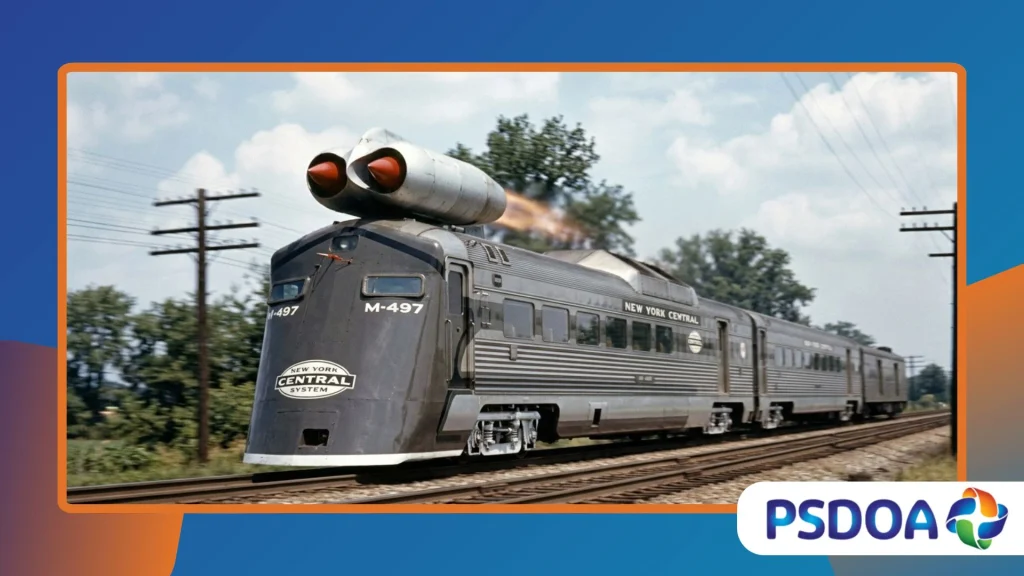
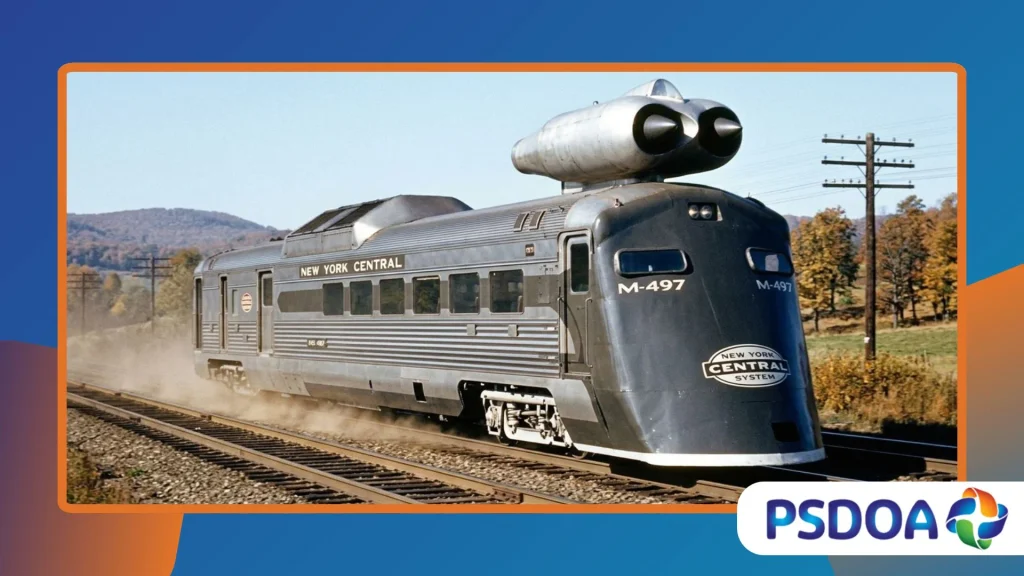
In July 1966, the New York Central Railroad strapped two surplus military jet engines onto a standard Budd Rail Diesel Car.
Engineer Don Wetzel designed this aerodynamic railcar to test high-speed travel on existing American freight tracks without building expensive new infrastructure.
During two days of testing between Butler, Indiana, and Stryker, Ohio, the experimental locomotive shattered the United States rail speed record.
It reached an astonishing 183.68 miles per hour on ordinary welded steel rails.
Despite proving that jet propulsion could conquer conventional tracks, railroad executives quietly dismantled the aircraft turbines and returned the car to mundane commuter service.
Inside This Article
- Origins and Engineering: How New York Central engineers built a supersonic-inspired train on a shoestring budget.
- The 1966 Record Run: What happened on the straightaway between Indiana and Ohio when the turbines roared to life.
- Technical Specifications: A complete breakdown of the prototype’s dimensions, power output, and performance metrics.
- Legacy and Demise: Why American railroads abandoned jet railcars despite their unmatched speed capabilities.
- Common Questions: Answers to the most frequent inquiries about the prototype’s fate and historical impact.
What Was the M-497 Black Beetle and Why Did Engineers Build It?
How Did the Decline of American Passenger Rail Spark This Project?
By the mid-1960s, American passenger railroads faced an existential crisis due to interstate highways and commercial aviation. Travelers abandoned slow regional trains in favor of sleek jetliners and personal automobiles.
New York Central Railroad President Alfred Perlman desperately needed a cost-effective breakthrough to prove that rail travel could still compete in the modern jet age.
Traditional high-speed rail required billions of dollars to lay specialized tracks and eliminate grade crossings.
Perlman challenged his Cleveland technical research center to achieve dramatic speed gains using existing track beds.
Does an aging railroad really need a clean-slate infrastructure overhaul just to move passengers faster between major Midwestern cities?
Who Designed the Jet-Powered Locomotive and What Parts Did They Use?
Lead engineer Don Wetzel approached the challenge with radical pragmatism and strict budgetary discipline.
Instead of commissioning a bespoke locomotive from scratch, Wetzel selected an existing 1953 Budd Rail Diesel Car numbered M-497.
His team removed the standard underfloor diesel engines and stripped the interior down to bare structural metal to accommodate heavy testing instruments.
To generate massive thrust, Wetzel acquired two used General Electric J47-19 turbojet engines originally built for Convair B-36 Peacemaker bombers.
Workers mounted the twin jet pods onto the forward roof section to avoid sucking track ballast into the intakes.
They also fabricated a sloped, sheet-metal nose cowling that gave the M-497 Black Beetle its distinctive aerodynamic silhouette and insect-like nickname.
++ Information Kiosks That Predicted the Internet Age
How Much Did the Entire Experimental Conversion Cost?
Financial constraints dictated every engineering decision at the Collinwood shops in Cleveland during the spring of 1966.
Wetzel’s crew relied heavily on surplus components and in-house fabrication to keep expenses remarkably low.
The entire modification project cost approximately $35,000, a microscopic sum compared to contemporary European and Japanese bullet train investments.
In today’s 2026 currency, that total research and development budget equals roughly $340,000.
Think of this conversion like bolting a Formula 1 engine onto a dependable family station wagon to test highway aerodynamics.
By repurposing existing rolling stock, New York Central bypassed years of costly manufacturing delays and proved that daring innovation does not always require massive capital.
How Fast Did the M-497 Black Beetle Travel During Its 1966 Test Runs?
Why Did Engineers Choose the Track Between Butler and Stryker?
Testing a 180-mile-per-hour train required an exceptionally straight, flat, and well-maintained stretch of railroad track.
Engineers selected a 69.5-mile segment of the New York Central main line running from Butler, Indiana, to Stryker, Ohio.
This specific corridor featured virtually no curves and utilized continuous welded rail, which eliminated the rhythmic clacking of traditional jointed tracks.
Before the runs began, track maintenance crews inspected every inch of the right-of-way and tightened spikes to prevent rail shifting.
Local law enforcement and railroad police closed all grade crossings along the route to protect motorists from the approaching jet blast.
Technicians also installed dozens of strain gauges and temperature sensors along the steel rails to measure structural stress in real time.
What Happened During the Historic Record-Breaking Run in July 1966?
On Saturday, July 23, 1966, Don Wetzel climbed into the front cab alongside a small crew of instrumentation specialists.
After igniting the twin J47 turbojets, the M-497 Black Beetle accelerated smoothly down the straightaway with a deafening roar that echoed across rural farmland.
As the speedometer climbed past 140 miles per hour, the modified Budd car handled the track with surprising stability.
The following morning, on July 24, Wetzel pushed the throttles to full military power during the final westbound pass.
The jet-powered railcar officially clocked 183.68 miles per hour, shattering the previous American rail speed record set decades earlier.
According to historical engineering logs preserved by the National Railway Historical Society, the standard steel wheels and track structure sustained zero structural damage during the 183.68 mph pass.
Also read: The Walking Machines Designed Before Modern Robotics
How Did the Crew Stop a Jet Train Safely on Standard Rails?
Accelerating a heavy passenger car to aviation speeds was only half of the engineering challenge.
Stopping a 51-ton vehicle from 183 miles per hour without melting the brakes required careful thermodynamic management.
The Budd car retained its standard off-tread disc brakes, which clamped onto cast-iron rotors mounted directly on the axles.
Wetzel began throttling down the jet engines miles ahead of the designated stopping zone in Indiana.
He applied the disc brakes gradually in controlled intervals to dissipate extreme kinetic energy without warping the rotors.
Even under maximum braking force, the M-497 Black Beetle came to a complete halt smoothly, demonstrating that existing braking hardware could handle extreme velocities.
Why Did the M-497 Black Beetle Never Enter Commercial Passenger Service?
What Practical Problems Prevented Daily Jet Train Operations?
Despite achieving headline-grabbing speeds, the experimental prototype suffered from severe operational flaws that made commercial deployment impossible.
The twin General Electric turbojets consumed aviation fuel at a staggering rate, burning hundreds of gallons during a single short test run.
Operating a fleet of jet trains would have bankrupted any passenger railroad through fuel expenses alone.
Noise and exhaust pollution presented equally insurmountable obstacles for suburban and urban transit corridors.
The deafening turbine roar shattered windows near tracks and terrified livestock across rural Ohio and Indiana.
Furthermore, the searing exhaust plume threatened overhead station canopies, wooden bridge timbers, and neighboring freight trains passing on adjacent tracks.
Read more: The Clockwork Airplane That Never Got Off the Ground
How Did the Penn Central Merger Affect High-Speed Rail Research?
Corporate politics sealed the fate of the project even faster than its engineering limitations.
New York Central executives viewed the 1966 tests primarily as a publicity stunt and a pure data-gathering exercise regarding high-speed wheel-to-rail dynamics.
They never intended to put jet-propelled railcars into daily revenue service carrying paying commuters.
In February 1968, the New York Central merged with its longtime rival, the Pennsylvania Railroad, forming the ill-fated Penn Central Transportation Company.
The newly combined management immediately slashed experimental research budgets to address mounting financial losses.
Meanwhile, the rival Pennsylvania Railroad already favored electric Metroliner trains for the Northeast Corridor, leaving zero corporate appetite for turbine experiments.
What Happened to the Original Railcar After the Jet Engines Were Removed?
Following the triumphant July 1966 runs, mechanics hauled the prototype back to the Collinwood shops and unbolted the twin J47 engines.
Workers removed the streamlined fiberglass and steel nose cone, restoring the car’s flat stainless-steel front end.
They reinstalled standard diesel powerplants beneath the floor and returned the vehicle to mundane commuter duties.
The historic railcar continued hauling everyday passengers around New York City for Penn Central and later Metro-North Railroad until 1984.
Although the original car was eventually scrapped after decades of commuter service, its twin J47 jet engines survived.
Today, aviation and rail enthusiasts can view one of the actual turbines displayed at the Lake Shore Railway Museum in North East, Pennsylvania.
Technical Specifications and Performance Data
| Specification Category | M-497 Black Beetle Data |
| Base Railcar Model | 1953 Budd Rail Diesel Car (RDC-3) |
| Propulsion System | Two General Electric J47-19 Turbojets |
| Total Combined Thrust | Approximately 10,400 pounds-force (46 kN) |
| Top Recorded Speed | 183.68 mph (295.6 km/h) |
| Record Date & Location | July 24, 1966 (Butler, IN to Stryker, OH) |
| Total Conversion Cost | ~$35,000 USD in 1966 (~$340,000 in 2026) |
| Test Track Length | 69.5 miles of continuous welded rail |
| Empty Vehicle Weight | Approximately 102,600 pounds (51.3 tons) |
A Bold Experiment That Still Challenges Modern Rail Ambitions
Nearly sixty years after tearing across the Midwestern plains, the M-497 Black Beetle remains the undisputed holder of the United States light-rail speed record.
Don Wetzel and his small engineering team proved that existing American freight corridors could safely support extreme velocities when properly maintained.
Their audacious $35,000 prototype exposed a critical truth that still haunts transportation planners in 2026: America’s rail speed bottleneck is rarely caused by physics, but rather by policy, funding, and infrastructure priorities.
Today, as modern transit agencies debate multi-billion-dollar high-speed rail corridors from California to Texas, this forgotten jet train offers a timeless lesson in resourceful engineering.
You do not always need unlimited budgets to challenge conventional limits and rewrite record books.
What other forgotten transportation prototypes do you think deserve a second look today? Share your thoughts and favorite historical rail stories in the comments below.
Frequently Asked Questions
Does the M-497 Black Beetle still hold the American rail speed record?
Yes, the prototype’s 183.68 mph run on July 24, 1966, remains the official all-time speed record for a self-propelled railcar in the United States.
While modern Acela trainsets in the Northeast Corridor are technically capable of reaching 165 mph, federal track restrictions limit their commercial operating speeds to 150 mph.
No conventional American train has officially surpassed the 1966 benchmark on domestic tracks.
Did other countries ever build jet-powered trains like the American prototype?
Yes, the Soviet Union built a remarkably similar experimental railcar called the SVL (High-Speed Laboratory Car) in 1970 using two Yak-40 regional jet engines mounted on an ER22 commuter train.
The Soviet prototype reached approximately 155 mph during testing before being abandoned due to high fuel consumption and noise.
France also tested jet-assisted aerodynamic trains, known as the Aérotrain, on an elevated concrete monorail track during the late 1960s and early 1970s.
Why did engineers mount the jet engines on the front roof instead of the rear?
Lead designer Don Wetzel placed the twin J47 turbojets over the front cab after wind tunnel testing revealed dangerous aerodynamic turbulence at the rear of the boxy Budd car.
Mounting the engines forward ensured clean, undisturbed airflow into the turbine intakes while keeping the intakes high enough above the ground to prevent sucking up loose gravel, ballast, or track debris.
Was the passenger cabin inside the M-497 comfortable during the 183 mph run?
No, because engineers completely stripped out all passenger seats, luggage racks, and interior wall panels prior to the test runs.
The interior was filled with heavy oscillographs, telemetry recorders, wiring harnesses, and ballast weights to simulate a full passenger load.
Crew members reported that the ride was surprisingly smooth on welded rail, though the cabin noise from the roof-mounted jets required heavy aviation ear protection.
Can visitors see the M-497 Black Beetle in a museum today?
Unfortunately, the stainless-steel Budd railcar itself was scrapped in the mid-1980s after completing two decades of ordinary commuter service in New York following the removal of its jet engines.
However, the original General Electric J47-19 jet engines were preserved, and one of them is currently on public display at the Lake Shore Railway Museum in North East, Pennsylvania, alongside archival photographs and blueprints.
