
La circulación termohalina del océano: la cinta transportadora de la vida.
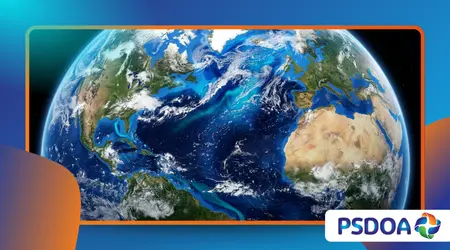
La circulación termohalina del océano Representa el pulso más poderoso, aunque silencioso, de nuestro planeta.
Anuncios
Traslada enormes volúmenes de agua a través de todas las cuencas oceánicas, actuando como un termostato global que impide que la Tierra se convierta en un mundo de extremos inhabitables.
Al distribuir el calor tropical hacia los polos helados, este sistema garantiza que nuestro clima se mantenga equilibrado.
Sin este flujo constante, el clima en Europa probablemente se sumiría en un silencio gélido permanente. Mientras tanto, los trópicos se transformarían en insoportables trampas de calor.
En 2026, los científicos monitorean estas corrientes con una urgencia que raya en la alarma.
Anuncios
La fuerza de esta corriente determina la supervivencia de las infraestructuras costeras y la base misma de la seguridad alimentaria mundial.
Dinámica de las profundidades marinas
- El motor de temperatura: El agua fría y densa del Atlántico Norte se hunde y da origen a la corriente submarina global.
- La mano invisible de la salinidad: Cómo la concentración de sal arrastra enormes masas de agua a través del oscuro lecho oceánico.
- Distribución térmica: El mecanismo que mantiene al Reino Unido significativamente más cálido de lo que sugiere su latitud septentrional.
- Alerta AMOC: Por qué la posible desaceleración de la rama atlántica es una preocupación primordial para los investigadores en esta década.
¿Qué impulsa la cadena de montaje global?
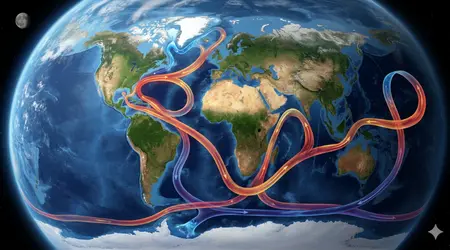
En las profundidades bajo las olas, La circulación termohalina del océano Funciona como una máquina impulsada por la densidad. Es un mundo donde la temperatura y el contenido de sal son las únicas leyes que importan.
El agua fría es físicamente más densa que el agua caliente, lo que provoca que “caiga” hacia el abismo en regiones específicas como el mar de Labrador.
Este hundimiento crea una poderosa succión en la superficie. Atrae aguas tropicales cálidas hacia el norte para llenar el vacío, continuando un ciclo tan antiguo como los propios océanos.
Es un proceso lento y majestuoso; una sola gota de agua puede tardar aproximadamente mil años en dar la vuelta completa al planeta.
¿Cómo provoca la sal el movimiento bajo el agua?
La sal añade peso físico al agua. Cuando se forma hielo marino en el Ártico, deja la sal en el líquido circundante.
Este proceso, conocido como “rechazo de salmuera”, crea una cascada descendente localizada en el océano. Esta agua densa y salina alimenta las corrientes profundas que se desplazan lentamente hacia el hemisferio sur.
Imagínalo como un ascensor gigante a cámara lenta. La sal y el frío actúan como los pesados pasajeros que obligan al vagón a descender al sótano.
Esta corriente profunda hace algo más que mover agua; transporta oxígeno vital al abismo, alcanzando profundidades donde la luz del sol jamás ha tocado la arena.
++ El mensaje interestelar que enviamos (y del que podríamos arrepentirnos)
¿Por qué es vital la transferencia de calor para Europa?
La rama superficial de este sistema, a menudo vinculada a la Corriente del Golfo, transporta una inmensa energía térmica hacia el noreste del Atlántico.
Esta liberación de calor equivale aproximadamente a la potencia de un millón de centrales nucleares. Es la única razón por la que ciudades como Londres o París no comparten el clima gélido y subártico de Labrador, Canadá.
Este intercambio no es solo una peculiaridad geográfica, sino la razón por la que el norte de Europa se convirtió en una potencia agrícola e industrial.
¿Por qué es alarmante el estado actual de los océanos?
Datos recientes sugieren que La circulación termohalina del océano Ha alcanzado su estado más débil en más de un milenio. Hay algo inquietante en la rapidez con que se está desarrollando esta situación.
El agua de deshielo de los glaciares de Groenlandia está llegando al Atlántico Norte, diluyendo la sal y, en esencia, "obstruyendo" el motor.
Cuando el agua está demasiado dulce, se mantiene a flote. Si el agua no puede hundirse, toda la cinta transportadora se detiene.
No se trata de una teoría lejana relegada a los libros de texto; los sensores ya están registrando un descenso medible en la Circulación Meridional de Vuelco del Atlántico (AMOC, por sus siglas en inglés).
Lea también: Cómo las colonias de hormigas imitan los sistemas de tráfico humano
¿Qué revelan las últimas mediciones de 2026?
Las observaciones de la red RAPID indican una desaceleración de la AMOC (circulación meridional de vuelco del Atlántico) durante el último siglo, con una tendencia más pronunciada observada desde 2020.
Este cambio ya se está relacionando con el clima errático en América del Norte y el desplazamiento de las zonas de lluvias en los trópicos.
Los investigadores debaten actualmente sobre la proximidad de un "punto de inflexión". Este es un umbral a partir del cual la circulación podría sufrir un colapso rápido e irreversible.
Un acontecimiento de esta índole redefiniría la geografía mundial, forzando una migración masiva de especies y seres humanos fuera de zonas que de repente se volverían inhóspitas.
Leer más: La extraña ciencia detrás de la masa negativa
Cómo el agua dulce altera el motor
El agua dulce es considerablemente más ligera que el agua salada. Actúa como una mancha de aceite en la superficie del océano, impidiendo que se hunda.
Esta "capa" impide que el océano respire, atrapando el calor en la superficie y privando a las profundidades marinas de oxígeno disuelto.
Imagínese intentar hundir un corcho en un vaso de agua. Eso es, en esencia, lo que el deshielo está provocando en el Atlántico Norte.
Esta interrupción rompe el ciclo natural, provocando que el calor se acumule en los trópicos mientras el norte comienza a enfriarse.
¿Cómo cambia este descubrimiento nuestro futuro?
Comprensión La circulación termohalina del océano Esto nos permite desarrollar modelos más precisos sobre el aumento del nivel del mar y la agricultura regional hasta la década de 2030.
El conocimiento del reloj interno del océano es nuestra mejor defensa contra los cambios que se avecinan en nuestra realidad atmosférica.
Al cartografiar estos cambios en las profundidades marinas, podemos apreciar los hilos invisibles que conectan el deshielo de un glaciar en el norte con una sequía en el hemisferio sur.
El océano no es simplemente una masa de agua; es un organismo en movimiento al que apenas estamos empezando a escuchar de verdad.
¿Se puede restablecer el flujo?
Las propuestas tecnológicas para 2026 incluyen la eliminación de carbono a gran escala para frenar el calentamiento del Ártico y estabilizar el equilibrio salino.
Si bien estas ideas están en su fase inicial, el objetivo principal es preservar el ritmo natural de la corriente más vital del planeta.
La naturaleza es resistente, pero la vertiginosa velocidad del cambio moderno está poniendo a prueba los límites de la capacidad de adaptación del sistema.
Proteger la "cinta transportadora" del océano es quizás el desafío científico más importante de nuestro tiempo.
¿Por qué está fallando la oxigenación de las profundidades marinas?
A medida que la circulación se ralentiza, las profundidades oceánicas se estancan. Esto da lugar a "zonas muertas" donde la vida marina no puede sobrevivir.
Sin el movimiento constante de la cinta transportadora, los pulmones del océano comienzan a fallar.
Esto impide que los nutrientes regresen a la superficie, lo que podría provocar un colapso en la cadena alimentaria marina de la que dependen miles de millones de personas para obtener proteínas.
Salud e impactos de la circulación global 2026
| Región | Flujo actual | Nivel de salinidad | Impacto en el clima | Riesgo biológico |
| Atlántico Norte | En declive (-15%) | Nivel crítico bajo | Tendencias de refrigeración | Alto |
| Océano Austral | Disminución de la velocidad | Normal | Derretimiento de la plataforma de hielo | Moderado |
| Atlántico tropical | Fortalecimiento | Alto | Riesgo de ola de calor | Extremo |
| Mar de Labrador | Debilitación | Bajo | Frecuencia de tormentas | Alto |
| Abismo profundo | Estancamiento | Normal | Pérdida de oxígeno | Muy alto |
| Cuenca Ártica | Calentamiento | Muy bajo | Desplazamiento del vórtice polar | Extremo |
Una investigación publicada a finales de 2025 destaca que las tasas de formación de sedimentos en aguas profundas se encuentran en su nivel más bajo registrado hasta la fecha.
Esto confirma que La circulación termohalina del océano Está reaccionando a los cambios en la superficie mucho más rápido de lo que predecían los modelos del siglo XX.
Monitorizar estas corrientes es como comprobar el ritmo cardíaco de un paciente; si el ritmo cambia, todo el cuerpo sufre las consecuencias.
Si perdemos la cadena de suministro, perdemos la estabilidad que permitió el florecimiento de la civilización humana. El océano sigue siendo nuestro mayor aliado contra el calor, pero incluso un aliado tiene un límite.
Cada gota de agua cuenta una historia de temperatura, salinidad y tiempo. Es un tapiz líquido que cubre el setenta por ciento de nuestro hogar, y es hora de que escuchemos el mensaje que las corrientes traen hasta nuestra puerta.
¿Cómo cambiará el clima de tu zona si finalmente se detiene el aporte de calor del océano? ¡Comparte tu experiencia en los comentarios!
El ritmo del corazón azul
La circulación termohalina del océano Esto sirve como un crudo recordatorio de que la Tierra es un sistema único e interconectado.
En las profundidades marinas, no existen eventos aislados. A medida que avanzamos hacia 2026, la prioridad es clara: debemos comprender el agua para proteger la tierra.
Preguntas frecuentes
¿La “cinta transportadora” es un objeto físico?
No. Es un modelo conceptual que se utiliza para describir la trayectoria global de las corrientes de agua impulsadas por la densidad y la temperatura.
¿Es posible que realmente se produzca el colapso de AMOC?
Sí. Los registros geológicos muestran que ya se ha derrumbado antes, sobre todo durante el período del Dryas Reciente, lo que provocó rápidos cambios climáticos.
¿El deshielo hace que el océano sea más salado?
En realidad, ocurre lo contrario. Los glaciares son de agua dulce, por lo que su deshielo diluye la concentración de sal del océano.
¿Cuánto tiempo tarda el agua en circular?
Un solo recorrido por toda la cadena de transporte global tarda entre 1.000 y 1.200 años en completarse.
El peso del agua: El estudio de las profundidades marinas es el estudio de nuestra propia supervivencia. Comprender la circulación oceánica es la única manera de desenvolvernos en un mundo que se transforma bajo nuestros pies.
