
Fairy Circles: The Mysterious Perfect Circles in Desert Grass
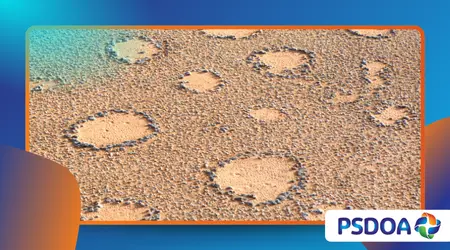
Fairy Circles represent one of the most intriguing geographical puzzles of our modern era, stretching across the arid landscapes of the Namib Desert.
Anúncios
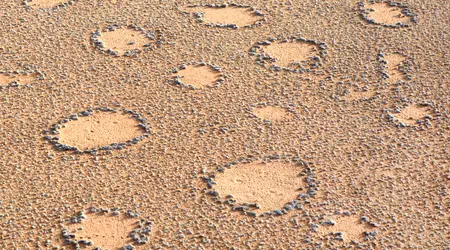
These barren patches, surrounded by rings of lush grass, appear like perfectly spaced polka dots dropped from the sky onto the red sand.
Scientists have debated their origin for decades, moving between theories of sand termites and complex plant competition for scarce water resources.
In 2026, new satellite imagery has revealed that these formations are not limited to Africa, appearing in remote parts of the Australian outback too.
The precision of these gaps suggests a level of environmental organization that challenges our traditional understanding of how desert ecosystems survive and thrive.
Highlights of the Desert Mystery
- Global Presence: Discovery of similar patterns in Australia and potentially Asia.
- The Rival Theories: Termite engineering versus plant self-organization.
- Ecological Resilience: How these circles act as water reservoirs for survival.
- Cultural Significance: Local myths versus the cold reality of biological data.
What are Fairy Circles and why do they form in the desert?
The mystery of Fairy Circles deepens as we analyze their spatial distribution, which follows a mathematical pattern known as Turing patterns.
These circles typically measure between two and fifteen meters in diameter, maintaining a ghostly barren center where nothing grows for years.
Local Himba people traditionally believed these were footprints of gods or patches of ground once poisoned by a dragon’s breath underground.
Ecologists now view them as a “living skin,” where the landscape breathes and adapts to extreme heat through these hexagonal gaps.
How does vegetation create these patterns?
Plants in these harsh environments act like neighbors sharing a single bottle of water; they organize themselves to maximize every drop.
Stronger grasses at the edge pull moisture from the center, effectively “starving” the middle zone to keep the outer ring alive.
This process creates a natural irrigation system that allows the surrounding vegetation to withstand droughts that would kill unorganized plant life.
It is a ruthless but efficient survival strategy where the group sacrifices a small patch of land to save the entire meadow.
++ Fogbows: The Ghostly White Rainbows Formed in Dense Mist
Do termites play a role in the construction?
The sand termite theory suggests these insects clear the grass to prevent water loss through transpiration, creating a private underground reservoir.
By removing the plants, termites allow rainwater to sink deep into the sand, where it stays protected from the scorching sun.
This creates a permanent damp spot that supports the termite colony during years when the desert receives almost zero rainfall.
Recent 2026 field studies show that both plant competition and termite activity might be working together in a rare biological partnership.
How do Fairy Circles manage water in extreme heat?
Investigating the Fairy Circles reveals a sophisticated hydraulic engineering system that operates without any human intervention or modern technology.
The barren soil in the center is more than just empty space; it acts as a funnel for the rare desert rains.
Because there are no roots in the middle to drink the water immediately, it seeps deeper into the lower soil layers.
This moisture then moves laterally toward the peripheral grass, providing a steady supply of life-sustaining fluid during the long dry months.
Think of it like a series of natural cisterns distributed across thousands of miles of otherwise inhospitable, dry, and unforgiving terrain.
Also read: Frost Quakes (Cryoseisms): When Frozen Ground Explodes Without Warning
Why is the soil composition different inside the ring?
Researchers have found that the sand within the circle has a higher moisture content than the sand under the dense grass.
This inverse relationship proves that the “hole” is the most valuable part of the ecosystem for storing and distributing essential resources.
The lack of organic matter in the center also prevents the growth of fungi that could otherwise harm the surrounding vegetation’s roots.
Nature essentially creates a sterile, protected zone to ensure the long-term viability of the plants that form the visible green border.
Read more: The Sinking Forest of Lake Kaindy: Trees Growing Underwater
Can these patterns predict climate change?
As global temperatures rise in 2026, the movement and expansion of these circles provide vital clues about increasing desertification in southern Africa.
If the circles grow larger or move closer together, it signals that the environment is under extreme stress from lack of water.
Scientists use these shifts as an early warning system to monitor the health of arid regions and the species that inhabit them.
The circles act as a biological barometer, measuring the pressure of the sun against the resilience of the earth’s most durable flora.
What does the latest research say about their global existence?
While Namibia was once thought to be the only home of Fairy Circles, the discovery of identical rings in Australia changed everything.
This suggests that the phenomenon is a universal response of nature to specific levels of aridity rather than a local biological fluke.
In the Pilbara region, these circles form in different soil types but maintain the same mathematical spacing found half a world away.
This global consistency points toward a fundamental law of physics or biology that dictates how life must arrange itself to persist.
Could it be that we are looking at a planetary blueprint for survival that we only recently began to decode and understand?
Is there a link to artificial intelligence mapping?
In 2026, AI algorithms scanning thousands of square miles of satellite data have identified potential “candidate sites” in the Gobi and Sahara.
These digital tools can spot the hexagonal symmetry of the circles even when they are obscured by shifting sands or rocky outcrops.
This technological leap is allowing us to map the distribution of these phenomena faster than any previous generation of scientists could manage.
The data suggests that these patterns are far more common than we previously assumed, hiding in plain sight across our planet’s deserts.
What are the main differences between African and Australian circles?
The African circles are often linked to termites, whereas the Australian versions seem almost entirely driven by the plant competition model.
Despite these different primary causes, the resulting visual pattern is nearly identical, which fascinates physicists studying self-organizing systems in complex nature.
This tells us that nature can arrive at the same perfect solution using different tools depending on what is available in the environment.
The goal remains the same: create a sustainable water management system that requires zero maintenance and survives for hundreds of years.
Comparison of Fairy Circle Locations (2026 Data)
| Feature | Namib Desert (Africa) | Pilbara Region (Australia) |
| Dominant Theory | Termite + Plant Hybrid | Primarily Plant Competition |
| Typical Diameter | 2 – 15 Meters | 4 – 7 Meters |
| Longevity | Up to 60 Years | Unknown (Likely Decades) |
| Soil Type | Sandy/Red Soil | Stony/Clay-heavy Soil |
| Occurrence | Millions of Circles | Scattered Large Patches |
Why should we protect these rare natural formations?
The Fairy Circles are not just a visual curiosity; they are vital carbon sinks in an environment where very few plants can survive.
By allowing grass to thrive in the desert, these formations help trap dust and nutrients that would otherwise blow away in storms.
They also provide a unique habitat for specialized insects and reptiles that depend on the moisture gradients created by the circles.
Destroying or disturbing these patterns could lead to a rapid collapse of the surrounding ecosystem, turning stable grasslands into shifting dunes.
Preserving them means protecting a mystery that still has much to teach us about water conservation in an increasingly thirsty world.
How does tourism affect the circles?
Unregulated off-road driving can crush the delicate crust of the barren centers, preventing the “funnel” effect from working during the next rain.
When the center is compacted, water runs off the surface instead of soaking in, which eventually starves the surrounding ring of grass.
Sustainable tourism initiatives in 2026 are now educating visitors on why they must observe these wonders from a respectful and safe distance.
Protecting the physical structure of the circle is essential for maintaining the biological clock that has ticked for over half a century.
Can we learn from their design for urban planning?
Architects are studying these natural patterns to design “sponge cities” that manage stormwater runoff more efficiently in dry, urbanized environments.
By mimicking the spacing of the circles, we can create urban green spaces that nourish themselves from collected rainwater without external irrigation.
The Fairy Circles offer a masterclass in decentralized resource management that could help us build more resilient cities in the face of drought.
Nature has already solved the problems of water scarcity; we just need to be smart enough to copy its ancient, proven designs.
Decoding the Desert’s Perfect Geometry
The mystery of these perfect rings continues to captivate the scientific community, proving that the earth still holds many secrets under its sand.
Whether created by hungry termites or thirsty plants, these formations represent the peak of natural engineering and a testament to life’s incredible endurance.
We must continue to study them with humility, recognizing that our most advanced computers are only just beginning to grasp their simple, elegant logic.
In the end, these circles remind us that even in the most desolate places, there is a hidden order and a purpose to every patch of ground.
As we face a future with more extreme weather, the lessons carved into the desert floor become more relevant and valuable than ever before.
Have you ever seen a natural pattern that looked too perfect to be real? Share your experience in the comments below!
Frequently Asked Questions
Can I visit the Fairy Circles?
Yes, they are most accessible in the Namib-Naukluft National Park in Namibia, but you must stay on marked paths to protect them.
Do they appear and disappear?
They have a lifecycle; they appear, remain stable for decades, and eventually “close” as grass moves back into the center during wet cycles.
Are there any in the USA?
While some “mima mounds” look similar, they are not true fairy circles; the phenomenon is currently strictly limited to very specific arid zones.
Can you grow crops in the circles?
No, the soil in the center is often nutrient-poor and lacks the microbial life necessary for traditional agriculture, as nature intended.
