
The Science of Sleep Paralysis and Shadow Hallucinations
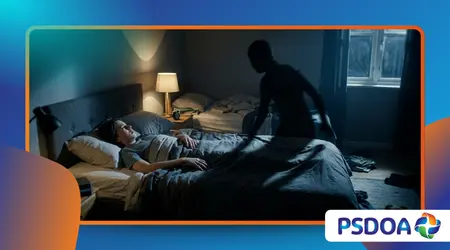
Science of Sleep Paralysis represents one of the most chilling frontiers where human neurology meets ancient folklore in our modern 2026 landscape.
Anúncios
Imagine waking up in the dead of night, your mind fully alert, yet finding your limbs leaden and unresponsive to your will.
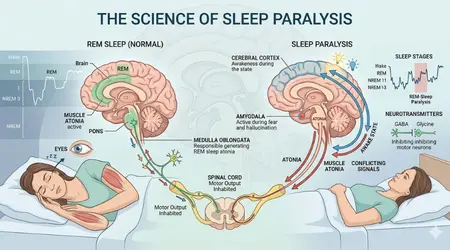
This terrifying state occurs when the brain prematurely exits the REM cycle while the body remains chemically locked in a protective “atonia.”
Recent breakthroughs in neuroimaging have finally allowed researchers to map the specific electrical misfires that conjure dark, looming figures in our rooms.
We are no longer looking at demons or spectral visitors, but at a fascinating biological “glitch” that defines the edge of consciousness.
Understanding this phenomenon requires a deep dive into how our brains construct reality while we are caught between two disparate worlds.
Highlights of This Investigation
- Mechanics of Atonia: How neurotransmitters like glycine paralyze your muscles during sleep.
- The Shadow Archetype: Neurological reasons behind the “intruder” hallucination.
- Prevention and Control: Evidence-based methods to break the cycle.
- Global Statistics: A look at who is most susceptible to these episodes.
What is the Science of Sleep Paralysis and Why Does It Happen?
The Science of Sleep Paralysis reveals that this condition is essentially a timing error between the brainstem and the cortex.
During Rapid Eye Movement (REM), the brain sends signals to paralyze voluntary muscles, preventing us from physically acting out our vivid dreams.
Sometimes, the transition to wakefulness happens too quickly, leaving the “paralysis switch” on while the conscious mind is already broad awake.
This disconnect creates a visceral sense of vulnerability, as the survival instincts of the brain scramble to interpret the sudden lack of movement.
How do neurotransmitters control this?
Chemicals like GABA and glycine act as the body’s internal deadbolt, silencing the neurons that move our arms, legs, and torso.
When these chemicals linger past the moment of waking, the individual experiences the heavy, “weighted” sensation often reported during these terrifying episodes.
++ The Ocean’s Thermohaline Circulation: The Conveyor Belt of Life
Is the amygdala responsible for the fear?
Yes, the amygdala enters a state of hyper-vigilance, sensing a threat because it cannot find the source of the body’s immobilization.
This primitive part of the brain then works overtime, scanning the dark room and inventing a “monster” to justify the intense biological panic.
Why Do We Hallucinate Dark Figures?
The Science of Sleep Paralysis explains “shadow people” as a projection of the body’s own neural map onto the external environment.
When the parietal lobe cannot locate the body’s position, it creates a “ghostly” duplicate that the mind perceives as an outside entity.
This often manifests as a dark silhouette standing in a corner or hovering directly over the person’s chest, causing immense psychological distress.
Consider it a “mirror error”; the brain sees its own reflection in the room but interprets it as a predatory, lurking stranger.
Also read: Time Dilation in Real Life: What Happens to Astronauts?
What is the “Intruder” hallucination?
This specific hallucination is fueled by the hyper-aroused midbrain, which interprets every shadow or creak in the house as a definitive threat.
The brain essentially “fills in the blanks” of the dark room with our deepest subconscious fears, rendered with startlingly high-definition clarity.
Read more: How Ant Colonies Mimic Human Traffic Systems
Why do some feel a physical presence?
The sensation of pressure on the chest is actually the brain’s misinterpretation of shallow REM breathing being restricted by a conscious effort.
Our ancestors called this the “Old Hag,” but we now know it is simply a physical mismatch between lung capacity and awareness.
How Does Modern Science Explain These Experiences?
Investigating the Science of Sleep Paralysis in 2026 has led to the discovery of “multisensory integration” failures in the temporoparietal junction.
This specific brain region is responsible for distinguishing “self” from “other,” and its malfunction during sleep creates the spectral “other.”
A 2024 study by the Global Sleep Initiative found that nearly 40% of recurring sufferers also experience “out-of-body” sensations during these events.
These are not spiritual journeys, but rather the brain’s desperate attempt to resolve the conflict between sensory input and motor output.
2026 Sleep Paralysis Prevalence and Impacts
| Demographic | Prevalence Rate | Primary Hallucination Type |
| General Population | 7.6% | Visual Shadows |
| Students (High Stress) | 28.3% | Chest Pressure |
| Narcolepsy Patients | 50.1% | Auditory / Vocalizations |
| Shift Workers | 15.4% | Sense of Presence |
What is the role of sleep deprivation?
Missing sleep or having an erratic schedule disrupts the stability of REM cycles, making “REM intrusion” into wakefulness much more likely.
When the body is exhausted, it crashes into REM faster, increasing the chance of a messy, incomplete transition back to the waking state.
What Are the Most Common Triggers Today?
The Science of Sleep Paralysis suggests that sleeping in the supine position (on your back) is the single greatest physical trigger.
Gravity causes the tongue and soft tissues to slightly narrow the airway, which the brain interprets as a choking “demon” or intruder.
Environmental factors, such as high stress and excessive blue light exposure before bed, also chemically prime the brain for these glitches.
Maintaining a strict “sleep sanctuary” and consistent routine is the most effective way to keep the neural “paralysis switch” working correctly.
Does caffeine play a part?
Stimulants consumed late in the day can fragment sleep architecture, leading to micro-awakenings that occur precisely when the body is paralyzed.
By keeping the mind “half-awake,” caffeine prevents the smooth slide into deep, non-REM stages where paralysis is naturally lifted by the brain.
How does anxiety influence the content?
While the biology is universal, a mind prone to anxiety will create more aggressive and terrifying hallucinations than a calm one.
The “shadow” is essentially a mirror of your current internal stress levels, projected onto the wall of your bedroom in real-time.
How Can You Break the Spell of Paralysis?
Mastering the Science of Sleep Paralysis means learning how to communicate with your brain while your body is still in lock-down mode.
Instead of fighting the paralysis which increases panic experts recommend focusing entirely on moving a single small muscle, like a pinky toe.
This “micro-movement” sends a clear signal to the motor cortex that you are trying to move, forcing the brain to reboot.
Another effective technique involves rapid, intentional eye movements, as the eye muscles are rarely affected by the chemical paralysis of REM.
Why shouldn’t you try to scream?
Attempting to vocalize often fails because the vocal cords are paralyzed, which only heightens the “suffocation” panic and intensifies the hallucination.
Remaining calm and breathing steadily is the fastest way to convince your amygdala that there is no actual emergency in the room.
Can “Lucid Dreaming” help?
Many people have successfully trained themselves to recognize the onset of an episode, turning a terrifying encounter into a controlled scientific observation.
Once you realize the “shadow person” is just a neural projection, the fear dissipates, and the episode usually ends within a few seconds.
Is There a Future Cure for This Condition?
Current research into the Science of Sleep Paralysis is exploring the use of wearable tech to detect early signs of REM fragmentation.
In 2026, smart mattresses are being developed to gently vibrate the user out of a supine position if paralysis triggers are detected.
Pharmacological interventions are also becoming more precise, targeting the specific glycine receptors that fail to reset during the morning wake-up.
Until these technologies are perfected, education remains our strongest tool in reclaiming the night from the “shadows” of our own minds.
What is the “Vibration” technique?
Some researchers suggest that high-frequency audio or mild haptic feedback can “jolt” the brainstem out of its frozen state without causing trauma.
This approach mimics the natural process of waking up, providing the external stimulus the brain needs to complete the transition.
How can we destigmatize the experience?
By sharing these scientific facts, we move away from the “haunted” narrative and treat the condition as a common neurological hiccup.
No one should feel “crazy” for seeing a shadow; it is simply your brain being a bit too creative at the wrong time.
Conclusion: Turning the Light on the Shadows
The Science of Sleep Paralysis proves that our most terrifying nightmares often have the most logical, biological explanations behind them.
We have moved from the era of exorcisms to the era of electroencephalograms, finding that our “demons” are merely misfiring neurons and chemical lags.
By understanding the mechanics of REM atonia and the hyper-vigilance of the amygdala, we can face the night with curiosity rather than dread.
If you find yourself frozen tonight, remember: your body is just protecting you, and your mind is just trying to make sense of it.
Will you try to wiggle your toe the next time a “shadow” visits, or will you let the panic take the lead?
Have you ever felt a presence in the room while frozen? Share your story in the comments so we can demystify this together.
Frequently Asked Questions
Is sleep paralysis a sign of mental illness?
Absolutely not; it is a common sleep transition error experienced by millions of healthy individuals worldwide every single year.
Can I die from sleep paralysis?
No, it is physically impossible to die from the episode itself, as your autonomic functions like your heartbeat and breathing continue automatically.
Does sleeping on my side really help?
Yes, statistics show that side-sleepers experience significantly fewer episodes because the airway remains more open and the “intruder” reflex is lower.
Why does it feel like it lasts for hours?
Time perception is distorted during REM states, making a thirty-second episode feel like an eternity of struggle for the panicked conscious mind.
