
Pre-Internet Data Transmission Devices That Were Years Ahead
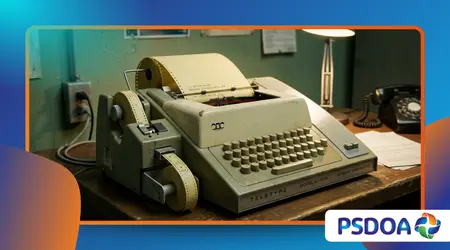
Pre-Internet Data Transmission Devices represent a fascinating chapter in history where brilliant engineers built the foundations of our modern hyper-connected world using analog tools.
Anúncios
Long before the first web browser existed, visionary inventors successfully moved complex information across continents using electricity, light, and even specialized mechanical signals.
These ancestors of our current fiber-optic cables and wireless routers proved that the human hunger for instant communication has always outpaced available technology.
Understanding these forgotten milestones helps us appreciate the massive risks taken by early pioneers who dared to imagine a world without physical borders.
Essential Guide to Analog Connectivity
- The Pantelegraph: Discover how the 19th-century French postal system sent high-resolution images decades before the first digital scanner appeared on shelves.
- Acoustic Couplers: Learn how early home computer users bypassed strict telephone regulations by literally “talking” to machines through standard handsets.
- The Minitel Legacy: Explore the massive French network that offered online shopping, banking, and chat rooms while most of the world used paper.
- Teletype Evolution: Analyze the rugged machines that automated global newsrooms, creating the very first real-time text transmission standard for international journalism.
How did Victorian engineers send images through wires?
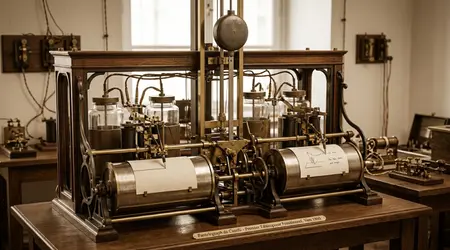
Pre-Internet Data Transmission Devices like the Pantelegraph shocked the public in 1865 by successfully transmitting signatures and drawings between Paris and Lyon.
Giovanni Caselli utilized a large pendulum to synchronize the sending and receiving units, ensuring every ink stroke arrived with surprising mathematical precision.
This mechanical marvel proved that the concept of a “fax” is nearly as old as the American Civil War, predating digital logic entirely.
It relied on electrochemical reactions on treated paper, turning simple electric pulses into visible, permanent records of human thought and intent.
What made the Pantelegraph so revolutionary?
Caselli’s invention allowed banks to verify signatures instantly across hundreds of miles, a process that previously took days via horse-drawn mail carriages.
It established the principle that any physical document could be broken down into repeatable electrical signals for rapid long-distance reconstruction.
The device operated with such efficiency that the French government maintained the service for years before traditional telegrams reclaimed the market dominance.
It remains a testament to the idea that sophisticated data transmission does not require silicon chips or complex modern programming languages.
++ Forgotten Inventions Designed for the Deaf in the Victorian Era
Why did we forget this early image transfer?
As the telephone rose to prominence, the world shifted its focus toward real-time voice communication, leaving the expensive Pantelegraph behind as a niche curiosity.
Maintaining the heavy pendulum synchronization required specialized technicians, making it too cumbersome for the average small business or household user.
The cost of sending one page equaled a laborer’s weekly wage, limiting its use to the wealthiest financial institutions and government high offices.
Eventually, the technology faded into the background, waiting for the digital revolution to rediscover the power of visual data sharing.
Why was the Minitel decades ahead of the Web?
France launched the Minitel system in the early 1980s, effectively creating the first mass-market digital society years before the general public heard of Google.
Millions of households received free terminals, allowing them to access over 25,000 different services including directory lookups and travel bookings.
This network operated on a proprietary videotex standard, providing a stable and secure environment for early e-commerce and social interaction across the country.
It was the first time an entire nation experienced the convenience of an “always-on” data connection within their own living rooms.
Also read: Forgotten World Fairs That Showcased Now-Lost Tech
How did the Minitel change social habits?
French citizens used the “Messageries Rose” to chat with strangers, inventing the digital social dynamics we now see on modern platforms like WhatsApp.
It democratized information, giving everyone equal access to the national phone directory and train schedules without leaving their front door.
Small businesses flourished by offering specialized digital services, proving that a thriving online economy could exist without high-speed broadband or powerful PCs.
The Minitel created a generation of tech-savvy users who understood the value of remote data long before their global peers.
Read more: How 1950s Concept Cars Predicted Autonomous Driving
What caused the decline of this French giant?
The closed nature of the Minitel system meant it could not easily communicate with the rapidly expanding and open global internet of the 1990s.
While it was incredibly efficient, its low-resolution monochrome screen could not compete with the rich multimedia experiences offered by modern web browsers.
France eventually decommissioned the service in 2012, but its influence on modern user interface design and digital privacy laws remains deeply significant.
It serves as a reminder that being first to market does not always guarantee a permanent place in the technological future.
How did acoustic couplers bridge the gap?
Inventors created Pre-Internet Data Transmission Devices like acoustic couplers to solve the legal and physical problem of connecting computers to strict telephone lines.
These devices held a physical phone handset over a speaker and microphone to convert digital data into audible, high-pitched whistles.
This ingenious workaround allowed early hackers and hobbyists to exchange files without needing a direct electrical connection to the phone company’s sensitive equipment.
It turned every public payphone into a potential data terminal, sparking a revolution in mobile computing and early digital activism.
Why was “sound” the chosen medium?
During the mid-20th century, phone companies owned all the hardware and strictly prohibited any third-party devices from being plugged into their wall jacks.
Using sound waves was a clever “non-invasive” way to transmit data without violating the rigid terms of service of the era.
It required a quiet room and a steady hand, as any background noise could easily corrupt the delicate stream of binary information being shared.
This method was slow often only 300 bits per second but it represented the birth of the personal telecommunications movement globally.
How did this lead to the modern modem?
As regulations loosened following the landmark Carterfone decision, engineers moved from acoustic coupling to direct-connect modems that plugged straight into the telephone lines.
This transition allowed for higher speeds and more reliable connections, paving the way for the high-bandwidth internet we use every day.
The acoustic coupler is the “missing link” in tech history, proving that human ingenuity can always find a path around restrictive corporate rules.
Have you ever wondered how we moved from whistling at machines to 5G speeds in just a few short decades?
Historical Comparison of Early Data Networks
| Device/System | Active Era | Transmission Method | Primary Use Case | Legacy Impact |
| Pantelegraph | 1860s | Pendulum / Electro-chemical | Signature Verification | Precursor to Fax |
| Teletype (TTY) | 1920s-80s | Baudot Code / Mechanical | News & Telegrams | Standardized Digital Text |
| Minitel | 1980s-2012 | Videotex over Phone Lines | E-commerce / Chat | First Mass Online Society |
| Acoustic Coupler | 1960s-80s | Audio Tones (FSK) | Remote Computing | Birth of Personal Modems |
| Radio Teletype | 1940s-Now | Shortwave Radio | Military / Marine | Wireless Data Foundations |
According to historical records from the Smithsonian Institution, the Pantelegraph was so reliable it achieved a 95% successful transmission rate during its initial Paris-Lyon trials.
This level of consistency for Pre-Internet Data Transmission Devices in the mid-1800s remains a staggering achievement for early telecommunications experts.
Using a Minitel was like having a smart assistant in 1982; it didn’t have the “brain” of AI, but it had the “reach” of the world.
It shows us that technology is often more about the access it provides than the raw power of its hardware.
We are currently standing on the shoulders of giants who didn’t even have access to a simple pocket calculator to help them.
These devices are the silent ancestors of every “like,” “share,” and “send” that defines our current existence in the 2026 digital landscape.
History proves that Pre-Internet Data Transmission Devices were never just failures or dead ends; they were the essential experiments that made the modern world possible.
Every time you send a high-res photo in a second, you are using concepts first tested with pendulums and paper.
The story of data is a story of human connection refusing to be silenced by distance or lack of tools. We continue to build better bridges, but the desire to cross the river remains the same as it was in 1865.
Do you remember a time when getting online involved a series of loud, mechanical beeps and boops? Share your experience in the comments!
The Foundation of Connectivity
In summary, Pre-Internet Data Transmission Devices like the Minitel and the Pantelegraph were not just gadgets; they were the blueprints for our digital future.
By studying these “forgotten” ideas, we gain a clearer perspective on the relentless pace of innovation and the eternal human drive for universal communication.
Frequently Asked Questions
What was the fastest pre-internet speed?
Most early systems like Minitel ran at 1200 bps for receiving, which is roughly 0.001 Mbps, yet it was enough for basic text and banking.
Were these devices secure?
Because they used proprietary networks and analog signals, they were often harder to “hack” in the modern sense, though they lacked today’s encryption standards.
Did the US have a Minitel equivalent?
Systems like Compuserve and Prodigy offered similar features in the 80s, but they required expensive PCs instead of the cheap, dedicated terminals used in France.
Can you still use an acoustic coupler today?
While technically possible for fun, modern digital phone lines (VoIP) often compress audio in a way that destroys the specific frequencies needed for data transfer.
