
The Audio Book Records of the 1930s
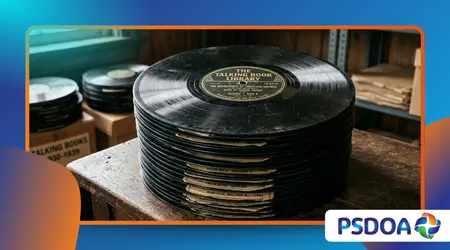
Audio Book Records of the 1930s laid the fundamental groundwork for our modern digital streaming giants, proving that the thirst for narrated literature is nearly a century old.
Anúncios
Long before Audible or Spotify existed, visionaries experimented with vinyl and shellac to bring the written word to those who could not see or read.
These ancient grooves represent a triumph of empathy over technological limitation, emerging during the Great Depression as a beacon of accessibility.
Today, we look back at these heavy, fragile discs not as obsolete junk, but as the high-tech ancestors of our current linguistic and literary culture.
The Evolution of Sound
- The Foundation: How the Library of Congress sparked a sonic revolution for the blind.
- Technological Hurdles: Solving the problem of limited playback time on early 78 RPM discs.
- Cultural Shift: Moving literature from the silent page to the shared living room speaker.
- Modern Legacy: Why these recordings remain vital for historians and audiophiles in 2026.
What were the original Talking Books?
The Audio Book Records of the 1930s were officially known as “Talking Books,” a project spearheaded by the American Foundation for the Blind and the Library of Congress.
They utilized 12-inch records spinning at 33 1/3 RPM, a radical departure from the standard 78 RPM music discs of that era.
Engineers had to innovate rapidly to fit more than five minutes of speech on a single side, eventually achieving fifteen minutes per record.
This technical leap allowed for entire novels to be recorded, though a single book often required a heavy box of several dozen double-sided discs.
How did they record these?
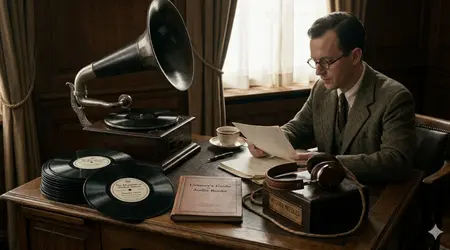
Narrators in the 1930s were often professional actors or radio personalities who had to maintain perfect diction and consistent pacing for hours on end.
Unlike modern digital editing, a single mistake on a wax master meant the entire side had to be rerecorded from the very beginning.
The recording studios were rudimentary but effective, using heavy acoustic insulation to block out the sounds of a bustling, pre-war New York City or Washington D.C.
These pioneers understood that clarity was paramount, as their primary audience relied entirely on sound to navigate the worlds of Shakespeare or Dickens.
++ Forgotten Moon Colony Plans by the U.S. Air Force
Why was the 33 1/3 RPM speed chosen?
Choosing a slower rotation speed was a stroke of genius that effectively tripled the amount of information a single disc could carry.
While music lovers demanded the high fidelity of faster speeds, the spoken word remained perfectly intelligible even with the reduced frequency response of the slower discs.
This decision essentially created a “low-bandwidth” solution for literature decades before the term existed in our modern computing vocabulary.
It allowed the “Books for the Adult Blind” program to distribute massive amounts of information through the postal service without overwhelming the recipients with weight.
Why did these records disappear from history?
The Audio Book Records of the 1930s eventually succumbed to the relentless march of magnetic tape and the rise of the compact cassette in later decades.
By the 1950s, the fragile shellac and vinylite discs were seen as cumbersome relics compared to the portability of the new reel-to-reel systems.
Most of these records were played until the grooves wore flat, as the heavy needles of the era were particularly destructive to the soft surfaces.
Consequently, finding a complete, playable set of a 1930s talking book is a rare feat for any modern museum or private collector.
Also read: Forgotten World Fairs That Showcased Now-Lost Tech
What happened to the players?
The government-issued record players were robust machines built to survive decades of use, but they were eventually recalled and destroyed as technology advanced.
These players were the “Kindles” of their time, provided for free to those who met the medical requirements for the national accessibility program.
Many users formed deep emotional bonds with these machines, as they represented their only window into the broader world of contemporary thought and classic fiction.
As the players were phased out, a unique chapter of industrial design and social welfare quietly closed its doors to the public.
Read more: How 1950s Concept Cars Predicted Autonomous Driving
How did the war affect production?
World War II redirected the materials needed for record production, such as shellac and various resins, toward the war effort and military communication.
This caused a significant slowdown in the distribution of new titles, forcing many users to listen to their existing collections repeatedly for several years.
Narrators also went off to serve, leaving the studios quiet and the production lines stagnant until the conflict finally ended in late 1945.
This gap in production contributed to the eventual shift in technology, as post-war innovation favored newer, more durable materials for sound reproduction.
Why is this invention relevant in 2026?
Studying the Audio Book Records of the 1930s provides a sobering perspective on how we value information and accessibility in our current high-speed digital age.
In 2026, we take instant downloads for granted, forgetting that a single chapter once traveled across the country in a wooden crate.
Did you know that the “Pratt-Smoot Act” of 1931 is still cited in modern accessibility lawsuits as the legal foundation for the right to read?
This historical continuity proves that the struggle for inclusive design is a marathon, not a sprint, across the technological landscape.
What does the data show?
Historical records from the Library of Congress indicate that by 1935, over 27 titles had been fully recorded and distributed to regional libraries.
While that seems small now, it represented the first time in history that non-Braille readers could independently access full-length literature without a human reader.
Today, researchers use AI to clean the hiss and crackle from these surviving discs, revealing the voices of a generation long since passed.
This restoration work is vital for preserving the authentic cadence and linguistic style of the early 20th century for future linguistic scholars.
Why was the social impact so high?
The psychological benefit of these records cannot be overstated; they rescued thousands of individuals from the profound isolation of a world without accessible text.
Analogously, these records were the “internet” for the blind, providing a stream of knowledge that bypassed the physical limitations of the eye.
It gave veterans of the first World War a way to stay informed and entertained, fostering a sense of dignity that had been previously lost.
The community that formed around these shared listening experiences was the precursor to the modern online book clubs and discussion forums we enjoy today.
1930s Audio Record vs. Modern Digital Specs
| Feature | 1930s Talking Book Record | 2026 Digital Audio Book |
| Material | Shellac / Vinylite Blend | Binary Data / Cloud Stream |
| Rotation Speed | 33 1/3 RPM | Not Applicable |
| Storage Capacity | 15 Minutes per side | 100+ Hours per device |
| Weight | ~300g per disc | 0g (Digital) |
| Durability | Fragile / Breaks easily | Permanent / Self-healing |
| Distribution | US Postal Service | Instant Global Download |
| Cost in 1930s | Funded by Federal Grants | Subscription Based |
| Audio Quality | 100Hz – 5000Hz (Lo-Fi) | 20Hz – 22,000Hz (Hi-Fi) |
| Narrator Source | Live Stage Actors | AI Voice / Professional |
| Player Type | Government Issued | Multi-device App |
According to a 2025 study by the Smithsonian Sound Archive, less than 5% of the original Audio Book Records of the 1930s survive in playable condition today.
This staggering loss highlights the importance of digitizing these remaining artifacts before the physical grooves degrade into silence forever.
Reflecting on the Audio Book Records of the 1930s allows us to appreciate the sheer determination required to innovate in the face of economic collapse.
These records were a promise kept by a society to its most vulnerable members, ensuring that the light of knowledge never truly faded.
The legacy of these discs lives in every podcast we download and every voice command we give to our devices in 2026.
We owe a debt of gratitude to the engineers who dared to spin the world a little slower so that everyone could hear its stories.
The journey of the spoken word is a testament to our desire to connect, learn, and grow, regardless of the medium we use.
As we move into even more advanced forms of storytelling, let us not forget the heavy vinyl discs that started it all.
What is your favorite book that you think would have sounded best on a crackling 1930s record player? Share your experience in the comments below!
Frequently Asked Questions
Who was the most famous narrator of that era?
Alexander Scourby is often cited as the “Voice of the 20th Century,” though he began his legendary career slightly after the initial 1930s boom.
Can I listen to these recordings today?
Yes, the Library of Congress and the Internet Archive have digitized several early titles, allowing you to experience the authentic sound of the 1930s.
Were these records available to the general public?
Initially, they were strictly reserved for the blind and visually impaired to avoid competition with the traditional book publishing industry of the time.
How heavy was a full audiobook?
A novel like “Gone with the Wind” would require dozens of records, often weighing over 20 pounds in its protective shipping container.
