
Fata Morgana Mirage: The Optical Illusion That Floats Cities
Fata Morgana Mirage shapes the horizon when unique atmospheric thermal layers bend light rays across vast expanses of water or ice, creating surreal visions of floating cities, towering castles, and distorted landscapes that have fascinated mariners and scientists for centuries.
Anúncios
Atmospheric optics reveals that this complex superior mirage occurs primarily due to temperature inversions, where a layer of warm air rests directly above a much colder surface layer, acting as a natural refracting lens.
What you will find in this special report:
- Understanding the fundamental atmospheric conditions required to trigger superior optical inversions.
- Examining historical sightings, from polar explorations to coastal European maritime folklore.
- Analyzing the scientific mechanics of light bending through varying air density gradients.
- Reviewing a structured data overview comparing standard mirages with complex atmospheric phenomena.
- Exploring answers to frequently asked questions regarding visibility, frequency, and modern sightings.
What is a Fata Morgana Mirage?
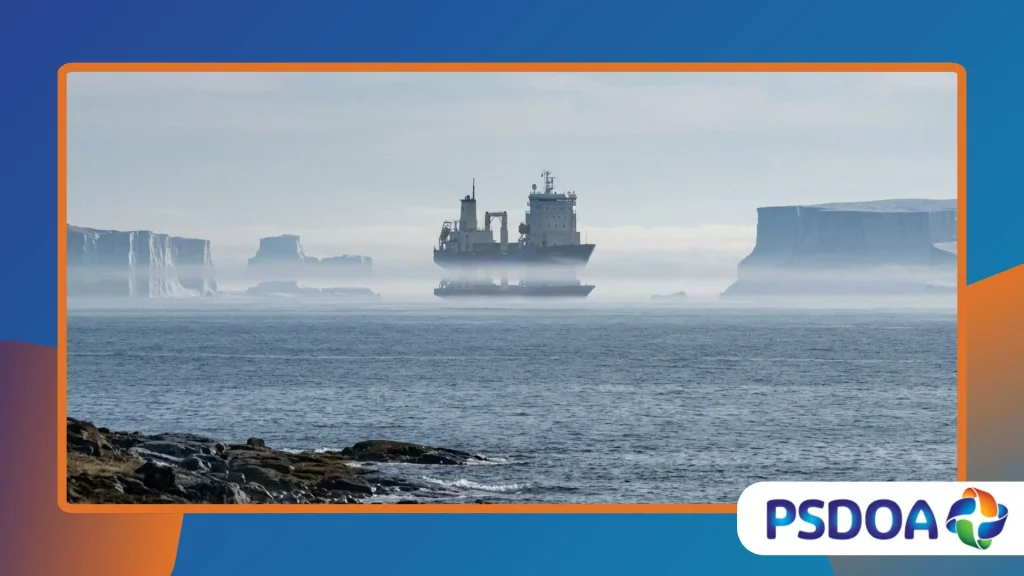
How Does Thermal Inversion Create Floating Cities?
Thermal inversions trap dense, cold air near the Earth’s surface while blanketing it with much warmer air currents aloft.
This sharp temperature boundary creates a dramatic refractive index gradient that bends incoming light rays downward toward an observer’s eye.
As light travels across long distances over cold ocean currents or glacial ice fields, distant coastal buildings or flat horizons are stretched vertically.
Observers witness breathtaking architectural silhouettes floating majestically above the actual sea level, transforming ordinary coastlines into mythical skylines.
Why Do Remote Landscapes Appear Suspended in Air?
Light rays bend because photons travel at varying speeds through air masses possessing distinct temperatures and molecular densities.
When horizontal light rays pass through these stratified thermal layers, they curve along the curvature of the Earth rather than traveling in straight lines.
This optical bending tricks the human visual cortex into projecting distant objects upward into the sky.
Mariners navigating polar waters often describe seeing phantom mountains and hovering harbors that remain completely invisible under normal atmospheric conditions.
++ Marine Snow: The Strange Underwater Blizzard in Deep Oceans
Where Do These Complex Optical Phenomena Occur?
Cold maritime environments and expansive Arctic ice sheets provide the ultimate thermal stability necessary for sustained refractive displays.
Regions such as the Strait of Messina between Italy and Sicily have historically reported famous sightings of castles in the air, inspiring rich mythological folklore.
Similar atmospheric conditions frequently manifest across the cold waters of the Great Lakes, Scandinavian fjords, and Antarctic coastal shelves during calm winter mornings.
How Does Light Bending Shape Atmospheric Mirages?
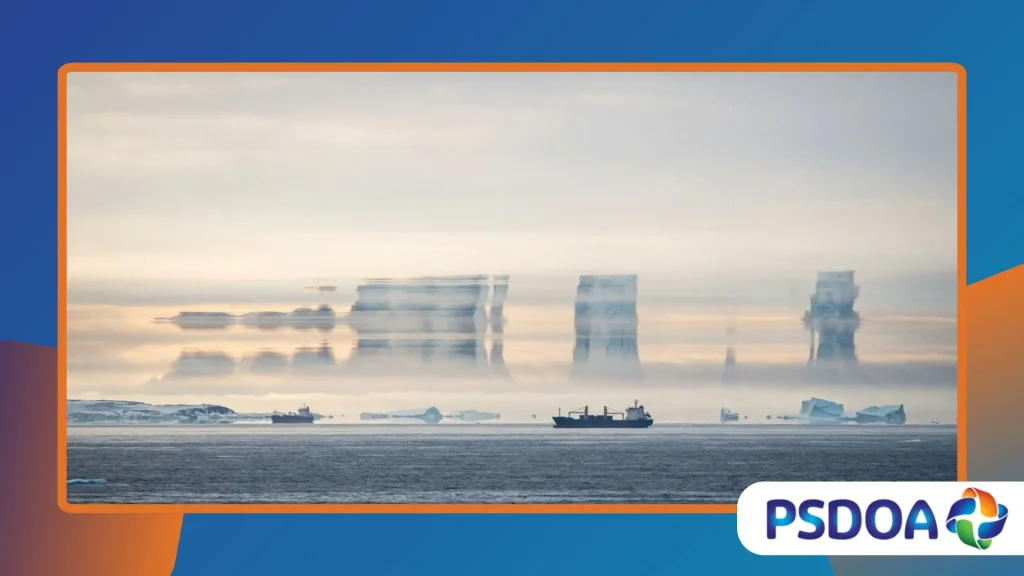
What Physical Laws Govern Superior Mirages?
Snell’s Law of refraction dictates how light changes direction when crossing boundaries between media with differing optical densities.
In standard inferior mirages, hot desert ground creates a heated air layer that bends light upward, producing illusory pools of water.
Conversely, a Fata Morgana Mirage relies on powerful surface-based thermal inversions that force light rays to curve downward, projecting elevated virtual images high above the true horizon.
Also read: Dust Veils: Atmospheric Layers That Turn Sunsets Purple
How Do Density Gradients Magnify Distant Objects?
Air density decreases rapidly with altitude under normal conditions, but a strong thermal inversion reverses this gradient near the surface.
Cold, heavy air remains trapped beneath a buoyant lid of warm air, forming a natural optical ducting channel.
Light entering this atmospheric duct travels uninterrupted for dozens of miles, magnified and distorted by successive layers of varying refractive intensity.
Read more: Mammatus Clouds: The Bubble-Shaped Storm Clouds Explained
Why Do Virtual Images Shift and Oscillate Constantly?
Atmospheric turbulence, gentle wind shears, and microscopic pressure fluctuations constantly alter the temperature boundaries within thermal inversion layers.
Because these meteorological parameters shift continuously, the suspended structures appear to shimmer, stretch, and dissolve before the viewer’s eyes.
This dynamic fluidity prevents the optical illusion from remaining static, giving the floating city effect an eerie, breathing quality.
What Are the Real-World Impacts of Atmospheric Refraction?
How Did Ancient Mariners Interpret Spectral Coastlines?
Historical ship logs from polar expeditions frequently document phantom islands and illusory mountain ranges that disrupted navigation charts.
Explorers would alter their courses to chase non-existent landmasses, only to watch the majestic stone towers evaporate as afternoon solar radiation disrupted the thermal inversion.
These deceptive atmospheric displays contributed significantly to maritime mythologies about wandering islands and cursed ghost ships.
What Modern Scientific Instruments Monitor Optical Ducts?
Modern meteorologists utilize advanced radiosondes, laser altimeters, and Doppler radar systems to measure temperature gradients and atmospheric refractive indices in real time.
By analyzing thermal stratification profiles across marine boundaries, atmospheric scientists can accurately predict when and where superior mirages will manifest along coastal horizons.
These technological advancements demystify ancient legends, grounding visual spectacles in rigorous thermodynamics and wave propagation theory.
How Do Climate Variations Influence Mirage Frequency?
Shifting global weather patterns and rising ocean temperatures directly influence the stability and frequency of coastal thermal inversions.
As Arctic sea ice retreats and marine boundary layers experience altered thermal exchanges, the persistence of stable surface ducts undergoes measurable shifts.
Climatologists study these optical anomalies as subtle indicators of broader thermodynamic transformations occurring within lower atmospheric layers.
| Atmospheric Parameter | Standard Horizon View | Fata Morgana Mirage | Inferior Desert Mirage |
| Temperature Profile | Normal decrease with altitude | Strong inversion (warm over cold) | Superadiabatic (hot ground, cool air) |
| Light Ray Curvature | Straight or slight refraction | Curves downward with Earth’s curvature | Bends upward away from ground |
| Apparent Image Position | True object location | Elevated, stretched, and floating | Inverted and depressed below object |
| Primary Geographic Zone | Universal | Polar waters, cold oceans, large lakes | Deserts, asphalt highways, flat plains |
Reflections on Nature’s Most Elusive Optical Masterpiece
Witnessing an ephemeral coastal city materialize across a freezing ocean horizon reminds observers of the profound complexity hidden within Earth’s atmosphere.
These rare optical displays bridge cold scientific thermodynamics with pure human wonder, turning ordinary air molecules into magnificent natural projectors.
Share your thoughts or coastal sighting experiences in the comments below to join the discussion.
Frequently Asked Questions
What exact weather conditions trigger a Fata Morgana Mirage?
An intense surface thermal inversion requires calm air, a freezing water or ice base, and a warm air mass blanketing above.
This specific stratification forms a natural refractive duct that bends light across long geographic distances.
Can photography capture these floating city illusions clearly?
High-zoom telephoto lenses equipped with image stabilization successfully capture these atmospheric phenomena.
Photographers must utilize clear atmospheric windows to overcome thermal shimmer and distance haze effectively.
Why do these optical displays resemble medieval castles?
Vertical magnification stretches distant flat coastlines, ship masts, and ice cliffs upward into columnar shapes.
The human brain naturally interprets these elongated vertical geometries as architectural pillars, towers, and ramparts.
Are superior mirages dangerous for commercial navigation?
Modern satellite GPS and advanced radar navigation systems render optical illusions harmless to shipping lanes.
Mariners recognize these shimmering atmospheric distortions as fascinating visual anomalies rather than genuine navigational hazards.
How far away can an object be to project an image?
Light ducted through stable marine thermal inversion layers can project virtual images from sources over fifty miles away.
The curvature of the Earth is effectively bypassed as light bends along the thermal boundary layer.
