
The Monowheel Vehicles That Promised the Future of Transportation
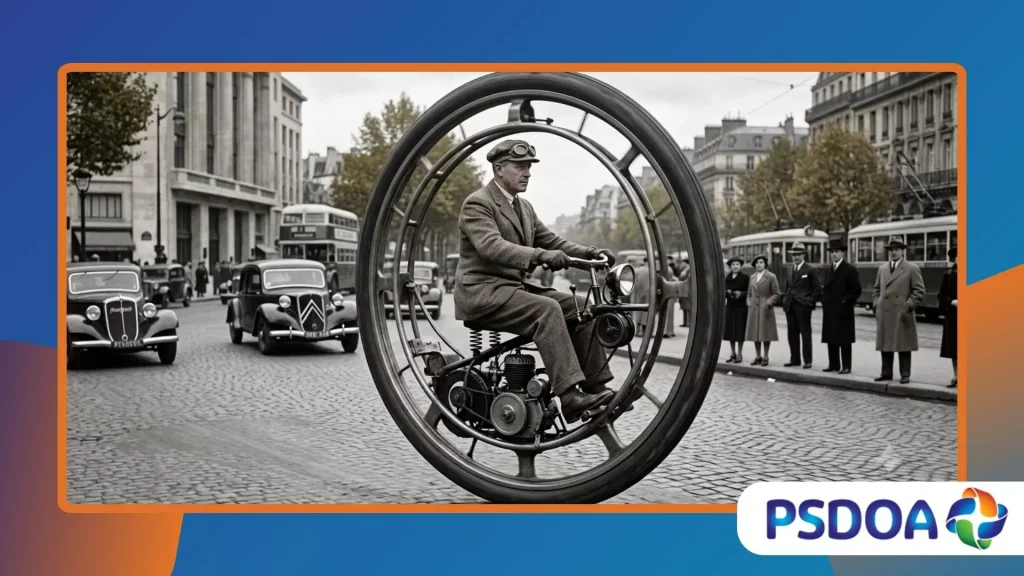
Monowheel vehicles captured the imagination of twentieth-century inventors who envisioned a streamlined future dominated by single-ring personal transport.
Anúncios
Sitting inside a giant rotating outer wheel offered a thrilling alternative to traditional multi-wheeled carriages during the early industrial revolution.
Engineers believed this radical geometry would minimize friction, increase fuel efficiency, and revolutionize personal transit across crowded urban centers.
Today, these retro-futuristic machines stand as testament to human ingenuity and our endless quest for mobility.
Understanding why these single-ring concepts captivated inventors requires examining early automotive innovation alongside modern physics principles.
These fascinating mechanical experiments combined mechanical daring with bold aesthetic design, inspiring generations of garage builders.
Modern transport research continuously looks to historical oddities to solve contemporary micro-mobility challenges in smart cities.
Are you ready to explore the wild history behind these forgotten mechanical marvels?
Key Highlights of Single-Wheel Innovations
- Exploring the origin stories of early single-ring transport concepts.
- Understanding gyroscopic stability challenges and the “gerbilling” effect.
- Evaluating historical milestones from hand-cranked rings to motorized prototypes.
- Analyzing modern micro-mobility electric unicyle adaptations.
What Are These Single-Ring Machines and How Do They Work?
Monowheel vehicles house the rider, engine, and control mechanisms entirely within a large outer ring tire that rotates along a track.
Inner frames rest on rollers along an interior track, keeping the driver upright through gravity and forward momentum during operation.
Think of a hamster wheel equipped with an engine, where the driver sits inside while the exterior ring propels everything forward.
Balancing required immense physical strength before modern electronic stabilization sensors transformed personal transportation devices.
Early inventors faced formidable mechanical challenges, particularly regarding steering precision and braking safety on open public roads.
Turning required the driver to lean their body mass sharply or drag feet along unpaved dirt surfaces to alter direction.
Hard braking caused the inner frame to spin wildly inside the rotating outer rim, trapping drivers in a terrifying phenomenon known as gerbilling.
Despite these inherent engineering flaws, bold visionaries kept refining their single-wheeled contraptions across Europe and America.
How Did Early Inventors Handle Steering?
Steering early single-ring machines relied almost entirely on shifting the operator’s body weight to lean the vehicle into turning curves.
Drivers tilted their torsos or extended legs outward, using momentum and centrifugal forces to alter their path gradually.
Advanced models experimented with small rudders or movable counterweights, though these mechanical additions yielded limited directional control on rough terrain.
++ Forgotten Military Robots From WWII
Why Was Braking Such a Major Safety Hazard?
Braking created severe rotational instability because rapid deceleration forced the inner driver cradle to rotate inside the spinning outer ring.
Emergency stops caused operators to spin upside down repeatedly inside their own vehicle frames like clothes tumbling in a dryer.
This structural flaw prevented regulatory approval for widespread commercial production across international markets.
Also read: How We Nearly Had a Global Pneumatic Mail System
What Role Did Internal Rollers Play?
Internal rollers connected the inner stationary platform to the outer rotating rim, allowing smooth power transfer from the motor.
These bearings carried the combined weight of the operator, engine, and structural frame during continuous operation.
High-grade steel rollers proved essential to prevent binding, which would instantly lock the mechanism and trigger violent accidents.
How Did Historical Prototypes Evolutionize Over Time?
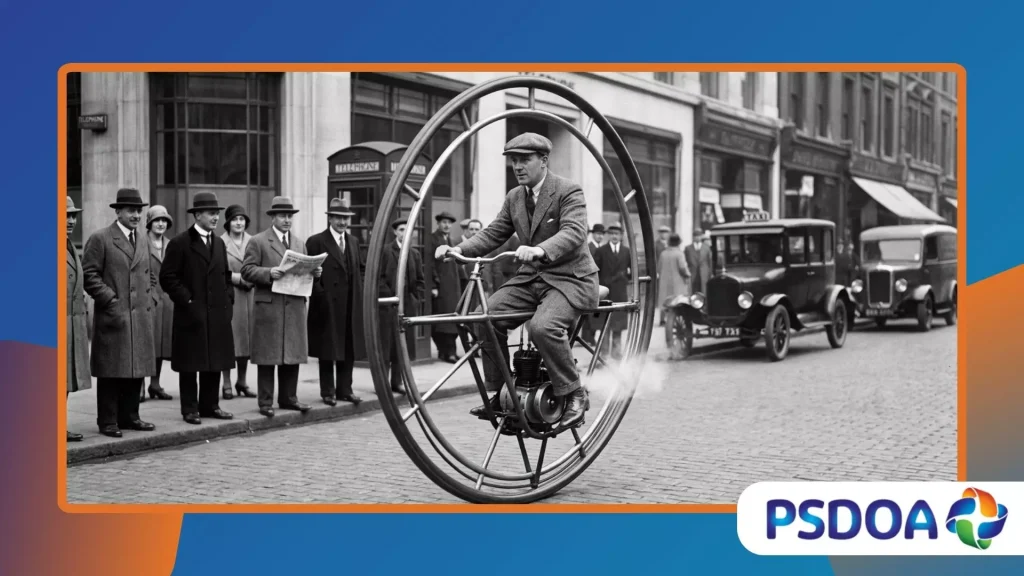
Evolution of Monowheel vehicles reached its peak during the 1920s and 1930s as ambitious engineers patented various motorized iterations.
Italian engineer Davide Cislaghi constructed a famous motorized model in 1923, capable of reaching impressive highway speeds across European test tracks.
Meanwhile, American inventor Charles F. Taylor built a working prototype in 1939 that utilized intricate internal gearing systems for stability.
Historical records cataloged by the Guinness World Records confirm that the fastest motorized monowheel reached 61.18 mph in 2015.
World conflicts shifted industrial priorities toward multi-wheeled military vehicles, leaving these single-ring experiments relegated to eccentric novelty status in technical journals.
Mass production favorability naturally gravitated toward four-wheeled automobiles that offered superior stability, passenger capacity, and predictable cargo space.
However, the foundational engineering principles explored during this golden era laid valuable ground work for modern micro-mobility development. History often hides brilliant lessons inside forgotten mechanical failures.
Read more: The Clockwork Airplane That Never Got Off the Ground
Who Built the First Patented Single-Wheel Design?
French craftsman Richard Hemmings patented one of the earliest recorded hand-cranked single-wheel transport devices back in 1869.
His invention, named the “Flying Flea,” required immense arm strength to rotate the inner hand pedals while maintaining vertical balance.
This mechanical milestone inspired subsequent generations of European engineers to experiment with steam and gas power.
Why Did Military Organizations Reject Single-Wheel Designs?
Military strategists evaluated single-wheel prototypes for trench warfare reconnaissance due to their narrow profile and terrain agility.
However, poor stability over muddy ditches and extreme vulnerability to side impacts made them impractical combat vehicles.
Defense departments quickly abandoned single-ring research, shifting funding toward armored tracked tanks and heavy motorcycles.
How Did Motorization Change the Industry Dynamics?
Adding internal combustion engines supplied necessary power to achieve higher speeds, improving gyroscopic stabilization along straight roads significantly.
However, added engine weight amplified the severity of gerbilling accidents when drivers hit obstacles or applied brakes quickly.
Increased speed magnified structural flaws, reinforcing public perception that single-wheel craft were far too dangerous.
Why Did These Transport Concepts Fail Commercially?
Analyzing Monowheel vehicles demonstrates how superior mechanical efficiency can still be defeated by fundamental safety and steering limitations in commercial markets.
Traditional bicycles and automobiles offer four stable points of contact, making parking, passenger transport, and slow maneuvering completely effortless.
Single-ring machines demand constant motion to maintain balance, creating exhausting operating conditions during heavy city traffic stops.
Commercial success requires practical reliability, a threshold these single-ring creations simply could not meet consistently.
Modern electric unicycles have revived interest in single-wheel transportation by replacing dangerous mechanical cradles with advanced computerized gyroscopic sensors.
Today’s self-balancing electric devices process tilt metrics thousands of times per second, eliminating the historical gerbilling hazards that plagued early inventors.
Retrospective analysis proves that early pioneers possessed brilliant visions; they simply lacked the microprocessing technology needed to tame physics.
Mechanical history serves as a stepping stone toward our current urban transport revolution.
How Do Electronic Gyroscopes Prevent Accidents?
Modern microprocessors calculate tilt angles continuously, adjusting electric motor output instantly to keep the operator perfectly upright at all times.
These high-speed computational feedback loops eliminate gerbilling by balancing acceleration forces smoothly against gravity.
Advanced algorithms accomplish electronically what mechanical link levers failed to achieve a century ago.
What Advantages Do Modern Electric Unicycles Offer?
Electric personal mobility devices provide compact, eco-friendly transit for urban commuters navigating crowded city streets and public transportation nodes.
Their lightweight frames, impressive battery range, and minimal storage footprints make them highly practical for last-mile commuting solutions.
Tech-driven innovation successfully realized the futuristic promises made by early industrial pioneers.
Will Single-Wheel Craft Ever Dominate Mainstream Transport?
While specialized single-wheel electric devices excel in micro-mobility niches, multi-wheeled autonomous vehicles continue to dominate mainstream commercial transportation goals.
Safety regulations, passenger capacity demands, and cargo requirements heavily favor stable multi-track vehicle designs for highway travel.
Single-ring transit remains an inspiring, high-efficiency alternative for specialized personal commuting.
Technical Comparison: Single-Wheel vs. Standard Transport
The comparative matrix below details fundamental operational parameters contrasting historical single-ring designs with traditional two-wheeled motorcycles and modern electric unicyle platforms.
| Transport Category | Balancing Mechanism | Steering Method | Primary Failure Mode |
| Historical Single-Ring | Forward momentum & weight distribution | Lean angle & foot dragging | Gerbilling (rotational tumbling) |
| Traditional Motorcycle | Two inline contact wheels | Handlebar steering & leaning | Low-speed side tipping |
| Electric Unicycle | Electronic self-balancing gyroscopes | Natural body tilt | Battery/sensor hardware failure |
Rediscovering the Legacy of Single-Ring Innovation
Studying Monowheel vehicles reminds us that technological progress is rarely a straight line, but rather a winding path filled with audacious experiments.
Early inventors dared to reimagine personal transit, leaving behind iconic machines that continue to spark curiosity and inspire modern engineers.
Their willingness to challenge traditional automobile design standards laid the groundwork for today’s micro-mobility electric revolution.
As smart cities seek clean, compact transportation solutions, historical ideas continue to shape our future moves.
What forgotten invention do you think deserves a modern technological reboot? Share your thoughts in the comments below!
Frequently Asked Questions
Are single-wheel vehicles legal to ride on public roads today?
Road legality varies significantly by region, as most jurisdictions require traditional vehicle configurations with standard lighting, mirrors, and dual braking systems.
Custom motorized single-ring builds are typically restricted to private land or specialized exhibition tracks due to safety regulations.
How difficult is it to learn to ride a single-wheel craft?
Operating historical mechanical models required exceptional balance, physical stamina, and extensive training to master steering and stopping without tipping.
Modern electric self-balancing devices feature automated gyroscopic assistance, allowing average riders to gain proficiency within a few hours of practice.
What is the origin of the term “gerbilling” in single-wheel transport?
The term “gerbilling” refers to the accidental rotation of the inner driver platform inside the outer wheel during sudden, hard braking.
Because the cradle spins inside the outer frame like a pet hamster running inside a wheel, early enthusiasts coined this vivid mechanical descriptor.
