
Brinicles: The Underwater ‘Finger of Death’ Freezing the Seafloor
What is a Brinicle? The Icy Finger of Death Explained
Imagine a world of crushing pressure and eternal twilight, deep beneath the polar ice. In this silent realm, a strange structure begins to form.
Anúncios
It descends from the ice ceiling like a ghostly stalactite, an ethereal, hollow tube of ice reaching for the seabed. This is a brinicle, one of nature’s most haunting and destructive creations.
Known more dramatically as the “icy finger of death,” a brinicle is a downward-growing hollow tube of ice that contains a core of extremely cold, super-salty water, or brine.
It is not solid ice but a delicate, icy sheath surrounding a descending plume of this dense liquid. The nickname isn’t just for dramatic effect; it’s a literal description of its impact.
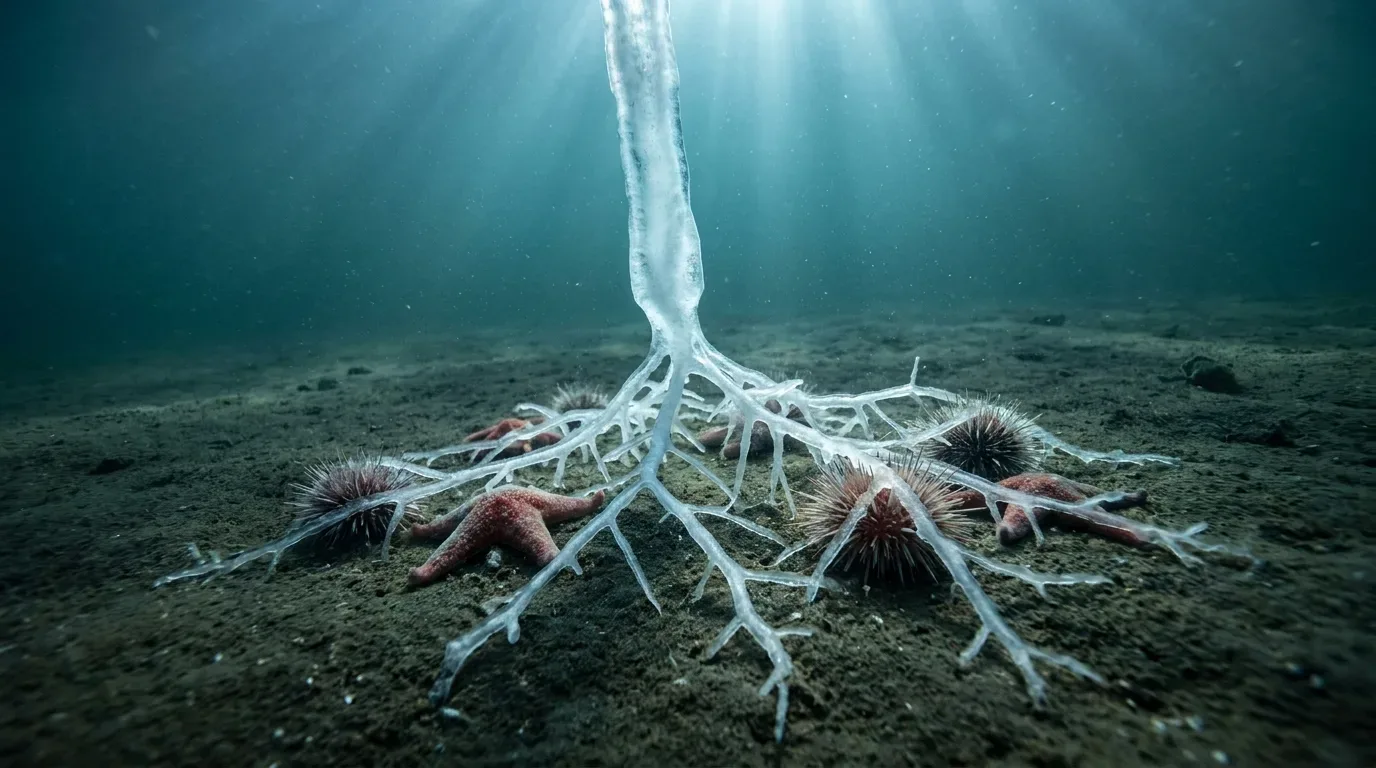
When this descending icicle touches the seafloor, the brine, which is denser and colder than the surrounding seawater, spreads outwards in a web of ice.
Any slow-moving creature in its path—starfish, sea urchins, sea cucumbers—is instantly encased in a frozen tomb. The brinicle is a localized, yet absolute, force of destruction, a chilling reminder of the brutal physics that govern life in Earth’s most extreme environments.
The Chilling Science Behind Brinicle Formation
The creation of a brinicle is a fascinating process that depends on a precise sequence of events, turning simple physics into a beautiful yet deadly spectacle.
It’s a story of salt, temperature, and density, playing out in the calm, frigid waters of the Arctic and Antarctic. The process can be broken down into four distinct steps.
Step 1: The Birth of Sea Ice and Salt Rejection
Everything begins at the ocean’s surface. As the polar air plummets to extreme sub-zero temperatures, the seawater begins to freeze, forming a layer of sea ice.
However, when water crystallizes into ice, it forms a lattice structure that has little room for impurities. Salt molecules are effectively expelled or rejected during this freezing process.
This doesn’t mean the salt disappears. Instead, it becomes trapped in a network of tiny, liquid channels and pockets within the newly formed sea ice.
This process dramatically increases the salinity of the remaining unfrozen water, creating a potent, super-concentrated brine.
Step 2: The Creation of Super-Salty, Super-Cold Brine
The brine trapped within the sea ice is unlike ordinary seawater. Its incredibly high salt concentration gives it a much lower freezing point, allowing it to remain liquid at temperatures that would freeze normal ocean water solid.
This brine is not only extremely salty but also intensely cold, often several degrees below the freezing point of the surrounding ocean.
Furthermore, this cold brine is significantly denser than the water beneath the ice sheet. This combination of extreme cold and high density is the crucial engine that drives the formation of a brinicle. It’s a pocket of potential energy, waiting for an escape route.
Step 3: The Descent into the Deep
Eventually, this dense brine finds a crack or a weakness in the sea ice. Gravity takes over, and the brine begins to leak downwards, sinking through the water column in a focused plume.
Because it is so much colder and denser than the surrounding seawater, it doesn’t mix readily. Instead, it plummets directly toward the seafloor like a liquid anchor.
This downward flow is the heart of the brinicle. It’s a continuous stream of super-cooled liquid descending into a less saline, slightly warmer environment.
This temperature and salinity differential is what sets the stage for the final, most visually striking step in its creation.
Step 4: The Icy Sheath Forms Around the Plume
As the plume of super-cold brine descends, it comes into contact with the surrounding seawater. This water, while cold, is not as cold or as salty as the brine.
The intense cold of the brine immediately freezes the seawater it touches. An icy shell, or sheath, begins to form around the descending plume.
This sheath grows rapidly, creating the hollow tube of ice that we recognize as a brinicle. The brine continues to flow down through the center of this self-made ice tunnel, extending it further and further downwards.
The brinicle acts like a chemical and thermal conduit, channeling the freezing potential from the surface ice directly to the seabed. It is a perfect, and deadly, delivery system.
A Frozen Trail of Destruction on the Seafloor
The slow, almost graceful descent of a brinicle belies its destructive power. For the creatures living on the polar seafloor, its arrival is a cataclysm.
The world of the deep benthos is one of slow movement. Starfish and sea urchins crawl at a glacial pace, ill-equipped to escape a sudden, creeping threat.
When the tip of the brinicle finally makes contact with the seabed, the brine inside, no longer contained by its icy sheath, pools and spreads outwards.
It flows across the seafloor, a creeping liquid that is still far below the freezing point of the ambient seawater. Anything it touches is instantly flash-frozen.
The result is a ghostly tableau of death. Starfish are frozen mid-stride, their arms encased in a delicate layer of ice. Sea urchins become crystalline sculptures, their spines locked in place.
This is why the term ‘finger of death’ is so apt. It is a targeted, inescapable freezing event that leaves a permanent scar on the small community of organisms it encounters.
It’s a powerful illustration of how the same ocean that sustains life can also deliver death in its most elemental form.
Capturing a Ghost: The Story Behind the First Filming
For decades, the brinicle was a theoretical phenomenon, described by oceanographers but never witnessed from start to finish. Its existence was inferred from the strange, ice-covered starfish found on the Antarctic seafloor.
The term ‘brinicle’ itself was coined back in 1974 by American oceanographer Seelye Martin, but observing one in action remained an elusive goal.
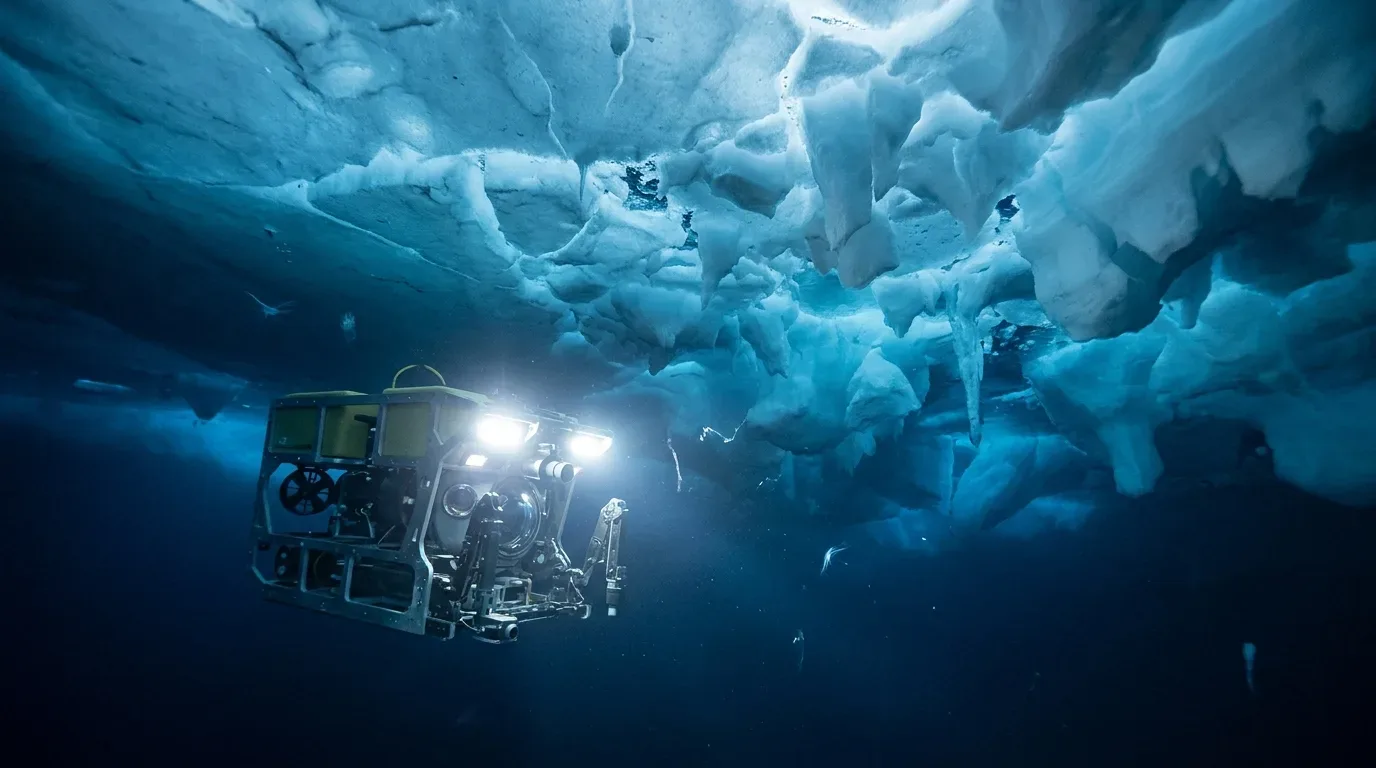
The primary challenge is the environment. Brinicles form under thick sea ice in some of the most remote and inhospitable locations on Earth.
The conditions must be perfect: calm waters, actively growing sea ice, and extreme cold. Any significant ocean current can disrupt the delicate descending plume, preventing the brinicle from ever forming.
The breakthrough came in 2011. A camera crew for the BBC documentary series ‘Frozen Planet’ managed to achieve the impossible.
Using specialized time-lapse equipment under the ice of Antarctica’s Ross Archipelago, cameramen Hugh Miller and Doug Anderson captured the entire life cycle of a brinicle.
They watched as the icy tendril formed, descended over several hours, and ultimately touched the seafloor, ensnaring unsuspecting sea stars in its path.
It was a world-first, transforming a scientific curiosity into a documented, and frankly terrifying, natural event. The footage revealed the phenomenon to be even more alien and mesmerizing than scientists had imagined.
The Perfect Conditions for an Icy Killer
The rarity of brinicles highlights how specific the environmental requirements are. They are not a common occurrence, even in the polar regions. The key ingredients are a combination of atmospheric and oceanic conditions that must align perfectly.
First, the air temperature must be extremely low, typically well below -20°C (-4°F), to drive the rapid formation of new sea ice and the subsequent creation of cold, dense brine. Second, the water must be exceptionally calm.
Even gentle currents can deflect the sinking brine plume, causing it to dissipate before it can form a stable, hollow tube. This is why brinicles are more commonly found in sheltered bays or areas with minimal water movement.
These conditions are a reminder of the delicate balance in polar ecosystems. Phenomena like brinicles are linked to the larger processes of sea ice dynamics and ocean circulation.
In fact, the sinking of cold, dense water is a micro-scale version of the engine that drives the planet’s great thermohaline circulation, which regulates global climate.
It also shares a conceptual space with other strange polar events, like the formation of rare nacreous clouds, which also depend on extreme cold and specific atmospheric stability.
Frequently Asked Questions about Brinicles
The alien nature of the brinicle often leads to a host of questions. Here are answers to some of the most common ones.
Are brinicles dangerous to humans?
In short, no. While they are incredibly destructive to small, slow-moving seafloor creatures, they pose no direct threat to humans. They form in environments far too cold and deep under the ice for a person to encounter without highly specialized submersible equipment. A diver would be at far greater risk from the freezing water itself than from a brinicle.
How big can a brinicle get?
The size of a brinicle depends on the depth of the water and the stability of the conditions. They can grow to be several meters long, extending from the underside of the sea ice all the way to the ocean floor. The growth is relatively slow, often taking five to six hours to reach the bottom, which is why time-lapse photography was essential to capture the process.
Why is the brinicle hollow?
The hollow structure is key to what makes a brinicle unique. It is not a solid icicle freezing from the inside out. Instead, the ice is a sheath that forms *around* the continuously flowing plume of super-cold brine. The relatively warmer seawater freezes on contact with the cold plume, creating a pipe that insulates the brine and allows it to continue its journey to the seafloor.
Are there other similar underwater ice formations?
The polar oceans are home to a variety of strange ice formations. While the brinicle is unique, other phenomena share some of its characteristics. For example, ‘pancake ice’ consists of circular pieces of ice that form in turbulent water, while ‘frost flowers’ are delicate ice crystals that can grow on the surface of new sea ice, wicking up salty brine. However, no other phenomenon combines the downward growth and destructive potential of the brinicle. It stands apart, much like other peculiar downward-moving ocean events, such as the constant drift of marine snow in the deep sea.
A Final, Chilling Thought
The brinicle is more than just a scientific curiosity; it is a stark illustration of the fundamental forces that shape our planet. In the silent, dark world beneath the ice, physics becomes a predator.
It demonstrates how a simple process—water freezing and rejecting salt—can cascade into a complex and deadly structure. It’s a testament to the incredible, and sometimes terrifying, creativity of nature.
As we continue to explore the Earth’s most remote corners, we are constantly reminded of how much we still have to learn. The first-ever filming of a brinicle happened just over a decade ago, a clear sign that the polar oceans still hold many secrets.
The icy finger of death is a humbling reminder that even in the 21st century, our planet is still full of mysteries waiting to be discovered, documented, and understood.
