
Necrobotics: How Dead Spiders Are Inspiring New Robots
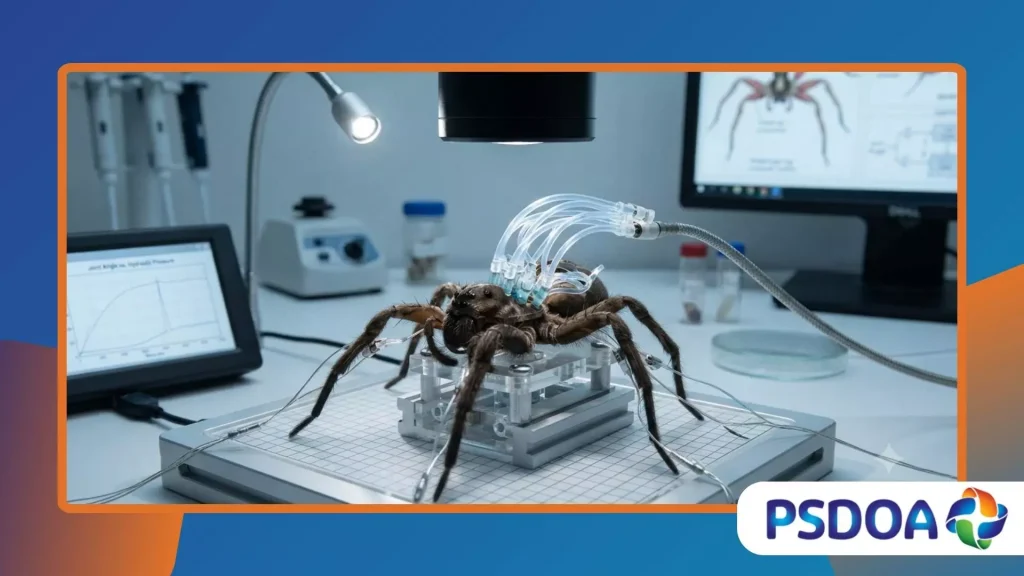
Necrobotics represents a groundbreaking intersection between biology and mechanical engineering, turning deceased biological specimens into functional robotic actuators.
Anuncios
Researchers at institutions like Rice University discovered that arachnids lack antagonistic muscles in their limbs, relying instead on internal hydraulic pressure to extend their legs.
When an arachnid dies, its hydraulic system depressurizes, causing the legs to curl inward into a natural resting posture.
Scientists realized they could harness this exact hydraulic mechanism by applying a controlled puff of air through a microscopic syringe inserted into the creature’s cephalothorax.
This innovative field challenges traditional engineering paradigms by utilizing pre-built natural structures instead of manufacturing complex synthetic motors from scratch.
Anuncios
Engineers now explore how biodegradable biological grippers can perform delicate tasks without generating electronic waste or requiring intricate micro-assembly procedures.
Nature has spent millions of years perfecting hydraulic actuators that rival the most sophisticated human designs. Are you ready to see how dead organisms are actively reshaping the future of automation?
Exploring the Frontiers of Bio-Robotics
- Unveiling the biological mechanics behind arachnid hydraulic joint extension.
- Pioneering pneumatic control systems for delicate laboratory manipulation tasks.
- Evaluating environmental advantages of biodegradable organic robotic components.
- Overcoming material fatigue and dehydration challenges in organic actuators.
What Are Necrobotics and How Do They Function?
Necrobotics transforms deceased wolf spiders into functional mechanical grippers by utilizing their unique internal hydraulic architecture for precise object manipulation.
Engineers inflate the dead arachnid’s prosoma chamber with air, causing all eight legs to extend outward simultaneously within milliseconds.
Releasing the pneumatic pressure allows the legs to curl inward with remarkable gripping force, capable of lifting objects heavier than the spider’s own body mass.
Think of this process as operating a natural hydraulic crane built completely by evolutionary biology rather than human factories.
Laboratory tests confirm that a modified wolf spider carcass can execute over one thousand continuous gripping cycles before joint degradation or tissue cracking occurs.
Researchers carefully seal the respiratory openings with specialized adhesives to maintain internal pressure during active pneumatic operation.
This low-energy actuation method bypasses complex electrical wiring and heavy metallic servos, introducing a completely sustainable approach to micro-robotics.
Nature provides the hardware; engineers simply supply the pneumatic trigger.
How Do Researchers Prepare the Specimens?
Scientists collect deceased specimens and store them in controlled environments to prevent rapid tissue decay before conducting delicate microsurgical modifications.
A tiny needle is inserted into the hydraulic chamber and secured using instant-curing polymers to create an airtight seal.
This preparation phase requires extreme precision to avoid fracturing the delicate chitin exoskeleton during pneumatic testing.
++ ¿Por qué algunos científicos intentan simular un universo en miniatura?
Why Are Wolf Spiders Preferred for Experiments?
Wolf spiders possess robust hydraulic chambers and long, flexible legs that deliver optimal load-bearing capacity for delicate micro-gripping applications.
Their anatomical structure provides a wide range of motion that smaller insects cannot match under experimental pneumatic pressure loads.
These physical traits make them ideal models for testing organic robotic concepts.
Lea también: Magnetorrecepción: El sentido oculto que los humanos podrían poseer
What Limits the Lifespan of Organic Actuators?
Dehydration causes the biological tissue to become brittle over time, reducing flexibility and leading to structural fractures during repeated extension cycles.
Researchers currently test various polymer coatings to lock in moisture and extend the operational longevity of these organic grippers.
Mitigating tissue decay remains a primary focus for ongoing laboratory development.
Why Is This Bio-Hybrid Technology Gaining Attention?
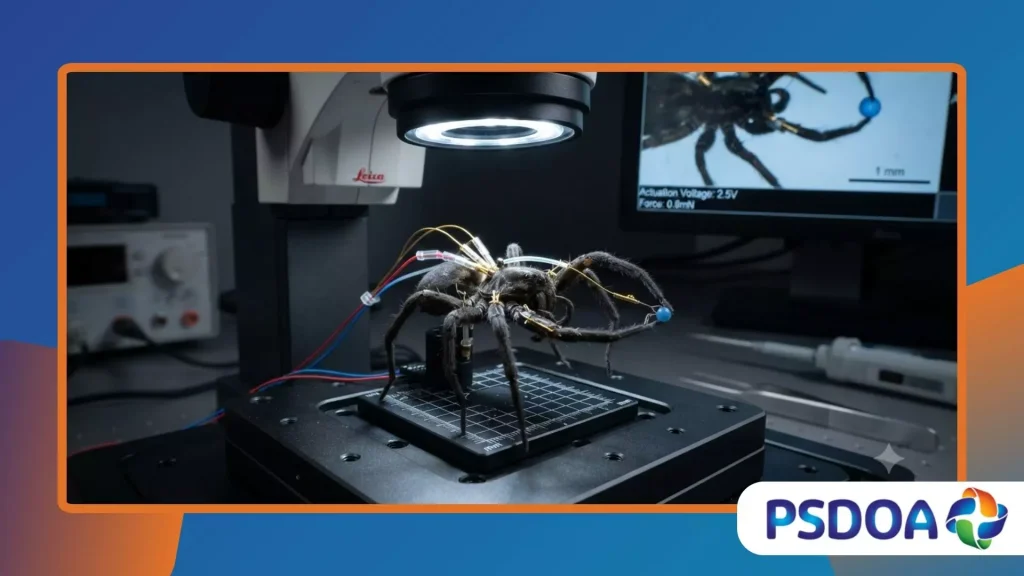
Developing Necrobotics offers unprecedented advantages in sustainability, as these biological grippers decompose naturally without leaving toxic electronic waste behind in fragile ecosystems.
Traditional robotics manufacturing relies heavily on rare earth minerals, silicon, and synthetic polymers that contribute significantly to global electronic pollution.
Organic actuators provide an eco-friendly alternative for temporary tasks, such as sorting delicate micro-components or handling fragile biological samples in controlled environments.
Sustainability in engineering is no longer just an abstract goal; it is an urgent design necessity.
A study published by mechanical engineers in Advanced Science demonstrated that spider-based grippers can safely handle fragile circuit boards without scratching sensitive surfaces.
The soft, flexible nature of organic joints adapts seamlessly to irregular shapes that rigid metallic claws often crush or damage.
This inherent compliance eliminates the need for complex force-feedback sensors required in conventional robotic assembly lines.
Efficiency meets environmental consciousness in this remarkable fusion of science and nature.
Leer más: Cronobiología: Cómo los relojes biológicos influyen en el rendimiento humano
How Does This Reduce Electronic Waste?
Deploying biodegradable organic components instead of miniature electric motors drastically cuts down the volume of hazardous electronic trash discarded annually.
Once a necrobotic gripper reaches the end of its operational lifecycle, it can be safely composted without harming the surrounding environment.
This closed-loop design philosophy aligns perfectly with modern green engineering standards.
What Are the Industrial Application Limits?
While organic grippers excel at handling delicate, lightweight objects, their susceptibility to humidity changes and tissue wear restricts heavy industrial deployment.
They cannot operate effectively in extreme temperatures or corrosive chemical environments where synthetic materials thrive.
Recognizing these boundaries ensures engineers deploy bio-hybrid systems only where they offer clear functional superiority.
How Do Ethical Considerations Impact Research?
Using deceased common insects and arachnids sourced from natural mortality rather than intentional culling satisfies standard institutional bioethics guidelines.
Researchers maintain transparent protocols regarding specimen handling, ensuring public trust remains intact as the field evolves.
Ethical responsibility must guide every breakthrough in bio-hybrid engineering.
What Are the Future Applications of Organic Robotics?
Advancing Necrobotics research opens exciting possibilities for delicate field biology tasks, such as collecting fragile ecological samples without causing environmental contamination.
Field researchers could deploy biodegradable micro-robots to gather delicate soil organisms or plant seeds in remote wilderness areas safely.
If a device malfunctions or gets lost during fieldwork, it simply decomposes harmlessly into the soil within weeks.
This seamless integration with natural ecosystems represents a paradigm shift in environmental monitoring technology.
Consider an analog from civil engineering: building temporary scaffolding that dissolves away once the permanent stone arch cures completely.
Similarly, organic micro-robots act as temporary biological tools that vanish without a trace after completing their assigned mission.
As material science and biotechnology converge, our definition of what constitutes a “machine” continues to evolve rapidly.
Innovation often requires looking backward at nature’s existing blueprints rather than inventing entirely new systems.
Can These Devices Assist in Microsurgery?
Medical researchers speculate that soft organic actuators could eventually inspire safer micro-instruments designed to navigate delicate human tissues during minimally invasive surgeries.
Their natural compliance minimizes the risk of tearing fragile blood vessels compared to rigid steel surgical tools.
Translating these concepts into certified medical devices remains a long-term exploratory goal.
How Might Swarm Robotics Benefit From This?
Deploying swarms of inexpensive, biodegradable organic robots could revolutionize search-and-rescue operations inside tight, collapsed structural spaces.
Because the units are built from abundant biological materials, losing a few devices during a mission carries minimal financial or environmental cost.
Swarm coordination algorithms already tested on synthetic drones can easily adapt to organic actuators.
What Role Does Material Science Play Moving Forward?
Advanced polymer chemistry allows scientists to reinforce natural joints, protecting them against environmental moisture loss and mechanical wear over time.
Cross-linking biological proteins with synthetic hydrogels creates hybrid structures that combine the best traits of both worlds.
Material engineering unlocks the true commercial potential of bio-robotics.
Comparative Matrix of Actuator Technologies
The structured table below contrasts traditional mechanical actuators with emerging bio-hybrid organic robotic systems.
| Actuator Technology | Impacto ambiental | Load-to-Weight Ratio | Manufacturing Complexity | Primary Operational Limit |
|---|---|---|---|---|
| Electric Servos | High (E-waste generation) | Moderado | High (Precision machining) | Heat dissipation and weight |
| Pneumatic Elastomers | Moderate (Synthetic polymers) | Alto | Moderate (Mold casting) | Air leakage over time |
| Necrobotics | Zero (Fully biodegradable) | Exceptionally High | Low (Harvesting natural structures) | Tissue dehydration and wear |
Securing a Sustainable Future in Automation
Explorador Necrobotics demonstrates that humanity’s most innovative technological solutions often hide quietly within the natural world around us.
By repurposing biological architecture through pneumatic engineering, researchers bridge the gap between advanced automation and ecological sustainability.
This dynamic field challenges us to rethink how we design machines, prioritizing biodegradability and harmonious environmental integration over permanent synthetic pollution.
Support sustainable science by staying informed about breakthrough developments in bio-hybrid engineering.
What are your thoughts on integrating organic materials into future robotic automation? Share your perspective in the comments below!
Preguntas frecuentes
Are the spiders harmed or killed specifically for this research?
No, researchers exclusively use naturally deceased specimens collected from laboratory breeding stocks or controlled environments.
The process relies entirely on post-mortem hydraulic properties, meaning live animals are never subjected to experimentation.
How long does a typical necrobotic gripper remain operational?
A properly maintained organic gripper can execute between seven hundred and one thousand continuous cycles before tissue fatigue causes structural air leaks.
Applying specialized moisturizing polymers can extend this operational window further under laboratory conditions.
Can this technology be scaled up to larger animals?
Scaling up necrobotics is currently impractical because larger animals possess heavy skeletal frames and complex muscle systems rather than simple hydraulic leg extensions.
The technique remains uniquely suited for arachnids and small insects whose anatomy relies directly on internal fluid pressure.
