
The Secret Cantacronache Mission That Recorded Spain’s Resistance
Cantacronache Mission That Recorded Spain’s Resistance remains one of the most daring acts of cultural espionage in twentieth-century European music history.
Anúncios
During the summer of 1961, a small group of radical Italian intellectuals, composers, and poets crossed the border into Francisco Franco’s Spain disguised as ordinary tourists.
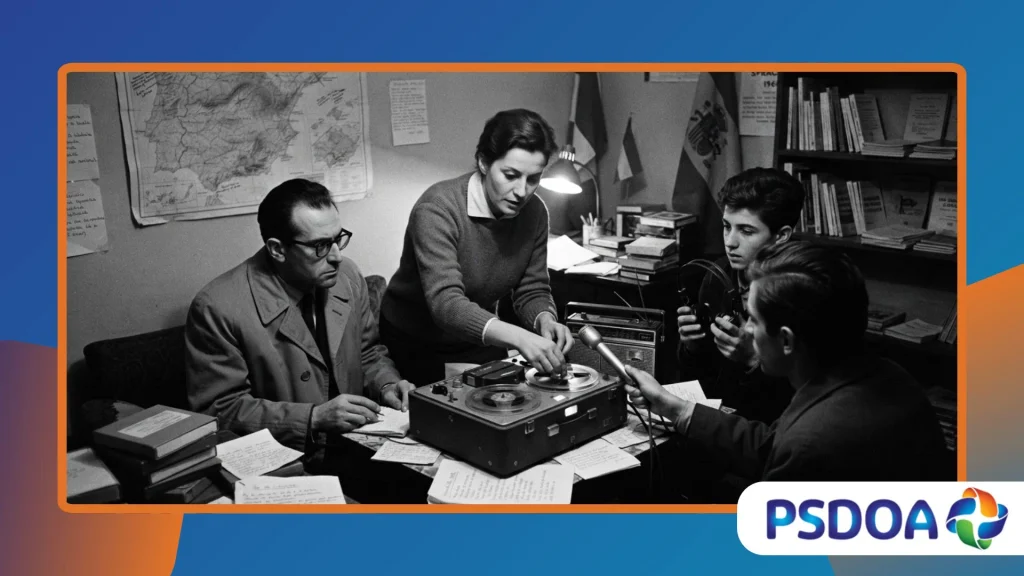
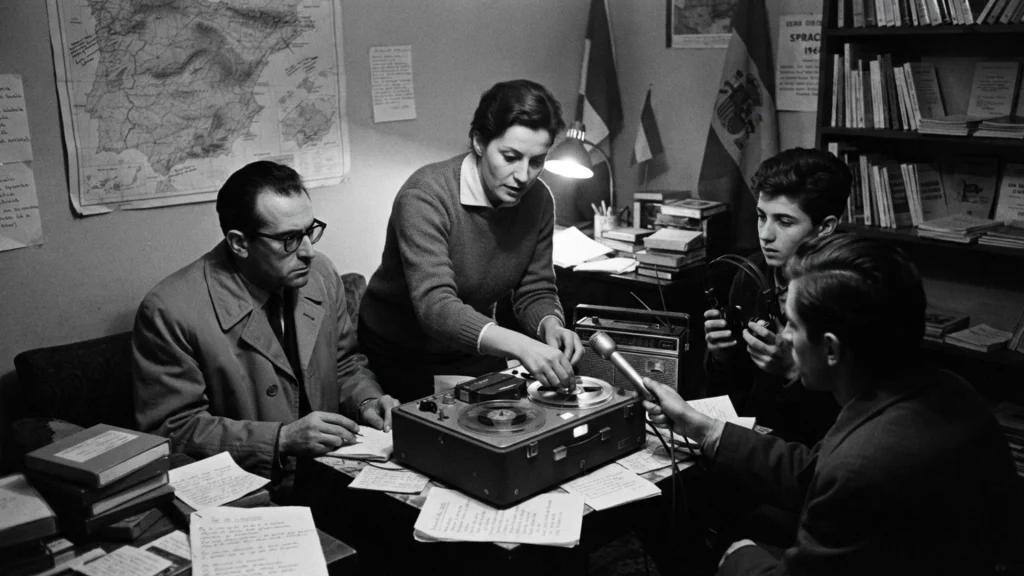
Packed inside the trunk of their car was a bulky, battery-operated Geloso tape recorder hidden beneath camping gear and beach towels.
While millions of European vacationers flocked to the sunny Costa Brava for cheap wine and flamenco shows, these undercover researchers traveled through working-class neighborhoods, mining towns, and university backrooms to capture the forbidden songs of anti-fascist defiance.
Had Franco’s secret police discovered those magnetic reels at any checkpoint, the Italian team faced immediate arrest, indefinite detention, and diplomatic ruin.
What makes this clandestine operation extraordinary is not merely the physical danger involved, but the artistic and political rigor behind every single recording session.
Founded in Turin in 1957 by figures like Sergio Liberovici, Michele Straniero, Fausto Amodei, and Italo Calvino, the Cantacronache collective rejected the escapist pop music dominating Italian radio at the time.
They believed songs should act as living journalism, chronicling real human struggles rather than manufactured romance.
When they turned their attention toward Spain in 1961, they wanted to prove to a complacent European public that the spirit of the Spanish Republic had not died in 1939.
Every melody they captured on tape served as an undeniable audio witness against dictatorship.
Key Highlights of This Clandestine Operation
- The Turin Collective’s Covert Entry: How Italian songwriters and poets transformed a summer holiday into an intelligence-gathering expedition across Francoist Spain.
- Clandestine Recording Logistics: The technical challenges of operating heavy analog equipment inside shuttered apartments and rural taverns without alerting state informants.
- Preserving Forbidden Ballads: The specific folk anthems, prison laments, and satirical verses that survived decades of censorship thanks to smuggled magnetic tape.
- International Release and Diplomatic Fallout: How the resulting 1962 vinyl album Canti della nuova resistenza spagnola sparked outrage in Madrid and galvanized solidarity across Europe.
What Was the Secret Cantacronache Mission in Francoist Spain?
How Did the Turin Collective Plan Their Undercover Journey?
Planning an illicit field-recording expedition inside a police state required months of quiet coordination with exiled Spanish anti-fascists living in France and Italy.
Members of the Cantacronache collective, led on the ground by ethnomusicologist and songwriter Michele Straniero alongside composer Sergio Liberovici and Spanish exile partner Margot Galante Garrone, established an underground network of trusted contacts before crossing the Pyrenees.
Rather than carrying official press credentials or academic permits, which would have triggered immediate surveillance by the Brigada Político-Social, the group traveled under the guise of middle-class Italian holidaymakers exploring Iberian architecture and coastal resorts.
They carefully memorized addresses, code phrases, and meeting times because carrying written notebooks with names of local dissidents posed an unacceptable security risk.
Every detail of their itinerary balanced plausible tourist sightseeing with prearranged nocturnal rendezvous in cities like Madrid, Barcelona, Valencia, and Seville.
Why would avant-garde musicians risk prison for a handful of amateur field recordings? In the early 1960s, General Francisco Franco was actively rebranding his regime to attract Western tourism and Cold War economic aid, presenting Spain to the world as a peaceful, harmonious nation.
By documenting grassroots protest songs still sung behind closed doors, the Cantacronache Mission That Recorded Spain’s Resistance aimed to shatter that carefully curated international illusion.
According to archival documentation preserved by the Istituto Piemontese Antonio Gramsci in Turin, the team collected over 100 distinct musical and spoken-word testimonies during a single intense summer campaign.
These recordings functioned like a time capsule buried beneath a concrete fortress, preserving voices that state censors had spent more than twenty years trying to erase from collective memory.
Who Were the Key Figures Behind the Clandestine Recordings?
At the heart of this audacious operation stood a remarkable coalition of Italian artists and Spanish anti-fascist intermediaries who bridged cultural and linguistic divides.
Michele Straniero, a prolific writer and founding voice of Cantacronache, acted as the primary field interviewer, guiding conversations with nervous workers and students who had never spoken into a microphone before.
Beside him worked Sergio Liberovici, a classically trained composer who evaluated the melodic structures and rhythmic variations of regional protest ballads on the spot.
Crucial to their survival was Margot Galante Garrone, whose fluency in Spanish and deep ties to anti-Francoist networks allowed the Italians to gain immediate trust inside tightly guarded underground circles.
Without her cultural mediation, frightened informants would never have revealed songs that carried severe prison sentences simply for being hummed in public.
On the Spanish side, the mission relied on an anonymous constellation of factory laborers, university activists, former Republican soldiers, and flamenco singers who risked their livelihoods to participate.
Many of these contributors insisted on remaining unnamed or using wartime pseudonyms, knowing that voice recognition by local police informants could destroy their entire families.
One retired Asturian miner, for example, sang a bitter ballad about the 1934 uprising inside a shuttered kitchen while his wife stood watch beside the front window overlooking the street.
Another young student in Madrid recorded satirical verses mocking state-controlled newspapers, whispering the lyrics closely into the microphone so neighbors could not hear through thin apartment walls.
Their combined courage turned a fragile technical experiment into an enduring historical monument.
++ The Ancient Trade Hub That Vanished From History
Why Did Franco’s Regime Fear Underground Protest Songs?
Authoritarian governments rarely fear highbrow political treatises as much as they fear a catchy melody that illiterate workers can memorize in five minutes.
Under Franco’s dictatorship, the Ministry of Information and Tourism enforced rigid pre-censorship over every record pressing, radio broadcast, and public performance across Spanish territory.
State censors understood that traditional folk tunes and flamenco rhythms could easily carry subversive new lyrics disguised as harmless regional folklore.
Once a satirical verse entered oral circulation in taverns or olive groves, no police battalion could confiscate it or trace its original author.
Music bypassed print illiteracy and crossed regional borders effortlessly, uniting isolated pockets of opposition through shared emotional resonance.
Furthermore, oral song traditions preserved an alternative historical narrative that directly contradicted official state propaganda about the Spanish Civil War.
While regime textbooks celebrated the 1939 victory as a glorious national crusade, underground ballads kept alive the memory of executed poets, imprisoned union leaders, and exiled neighbors.
The Cantacronache Mission That Recorded Spain’s Resistance tapped directly into this living counter-history at a pivotal moment when a new generation of Spanish youth was beginning to question their parents’ enforced silence.
By capturing both old Civil War anthems and newly composed verses protesting low wages and police brutality, the recordings proved that cultural resistance was evolving rather than fading away.
Franco’s officials recognized that if these tapes reached foreign pressing plants, Spain’s carefully polished image as a safe, modern European destination would suffer severe reputational damage.
How Did the Team Record and Smuggle the Forbidden Audio?
What Equipment and Techniques Kept the Recordings Hidden?
Operating audio gear in 1961 demanded ingenuity, patience, and physical stamina that modern smartphone journalists can scarcely imagine.
The Italian team relied on portable reel-to-reel magnetic tape recorders primarily compact Italian-built Geloso machines that ran on heavy dry-cell batteries and held narrow spools capable of capturing roughly thirty to forty-five minutes per side.
Because electrical outlets in rural Spanish homes were unreliable and plugging in equipment risked blowing fuses, battery operation was essential for rapid setup and quick escapes.
Recording sessions typically took place late at night inside interior rooms far from street-facing windows, with thick wool blankets hung over doors to muffle acoustic reflections and prevent sound from leaking into hallways.
Singers sat mere inches from the small plastic microphone, delivering passionate performances in hushed, controlled voices that still convey palpable tension more than six decades later.
Once a reel was filled, protecting the fragile acetate or polyester magnetic tape became an exercise in creative concealment.
Rather than labeling boxes with song titles or city names, the team marked spools with innocent tourist notes such as “Seville Cathedral bells” or “ambient café chatter from Barcelona.”
During road trips between provinces, exposed reels were separated from the recorder and tucked inside hollowed-out picnic baskets, spare tire compartments, and dirty laundry bags.
For instance, when Civil Guard officers stopped the team’s Fiat at a routine highway checkpoint outside Zaragoza, the inspectors glanced over road maps and souvenir postcards without suspecting that the deflated beach mattress on the back seat concealed tapes of banned communist and anarchist anthems.
Every mile driven toward the French border carried the constant threat of a thorough luggage search.
Also read: The Empire That Connected Europe and China Before the Silk Road
Which Songs and Voices Were Captured on Magnetic Tape?
The repertoire preserved during the expedition spans an astonishing spectrum of Spanish musical traditions, blending centuries-old regional folk forms with urgent contemporary protest.
Alongside iconic Civil War songs such as El paso del Ebro and En la plaza de mi pueblo, the collectors documented bitter prison laments composed inside Francoist penitentiaries during the 1940s and 1950s.
One particularly haunting recording features an unaccompanied Andalusian martinete a raw, percussion-free flamenco style traditionally sung by blacksmiths whose lyrics denounce arbitrary arrests and hunger in southern villages.
Another track captures a group of Catalan students singing satirical couplets set to popular radio jingles, turning commercial melodies into sharp political mockery.
The diversity of voices reveals a society where resistance took vastly different musical shapes depending on class, geography, and age.
Equally significant were the spoken testimonies and contextual explanations recorded between musical numbers, which transformed the archive into an oral history document.
Informants frequently paused before singing to explain where they had learned a melody, who had written the verses, or which prison cell had birthed a particular refrain.
In several recordings, you can hear the clinking of wine glasses, the strike of a match, or a sudden hush when footsteps passed outside the door.
These ambient details anchor the music in lived reality, stripping away romantic nostalgia and confronting listeners with the everyday anxiety of life under surveillance.
Through the Cantacronache Mission That Recorded Spain’s Resistance, ordinary people who never held public office secured a permanent place in European cultural memory.
Read more: Nebra Sky Disc: The Artifact That Rewrote Ancient Astronomy
How Did the Magnetic Reels Cross the Border Into Italy?
Bringing the completed archive out of Spain required as much careful choreography as gathering the material inside the country.
Aware that border guards at major crossings like La Jonquera frequently inspected foreign vehicles returning from extended stays, the Cantacronache team staggered their departures and used secondary mountain routes through the Pyrenees.
Reels were divided among different travelers and hidden inside camera cases, record sleeves of state-approved flamenco LPs, and false-bottomed suitcases to minimize the risk of losing the entire collection in a single interception.
Had customs officials played even thirty seconds of any reel on a standard tape deck, the Spanish lyrics calling for strikes and freedom would have immediately exposed the entire operation.
When the team finally reunited in Turin in late 1961, they possessed roughly twenty hours of raw, unedited magnetic tape containing over a hundred songs and interviews.
Transcribing the regional dialects, verifying historical references, and selecting tracks for public release took months of meticulous studio work in northern Italy.
Composers Sergio Liberovici and Fausto Amodei worked alongside poet Franco Fortini and writer Italo Calvino to translate every lyric into Italian so international audiences could grasp the precise political meaning behind the melodies.
By early 1962, the clandestine field recordings were ready to step out of the shadows and confront the world through vinyl pressing.
Why Does the 1962 Album Still Matter in European History?
How Did Franco’s Government React to the Release of the Record?
When the Turin-based label Italia Canta released the LP Canti della nuova resistenza spagnola (1939–1961) in 1962, the political shockwaves reached Madrid almost immediately.
Compiled from the Cantacronache Mission That Recorded Spain’s Resistance and accompanied by a thick booklet containing original Spanish texts, Italian translations, and critical essays, the album became an instant sensation among European intellectuals, labor unions, and student movements.
The Spanish embassy in Rome lodged formal diplomatic protests, denouncing the record as slanderous communist propaganda fabricated outside Spain.
Francoist authorities immediately banned the LP from entering Spanish territory, placing anyone caught possessing a smuggled copy under threat of military tribunal prosecution.
Yet state censorship only amplified the record’s symbolic power both abroad and inside Spain itself.
Translated editions and bootleg tape copies soon circulated through Paris, London, Stockholm, and even Latin America, inspiring international benefit concerts and solidarity campaigns for Spanish political prisoners.
Within Spain, clandestine copies smuggled back across the Pyrenees were copied onto home reel-to-reel machines and passed from hand to hand among university activists in Madrid and Barcelona.
Young singer-songwriters of the emerging Nova Cançó and Canción Protesta movements including artists who would later define Spain’s democratic transition drew direct inspiration from hearing ordinary citizens’ voices preserved on those Italian vinyl grooves.
What Impact Did the Recordings Have on Ethnomusicology and Journalism?
Beyond its immediate political impact, the 1961 expedition permanently reshaped how European folklorists, documentary producers, and investigative journalists approached popular music.
Before Cantacronache, academic ethnomusicology frequently treated traditional folk songs as static museum artifacts belonging to an idealized rural past, deliberately ignoring contemporary political verses as “corruptions” of pure folklore.
By documenting factory strikes, prison songs, and urban satire alongside ancient ballads, Straniero and Liberovici proved that living folk culture is inherently dynamic and responsive to social conflict.
Their fieldwork methodology treated working-class singers not as passive informants, but as active historians and authors of their own reality.
For modern media professionals, the project stands as an early blueprint for audio documentary journalism and grassroots citizen reporting.
Long before portable digital recorders or encrypted messaging apps existed, the collective demonstrated how compact recording technology could bypass state media monopolies and deliver primary-source evidence to global audiences.
Today, musicologists and historians frequently cite the 1962 release alongside Alan Lomax’s 1952 Iberian field recordings as twin pillars of twentieth-century Spanish sound preservation.
While Lomax captured traditional rural music with scholarly detachment, the Cantacronache Mission That Recorded Spain’s Resistance captured the urgent heartbeat of an active underground movement fighting for survival.
Where Are the Original Cantacronache Archives Preserved Today?
More than six decades after those nervous late-night sessions in shuttered Spanish apartments, the original magnetic tapes, handwritten field notes, and photographic negatives remain accessible to researchers and the public.
Following the deaths of founding members Michele Straniero in 2000 and Sergio Liberovici in 1991, their personal collections were transferred to the Istituto Piemontese Antonio Gramsci in Turin and the Centro Studi Sereno Regis.
Archivists have since digitized the fragile magnetic reels to prevent signal degradation, ensuring that subtle acoustic details from whispered introductions to distant street noises remain audible for future generations of historians.
In recent years, renewed scholarly interest in European anti-fascist memory has sparked fresh exhibitions, radio documentaries, and reissues examining the 1961 expedition.
Digital humanities initiatives now allow listeners to compare the raw field tapes with the edited 1962 vinyl tracks, revealing how the Italian editors carefully protected the anonymity of Spanish contributors while preserving emotional authenticity.
What began as an unlawful covert mission carried out with a battery-powered tape deck has matured into an indispensable primary archive for understanding twentieth-century resistance culture.
Key Milestones of the 1961 Cantacronache Expedition
| Phase / Date | Location | Core Activity | Primary Figures Involved | Historical Outcome |
| Spring 1961 | Turin & Paris | Underground coordination with Spanish exiles and logistical planning | Michele Straniero, Sergio Liberovici, Margot Galante Garrone | Established safe houses and contact networks across Spain |
| Summer 1961 | Madrid, Barcelona, Valencia, Seville | Clandestine night recording sessions using battery-powered Geloso decks | Italian researchers & anonymous Spanish workers, miners, students | Captured over 100 banned songs and oral testimonies on tape |
| Late Summer 1961 | Pyrenees Border Crossings | Smuggling disguised magnetic reels past Civil Guard checkpoints | Cantacronache team members traveling separately | Secured 20 hours of intact audio without a single arrest |
| Autumn 1961 | Turin Sound Studios | Transcription, historical verification, and Italian literary translation | Franco Fortini, Italo Calvino, Fausto Amodei, Liberovici | Prepared accurate bilingual liner notes for international audiences |
| Early 1962 | Italy & International Release | Publication of LP Canti della nuova resistenza spagnola (1939–1961) | Italia Canta record label & European solidarity groups | Triggered diplomatic protests from Madrid and inspired global activism |
Enduring Echoes of Underground Solidarity
History rarely survives by accident; more often, it endures because ordinary people decide that silence is more dangerous than risk.
Through sheer resourcefulness, artistic conviction, and cross-border solidarity, the Cantacronache Mission That Recorded Spain’s Resistance rescued an entire chapter of Iberian anti-fascist culture from oblivion.
Those fragile magnetic reels carried the voices of miners, prisoners, and students past armed checkpoints and state censors, proving that dictatorships can control printing presses and radio towers without ever silencing human memory.
As modern societies confront new forms of digital censorship and historical revisionism, the 1961 Turin expedition remains a compelling reminder of how grassroots documentation can outlive authoritarian power.
Have you ever encountered a historical protest song or banned recording that changed how you viewed a chapter of history? Share your thoughts and discoveries in the comments below.
Frequently Asked Questions
What was the Cantacronache collective?
Cantacronache was an influential Italian musical and literary collective founded in Turin in 1957 by composers, poets, and intellectuals including Sergio Liberovici, Michele Straniero, Fausto Amodei, and Italo Calvino.
Rejecting the escapist commercial pop music dominating Italian radio, the group pioneered socially engaged songwriting that functioned like musical journalism, chronicling labor struggles, political injustice, and everyday working-class life.
Why did Italian musicians travel to Spain to record protest songs in 1961?
In 1961, General Francisco Franco’s dictatorship maintained strict censorship over all Spanish media while promoting an image of peaceful stability to attract foreign tourists and Western investment.
Members of Cantacronache traveled undercover to document underground anti-fascist songs and prove to international audiences that grassroots opposition to the regime remained active across Spain.
How did the researchers avoid arrest by Franco’s police?
The team entered Spain disguised as ordinary summer tourists, avoided carrying written address books with dissident names, and conducted recording sessions late at night inside shuttered rooms.
They used compact, battery-powered Geloso tape recorders and hid exposed magnetic reels inside innocent-looking items like camping gear, spare tire compartments, and mislabeled tourist boxes before crossing the Pyrenees separately.
What was the name of the album released from these recordings?
The field recordings were compiled and released in Italy in 1962 on the LP titled Canti della nuova resistenza spagnola (1939–1961) by the label Italia Canta.
The release included a comprehensive booklet featuring the original Spanish lyrics, Italian translations edited by prominent writers like Franco Fortini and Italo Calvino, and historical commentary.
Are the original 1961 Spanish resistance recordings still available today?
Yes, the original magnetic tapes, transcripts, and archival documents from the expedition are preserved at the Istituto Piemontese Antonio Gramsci in Turin, Italy.
Archivists have digitized the fragile reels to ensure long-term preservation, allowing historians, musicologists, and curious listeners to study these primary audio documents of twentieth-century anti-fascist resistance.
