
The Leidenfrost Effect: Why Water Droplets Dance on Extremely Hot Surfaces
Leidenfrost Effect dictates how liquids behave when interacting with surfaces significantly hotter than the boiling point of the liquid.
Anúncios
When a droplet meets a skillet heated far beyond the boiling threshold, it does not instantly vaporize as expected.
Instead, the intense thermal energy instantly vaporizes the bottom layer of the droplet, creating a microscopic cushion of insulating vapor.
This thermally stable vapor barrier prevents direct contact between the liquid and the scorching solid surface, allowing the droplet to levitate and glide effortlessly across the pan.
Physicists and engineers continue studying this peculiar thermodynamic phenomenon because it governs critical industrial processes, ranging from high-temperature metallurgy and emergency cooling in nuclear reactors to advanced thermal management systems in aerospace engineering.
Quick Navigation Through This Article
- What defines this thermal phenomenon and its core mechanisms
- How extreme heat creates vapor barriers and levitation
- Why modern industries rely on droplet dynamics for cooling
What Causes the Leidenfrost Phenomenon?
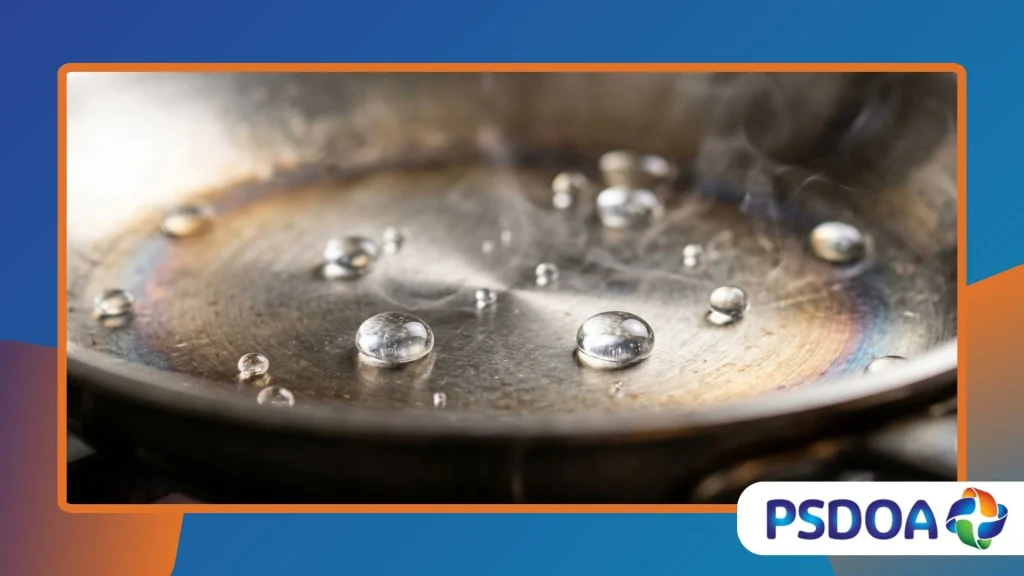
How Does Thermal Levitation Work?
The fundamental physics behind this process relies entirely on rapid phase change and extreme temperature differentials.
When a liquid droplet encounters a superheated surface, the thermal energy immediately converts the liquid interface into gas.
This rapid evaporation generates a high-pressure vapor layer beneath the droplet, counteracting gravity and suspending the liquid mass in mid-air.
Without direct physical contact, thermal conduction drops significantly, which drastically slows down the evaporation rate of the floating droplet.
Molecular interactions within the fluid create internal circulation currents driven by Marangoni convection effects.
These microscopic currents keep the droplet in continuous motion, causing it to skate across the hot surface with minimal friction.
Researchers at the University of California documented that droplet lifespans increase exponentially once the threshold temperature is crossed.
This unexpected thermal buffering protects the bulk liquid from instant destruction, defying ordinary intuition about boiling liquids.
Why Do Droplets Skate Across Hot Surfaces?
Surface tension and asymmetric vapor escape routes dictate the erratic, dancing trajectories observed during levitation.
As vapor continuously vents from beneath the droplet, tiny pressure gradients push and pull the liquid mass across micro-irregularities.
The droplet behaves almost like a frictionless hovercraft, propelled by its own evaporating steam in a self-sustaining thermodynamic loop.
Kinetic energy translates into lateral movement because escaping vapor creates tiny thrust vectors underneath the curved liquid boundary.
Industrial applications harness this exact behavior to cool high-temperature metal components safely during quenching processes.
Metallurgists carefully monitor surface temperatures to prevent uncontrolled vapor lock, ensuring uniform cooling rates across forged steel components.
Engineers also analyze these dynamics to prevent catastrophic thermal runaway in high-performance electronics and rocket thruster nozzles.
Understanding these microscopic vapor channels allows modern manufacturing plants to optimize heat transfer efficiency without risking equipment failure.
++ A New Sense? The Discovery of Human Magnetoreception
How Do Extreme Temperatures Alter Droplet Behavior?
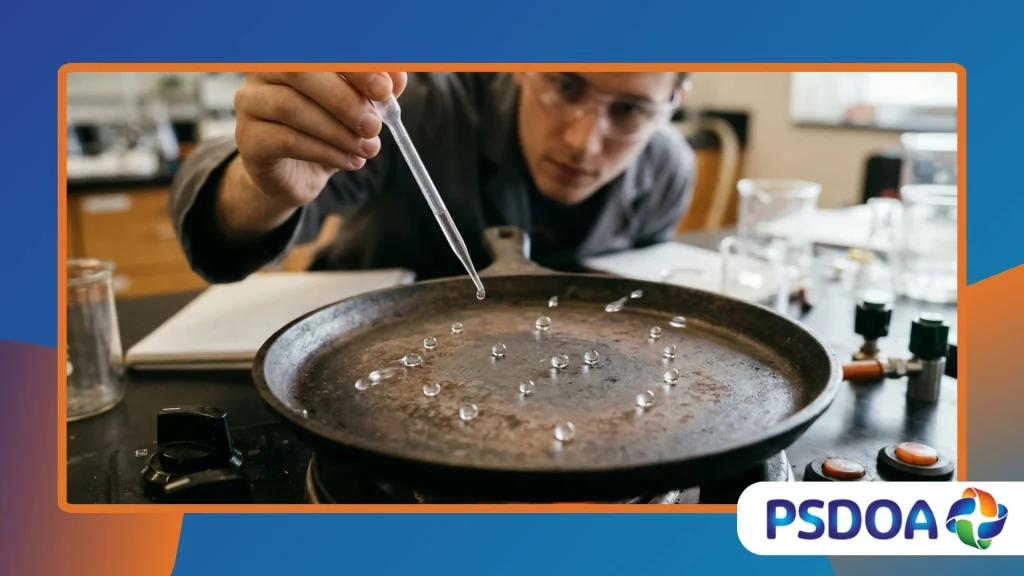
What Happens at the Leidenfrost Point?
The transition temperature marking the onset of this unique state is known as the Leidenfrost point.
Below this critical threshold, liquid droplets touch the hot surface directly, resulting in violent, noisy boiling and rapid dissipation.
Once the surface temperature exceeds this specific threshold, the protective vapor cushion forms instantaneously, quieting the boiling action entirely.
This dramatic shift represents a profound regime change in boiling heat transfer physics, shifting from nucleate boiling to stable film boiling.
Thermal physicists measure this transition meticulously using high-speed infrared cameras and precision pyrometers.
Data collected from recent thermal dynamics studies published by the American Physical Society confirm that droplet levitation stability depends heavily on ambient pressure and fluid purity.
Pure water exhibits a threshold around 193 degrees Celsius, though dissolved minerals and surfactants alter this temperature significantly.
Recognizing these precise thresholds helps chemical engineers design safer containment vessels for volatile molten materials.
Also read: Magnetoreception: The Hidden Sense Humans May Possess
Can This Effect Be Observed in Daily Life?
Kitchen cooks witness this scientific principle frequently when sprinkling water droplets onto a hot frying pan.
If the skillet is insufficiently heated, the water sizzles aggressively and evaporates within a fraction of a second.
However, when the pan reaches the correct superheated state, the water drops coalesce into agile spheres that dance across the metal surface for minutes.
This domestic observation demonstrates complex thermodynamics happening right on a household stove without specialized laboratory equipment.
Culinary scientists and food safety experts study these droplet interactions to improve cooking techniques and prevent uneven heat distribution.
Chefs utilize this knowledge when evaluating skillet readiness for delicate searing procedures, ensuring optimal crust formation on proteins.
Beyond the kitchen, firefighters and safety trainers demonstrate similar principles when explaining how water behaves when applied to massive industrial chemical fires.
Recognizing these thermodynamic boundaries prevents dangerous steam explosions in emergency response scenarios.
Read more: Chronobiology: How Body Clocks Shape Human Performance
Why Is This Thermodynamic Principle Crucial Today?
Where Are Droplet Dynamics Applied Industrially?
Advanced thermal engineering relies heavily on controlling droplet dynamics to cool high-powered microprocessors and aerospace propulsion systems.
Modern data centers generate immense thermal loads, requiring sophisticated cooling architectures that prevent hardware meltdowns under peak workloads.
By manipulating vapor barriers, thermal engineers design specialized heat pipes that transfer thermal energy away from sensitive silicon chips with unprecedented efficiency.
These innovations enable continuous technological advancement in artificial intelligence computing infrastructure.
Aerospace applications utilize similar principles to protect spacecraft heat shields during atmospheric re-entry phases.
As spacecraft plunge through the upper atmosphere at hypersonic speeds, surface materials experience extreme thermal stress and frictional heating.
Engineers engineer ablative materials and specialized cooling channels that leverage vapor generation to dissipate colossal amounts of thermal energy safely.
These advanced thermal protection systems ensure structural integrity for interplanetary exploratory vessels returning to Earth.
What Does Future Research Entail?
Current academic investigations focus on micro-textured surfaces that manipulate vapor layer stability at will.
Researchers discovered that laser-etched superhydrophobic surfaces can sustain or suppress levitation effects at much lower temperatures than smooth metals.
These discoveries open new pathways for developing ultra-efficient heat exchangers, self-cleaning solar panels, and advanced biomedical microfluidic devices.
Interdisciplinary teams worldwide continue pushing the boundaries of applied physics to unlock novel commercial applications.
| Parameter | Standard Boiling | Leidenfrost State |
| Surface Temperature | Below Threshold | Superheated Above Point |
| Heat Transfer Rate | Extremely High | Significantly Reduced |
| Droplet Lifespan | Short (Sizzles Instantly) | Extended (Minutes of Levitation) |
| Physical Contact | Direct Liquid-Solid | Insulated by Vapor Cushion |
Final Thoughts and Next Steps
Understanding the complex physics governing thermal levitation bridges the gap between everyday kitchen observations and cutting-edge industrial engineering marvels.
As researchers uncover deeper insights into microscopic vapor dynamics, humanity gains powerful tools for optimizing energy management across numerous technological sectors.
We invite you to share your thoughts, questions, or personal observations regarding thermodynamic experiments in the comments below.
Frequently Asked Questions
What defines the Leidenfrost Effect in simple terms?
This phenomenon occurs when a liquid produces an insulating vapor barrier that protects it from vaporization on extremely hot surfaces.
At what temperature does water exhibit this behavior?
Pure water typically demonstrates this unique levitation state when encountering surfaces heated above approximately 193 degrees Celsius.
Why does the liquid droplet float instead of boiling instantly?
The rapid generation of steam underneath the droplet creates a high-pressure vapor cushion that suspends the liquid in mid-air.
How do industries utilize this thermodynamic principle?
Engineers harness these vapor dynamics to improve cooling efficiency in nuclear reactors, aerospace propulsion systems, and high-performance computing hardware.
Can anyone observe this scientific phenomenon at home?
Home cooks can witness this effect easily by dropping water onto a thoroughly preheated skillet and watching the droplets skate around.
