
Why P-Wave Magnetism Can Hide Inside an Ordinary-Looking Metal
P-Wave Magnetism often stays invisible in standard laboratory checks because electrons split by spin and momentum without creating net macroscopic magnetization.
Anúncios
A dull gray crystal on a lab bench looks completely unremarkable to a magnet. Yet subtle spin-momentum locking inside its band structure can drive directional spin currents under external fields or strain.
Researchers studying unconventional collinear and non-collinear magnetic phases have explored parity-odd spin splitting, often discussed alongside p-wave magnetism in condensed matter physics.
Unlike classic ferromagnets where spins align uniformly, momentum-dependent spin splitting cancels net dipole moments across the Brillouin zone.
That cancellation hides magnetic order from basic compass or magnetometer tests.
At a Glance
- Hidden signature: Momentum-odd spin splitting can exist without net magnetization, masking magnetic behavior during routine lab checks.
- Crystal symmetry: Local inversion breaking or sublattice arrangements allow directional spin polarization even in seemingly ordinary metals.
- Device potential: Spin-split bands offer pathways for low-dissipation spintronics without stray magnetic fields disrupting nearby components.
How Can Hidden Spin Order Exist in Seemingly Non-Magnetic Metals?
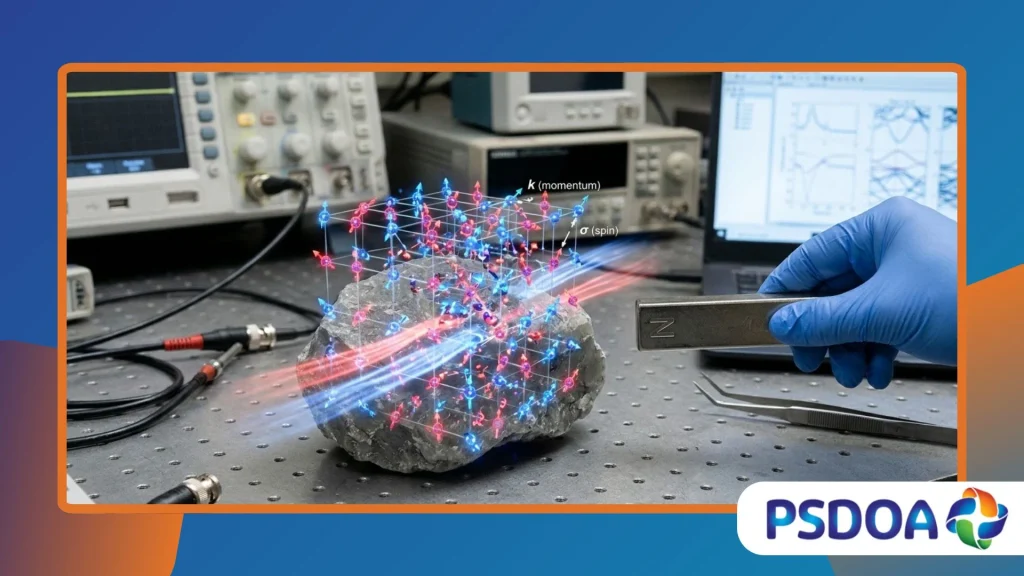
Conventional magnetism relies on unequal populations of spin-up and spin-down electrons across the whole crystal. When net magnetization is zero, everyday tools see no attraction or repulsion.
Momentum-dependent spin textures change that picture by tying electron spin orientation to wavevector direction.
Even when total spin averages to zero over all momenta, specific pockets in reciprocal space carry strong spin polarization.
Applying a voltage, current, or mechanical deformation shifts electron occupations selectively. Suddenly, an unassuming metallic conductor reveals active spin physics.
Why Do Standard Magnetometers Miss Subtle Spin Splitting?
Bulk magnetometry measures total magnetic moment per unit volume. If positive and negative momentum branches cancel out globally, the measured net moment remains near zero.
Instruments calibrated for standard ferromagnetism report a quiet baseline. Surface-sensitive and momentum-resolved probes are needed to see what bulk averages erase.
Techniques such as spin-resolved photoemission spectroscopy map spin orientation across momentum states directly.
Without momentum resolution, hidden spin splitting blends into ordinary metallic behavior.
++ A New Sense? The Discovery of Human Magnetoreception
How Does Crystal Symmetry Shape Momentum-Odd Spin Textures?
Crystal point groups and space groups dictate which spin-momentum couplings are allowed.
Specific sublattice geometries and time-reversal or inversion symmetries determine whether spin splitting is even or odd in momentum.
Small structural details decide whether hidden spin textures can emerge.
Materials scientists examine lattice distortions, strain, and chemical substitution to tune these symmetries.
A slight shift in atomic spacing can turn a passive metal into a platform for directional spin transport. Symmetry acts as the gatekeeper for unseen magnetic phenomena.
Also read: Magnetoreception: The Hidden Sense Humans May Possess
What Distinguishes P-Wave Magnetism From Conventional Ferromagnetism?
Ferromagnets exhibit uniform spin alignment and spontaneous net magnetization below their Curie temperature.
That net field can create stray magnetic fields that interfere with adjacent nanoscale circuits.
P-Wave Magnetism contrasts sharply because net magnetization can remain negligible while spin splitting varies with momentum direction.
This distinction matters for compact memory and logic architectures. Avoiding strong stray fields reduces crosstalk between neighboring elements.
Physicists compare spin-momentum locking mechanisms to find cleaner ways to manipulate electron spin.
Which Experimental Clues Reveal Hidden Spin Physics in Metals?
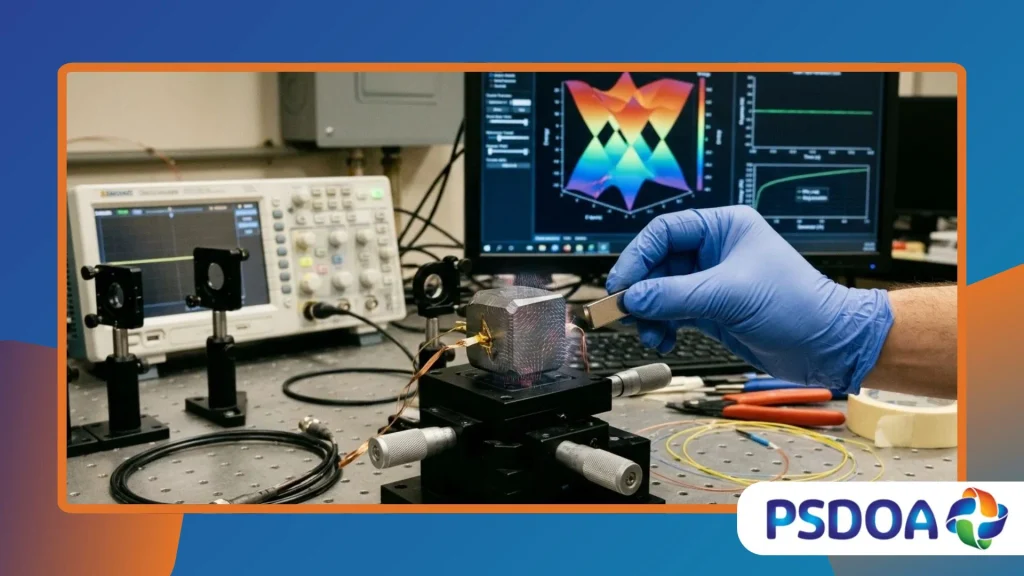
Spotting subtle spin order requires looking beyond static magnetic susceptibility. Researchers track transport anomalies, angular dependencies, and response to electric fields or strain.
Each measurement adds another piece to the structural puzzle.
Practical laboratory workflows combine crystal growth with precision characterization. Suppose a team synthesizes a candidate metal with a clean, flat cleavage plane.
Angle-resolved measurements can then test whether opposite momentum directions carry opposite spin projections.
Read more: Chronobiology: How Body Clocks Shape Human Performance
How Do Spin Transport Measurements Point to Hidden Order?
Charge currents flowing through a spin-split band structure can generate transverse or longitudinal spin signals.
Detectors sensitive to spin accumulation observe differences when current direction reverses.
These transport signatures hint at underlying spin-momentum coupling.
Separating true spin effects from ordinary Hall or thermal artifacts takes careful control experiments.
Researchers vary temperature, magnetic field orientation, and sample thickness to isolate genuine spin responses. Clean fabrication prevents edge defects from mimicking intrinsic physics.
Why Does Sample Quality Decide Whether Signals Appear?
Impurities, grain boundaries, and surface oxidation scatter electrons unpredictably. In real samples, strong disorder can wash out delicate momentum-dependent spin signatures.
A promising material may look inert simply because crystal defects dominate scattering.
Consider a second practical scenario where two batches of the same alloy behave differently.
One batch annealed under controlled atmosphere shows sharp quantum oscillations, while another shows broad damping. Better crystal purity often unlocks physics that rough samples hide.
How Do Researchers Separate Real Signals From Measurement Artifacts?
Experimentalists cross-check results across multiple techniques and independent laboratories.
Repeating measurements on rotated crystal axes tests whether angular symmetry matches theoretical predictions.
Skepticism and replication keep emerging condensed matter claims grounded.
Published findings in peer-reviewed physics journals undergo strict scrutiny before gaining broad acceptance. Clear error bars and reproducible sample recipes help the wider community verify observations.
Careful validation turns intriguing anomalies into reliable science.
Why Should Readers Watch Unconventional Magnetism Now?
Condensed matter physics continually expands what counts as magnetism. Moving beyond simple up-versus-down pictures opens fresh design space for information processing.
Could the next breakthrough in low-power electronics come from a metal that looks completely ordinary at first glance?
Interest in spin-based technologies grows as scaling limits challenge traditional charge-based electronics.
Exploring subtle quantum phases helps scientists understand how electrons organize inside real solids. Every verified discovery adds practical tools for future hardware engineers.
What Practical Hurdles Remain Before Real-World Adoption?
Lab demonstrations rarely translate overnight into commercial chips. Materials must remain stable at room temperature and integrate cleanly with standard semiconductor fabrication.
Cost, scalability, and repeatability remain central engineering tests.
Researchers also need reliable ways to read and write spin states quickly with minimal energy loss. Overcoming material and interface challenges takes sustained collaboration between theorists and experimentalists.
Progress advances step by step rather than all at once.
How Can Non-Specialists Read Science News Critically?
Exciting physics headlines sometimes overstate early-stage lab results as ready-made consumer products.
Checking whether a study reports a foundational mechanism or a working prototype helps set realistic expectations. Independent expert commentary provides helpful context when claims sound dramatic.
Paying attention to sample conditions, temperature ranges, and reproducibility signals adds clarity. Good science journalism explains both the promise and the remaining obstacles.
Informed readers can appreciate genuine breakthroughs without getting swept up in hype.
| Magnetic Regime | Net Magnetization | Momentum Spin Dependence | Stray Field Impact | Typical Probe Focus |
| Conventional Ferromagnet | Present below transition | Largely uniform alignment | Can be strong locally | Bulk magnetometry and hysteresis |
| Antiferromagnet | Near zero in ideal state | Sublattice staggered order | Generally minimal | Neutron or resonant scattering |
| Momentum-Split Metal | Often negligible net moment | Directional spin-momentum locking | Typically low stray field | Momentum-resolved and transport probes |
Where Does This Field Head Next in Materials Research?
Scientists continue screening crystal databases and synthesizing new compounds to uncover hidden spin phenomena.
Better computational modeling guides experimentalists toward promising candidates faster.
Combining theory, synthesis, and precision measurement drives the next wave of discovery.
As P-Wave Magnetism and related concepts are studied further, researchers will clarify where hidden spin order thrives and where it fades.
Share your thoughts or questions on unconventional materials in the comments below.
Frequently Asked Questions
Why does a metal with hidden spin order look ordinary?
Without net magnetization, the material does not pull a magnet or generate a strong external magnetic field. Its surface appearance and basic electrical conductivity can resemble many standard metals.
Does momentum-dependent spin splitting violate basic physics?
No, spin-momentum locking follows quantum mechanics and crystal symmetry rules. When symmetries permit directional spin splitting without net magnetization, both behaviors can coexist consistently.
Why do scientists care about low-stray-field magnetic materials?
Strong stray magnetic fields can disturb nearby magnetic elements in dense devices. Materials with minimal net magnetization may reduce unwanted magnetic interference in compact architectures.
Can impurities hide subtle magnetic behavior in experiments?
Yes, defects and disorder scatter electrons and can obscure delicate spin-dependent signals. High-purity crystals and careful surface preparation often make subtle effects easier to resolve.
How do researchers verify claims about unconventional magnetism?
They rely on reproducible sample synthesis, multiple independent measurement methods, and peer-reviewed scrutiny. Cross-checking angular dependence and ruling out artifacts confirms whether an effect is genuine.
